20
Diane Arbus
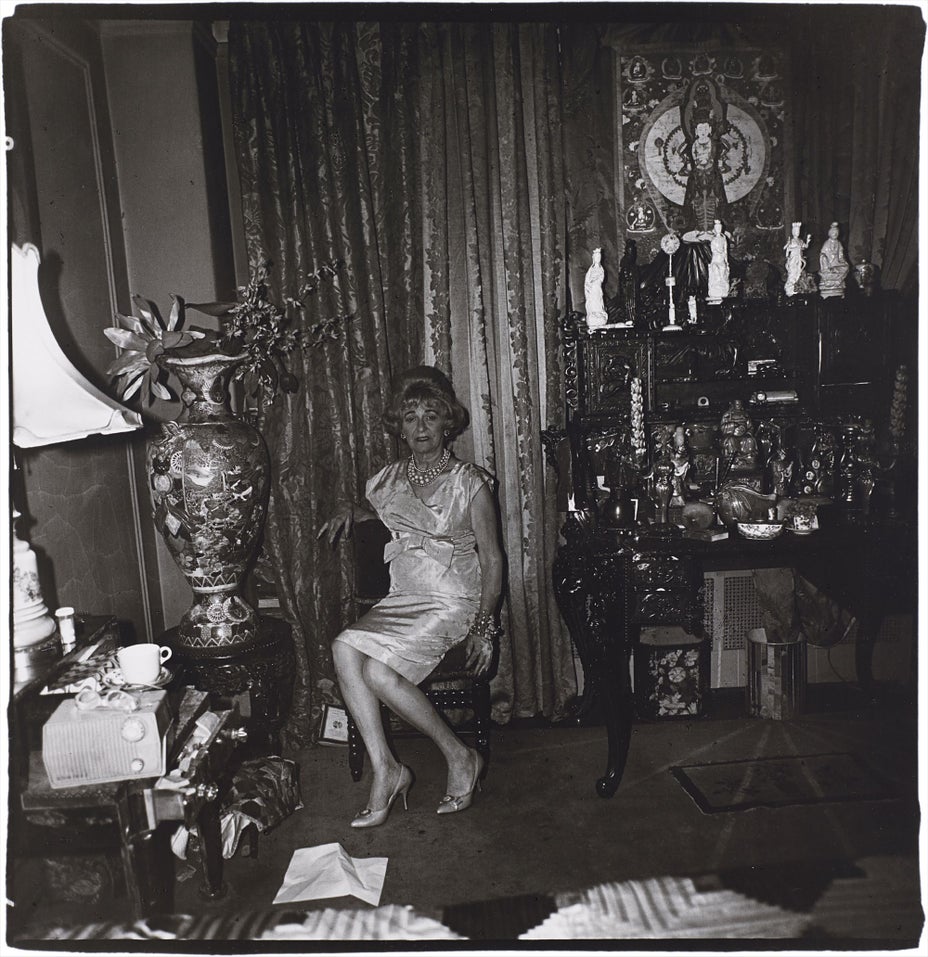
A widow in her bedroom on 55th St., NYC
Estimate
$200,000–250,000
Sold For
$233,000
1963
Gelatin silver print.
15 1/2 x 15 in. (39.4 x 38.1 cm)
Signed, titled, dated '1962' [sic] in ink by the artist, stamped 'A Diane Arbus print,' signed, dated by Doon Arbus, Executor, in ink, copyright credit and reproduction limitation stamps on the verso.
Full-Cataloguing
"I’ve never taken a picture I’ve intended. They’re always better or worse.” —Diane Arbus
Diane Arbus famously claimed, “I really believe there are things which nobody would see unless I photographed them.” Her portrait of a New York City widow, taken in 1963, is from an especially fertile period for the famed artist, whose work constitutes one of the most groundbreaking oeuvres of 20th century photography.
In 1967, the image was included in the legendary New Documents exhibition at the Museum of Modern Art, curated by John Szarkowski. Five years later, the year after the artist's death, the print offered here was chosen by Szarkowski for inclusion in MoMA's definitive 1972 Arbus retrospective. The exhibition drew large crowds and is still considered a landmark in Arbus’s legacy.
A wall text by Szarkowski acknowledged the artist's courage for exploring subjects that had been previously marginalized. “Arbus did not avert her eyes,” Szarkowski stated. “She stuck with her subjects, exploring their secrets (and thus her own) more and more deeply. She was surely aware of the danger of this path, but she believed that her bravery would be equal to the demands she made of it.” Over forty years later, Arbus’s work continues to inspire accolades for its power to challenge and illuminate.
Other early prints of this image are in the collections of MoMA and the San Francisco Museum of Modern Art.
Diane Arbus famously claimed, “I really believe there are things which nobody would see unless I photographed them.” Her portrait of a New York City widow, taken in 1963, is from an especially fertile period for the famed artist, whose work constitutes one of the most groundbreaking oeuvres of 20th century photography.
In 1967, the image was included in the legendary New Documents exhibition at the Museum of Modern Art, curated by John Szarkowski. Five years later, the year after the artist's death, the print offered here was chosen by Szarkowski for inclusion in MoMA's definitive 1972 Arbus retrospective. The exhibition drew large crowds and is still considered a landmark in Arbus’s legacy.
A wall text by Szarkowski acknowledged the artist's courage for exploring subjects that had been previously marginalized. “Arbus did not avert her eyes,” Szarkowski stated. “She stuck with her subjects, exploring their secrets (and thus her own) more and more deeply. She was surely aware of the danger of this path, but she believed that her bravery would be equal to the demands she made of it.” Over forty years later, Arbus’s work continues to inspire accolades for its power to challenge and illuminate.
Other early prints of this image are in the collections of MoMA and the San Francisco Museum of Modern Art.
Diane Arbus
American | B. 1923 D. 1971Transgressing traditional boundaries, Diane Arbus is known for her highly desirable, groundbreaking portraiture taken primarily in the American Northeast during the late 1950s and 1960s. Famous for establishing strong personal relationships with her subjects, Arbus' evocative images capture them in varied levels of intimacy. Whether in their living rooms or on the street, their surreal beauty transcends the common distance found in documentary photography.
Taken as a whole, Arbus' oeuvre presents the great diversity of American society — nudists, twins, babies, beauty queens and giants — while each distinct image brings the viewer into contact with an exceptional individual brought to light through Arbus' undeniable genius.