79
Eberhard
Ref. 17302
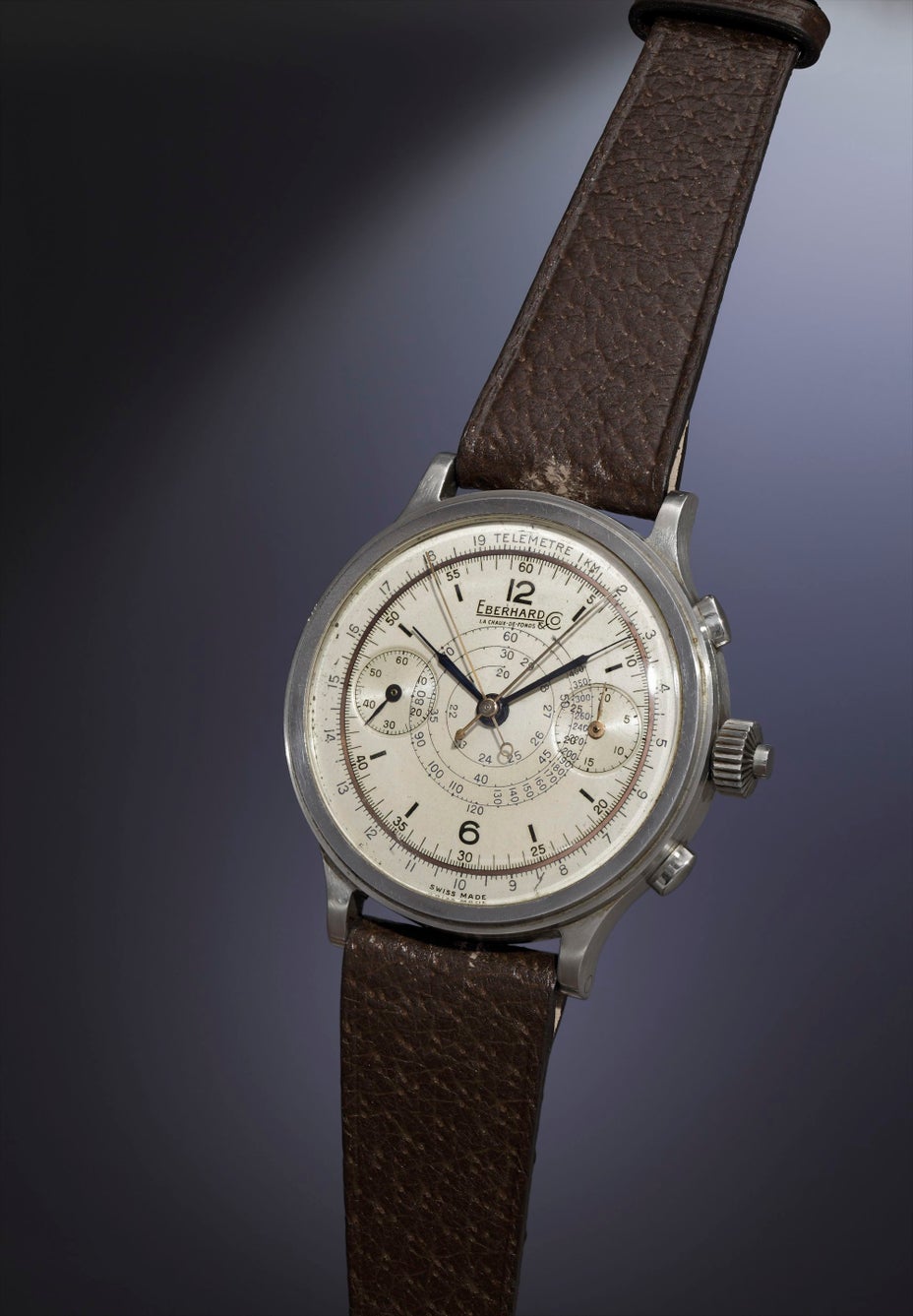
A very rare, attractive and oversized stainless steel split-seconds chronograph wristwatch with silvered dial with copper ring, telemeter scale and snail-shaped tachometer scale.
Full-Cataloguing
The present watch is fitted with an interesting and rarely seen implementation of the split-seconds chronograph complication. The start, stop and reset functions are all controlled by a single push piece that is integrated into the winding crown. The top pusher is responsible for the split-seconds function, meant to measure intermediate times without interrupting the timekeeping of an event. Appearing to look like a third chronograph pusher, the lower pusher at 4 o’clock instead works as a “stop and lock” mechanism controlled by simply sliding the bottom button up towards the crown. When the slide is moved upwards, the precise time is protected, and can be recorded by the user. The lock prevents the accidental actuation of the chronograph’s pushers that would result in losing the measurement.
Housed in an oversized case, the watch stands out with its extraordinary good looks. The silvered dial is beautifully accented with a very thin, mirrored copper-colored ring separating the chronograph seconds chapter ring and the outer telemètre scale. Additionally, the dial features a lovely snail-shaped tachometer scale at its center. The case is well preserved, retaining crisp edges and sharp lines along the stepped bezel and lugs, illustrating how carefully it was worn over its 75-year life.
Eberhard
Swiss | 1887From its earliest days, Eberhard & Co. has sought to bring innovation and precision to watchmaking. As early as the 1890s, the firm introduced a patented setting mechanism to its pocket watches, and in 1905 they introduced a digital system for reading the hours and minutes on a wristwatch. Throughout the firm's long history, they have produced high-quality chronograph watches, introducing their first chronograph wristwatch in 1919. Highly sought-after by collectors, Eberhard's first split-seconds chronograph appeared in 1939. Another key model is the Scafograph 100, an extremely rare diving model introduced in the 1950s. In 2001, Eberhard & Co. made history with their Chrono 4 model, the first chronograph wristwatch with counters horizontally arranged in one row.