
14
Ed Ruscha
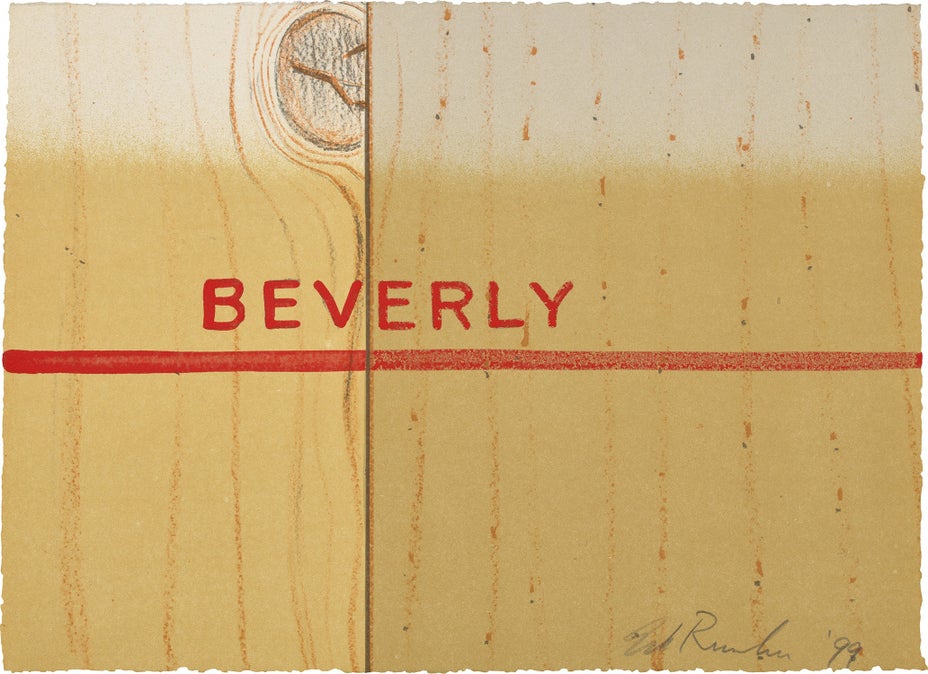
Beverly
- Estimate
- $20,000 - 30,000
Lot Details
acrylic and graphite on lithograph
signed and dated "Ed Ruscha '99" lower right
6 x 8 3/8 in. (15.2 x 21.3 cm.)
Executed in 1999.
Specialist
Full-Cataloguing
Catalogue Essay
The name Ed Ruscha has become synonymous with Los Angeles, his text-based paintings have revolutionized the relationship between the visual and the semiotic. As a West Coast artist, Ruscha fully embraced the visual culture of Los Angeles and both its natural and artificial landscapes. He has pioneered the notion of words as visual abstractions, inducing a physical reaction based on their chosen hue, typography and context. The word “Beverly,” executed in apple red makes reference to Beverly Boulevard one of the main east-west thoroughfares in Los Angeles which runs right through West Hollywood. Viewers will have conventional associations with aspects of the work—its font, the color red, the wood grain background and Ruscha is compelling the viewer to reconsider all of his preconceived notions. In the artist’s words, “I love the language, words have temperatures…when they reach a certain point and become hot words they appeal to me.”
Provenance
Ed Ruscha
American | 1937Quintessentially American, Ed Ruscha is an L.A.-based artist whose art, like California itself, is both geographically rooted and a metaphor for an American state of mind. Ruscha is a deft creator of photography, film, painting, drawing, prints and artist books, whose works are simultaneously unexpected and familiar, both ironic and sincere.
His most iconic works are at turns poetic and deadpan, epigrammatic text with nods to advertising copy, juxtaposed with imagery that is either cinematic and sublime or seemingly wry documentary. Whether the subject is his iconic Standard Gas Station or the Hollywood Sign, a parking lot or highway, his works are a distillation of American idealism, echoing the expansive Western landscape and optimism unique to postwar America.
Browse ArtistHis most iconic works are at turns poetic and deadpan, epigrammatic text with nods to advertising copy, juxtaposed with imagery that is either cinematic and sublime or seemingly wry documentary. Whether the subject is his iconic Standard Gas Station or the Hollywood Sign, a parking lot or highway, his works are a distillation of American idealism, echoing the expansive Western landscape and optimism unique to postwar America.