Property from a Private Collection
308
Edgar Brandt
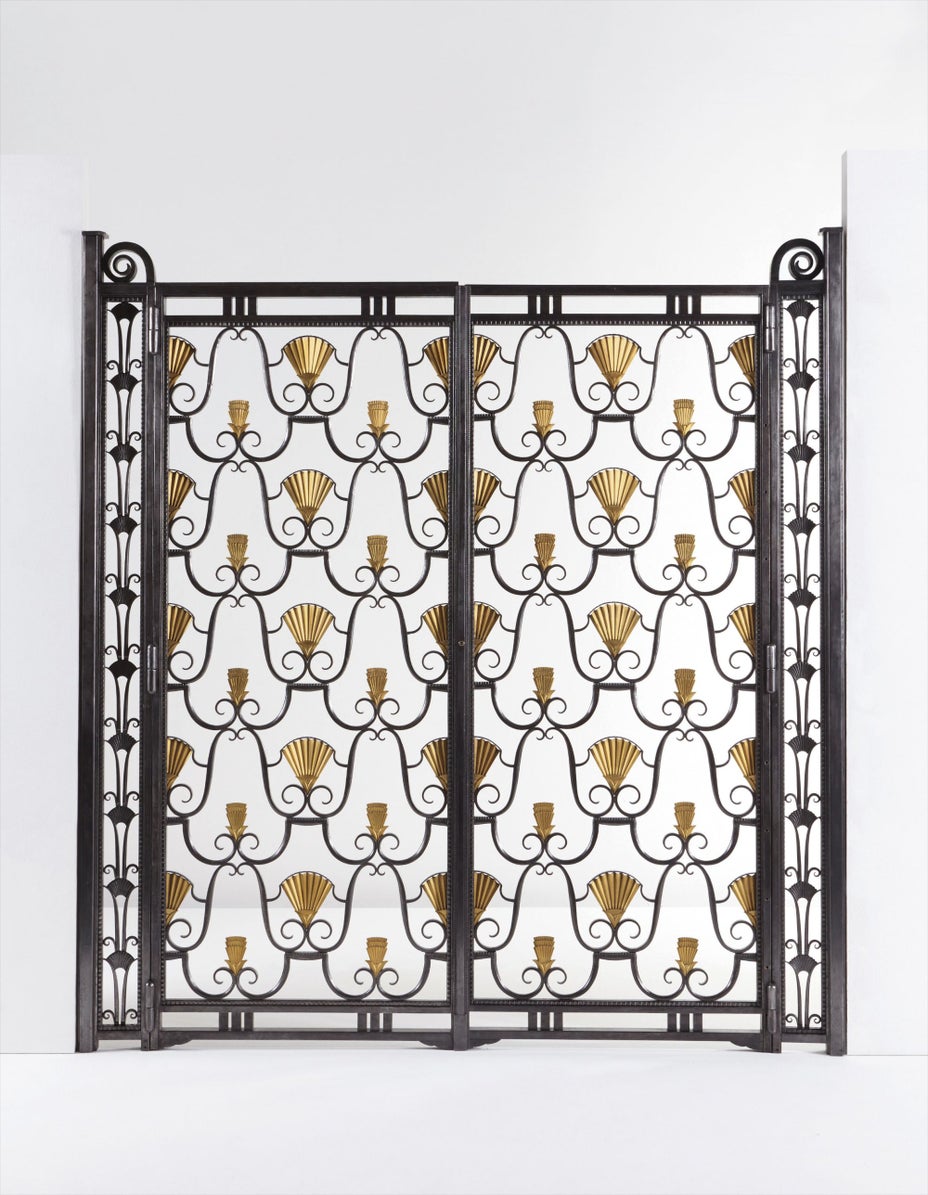
Pair of gates, from the Pavillon de L'Intransigeant, Exposition Internationale, Paris
Estimate
$80,000–120,000
Sold For
$100,000
1925
Wrought iron, bronze.
88 1/2 x 82 1/2 x 3 1/4 in. (224.8 x 209.6 x 8.3 cm)
Lower edge of each door impressed with MADE IN FRANCE and E. BRANDT.
Full-Cataloguing
In the early 1910s and 1920s, the ironsmith Edgar Brandt was heralded as a twentieth-century Vulcan, responsible for works such as the Mollien Stairway in the Louvre, the Monument of the Unknown Soldier under the Arc de Triomphe and the Bayonet Trench Monument at Verdun. These works and innumerable others, combined with his call for the alignment of art with modern industrial methods, made Brandt the leading ironsmith of his day. Therefore, he was poised to be a leader in planning for the 1925 Exposition Internationale in Paris.
Brandt's work, exhibited at various locations during the fair, was deemed hors concours (above the competition). For Émile-Jacques Ruhlmann's Hotel d'un Collectionneur (the House of a Rich Collector), Brandt forged many pieces. The design for the entrance door was memorable and it was very similar to the present pair of gates. These stunning gates were fashioned for a small building at the fair, the pavilion of the influential newspaper L'Intransigeant. In the summer of 1924 Brandt provided the entrance door for L'Intransigeant's new headquarters on the rue Réamur; therefore it was expedient to have their pavilion at the fair designed by Les Établissments Brandt.
The iron doors offered here have a joyful, sprightly appearance. The design is formed by a half-drop repeat of large and small pleated Egyptian fans enclosed within curved iron bars that end in C-scrolls. These pleated fans mimic lotus flowers, whose alternating sizes give the design a playful aspect. This technique of playing with two sizes of the same motif creates a syncopation that is visually upbeat and pleasing.
Several permutations of this design were forged by the ferronnier (blacksmith). One version, used for the central entrance gate to the exposition, was a portal for vehicles. In 1924 Brandt used another version of the pleated fan motif for the entrance door of couturier Paul Poiret's atelier on the Rond Point des Champs-Elysses. Brandt's reiteration of the Egyptian fans and C-scroll motifs are a testament to his ability to create iconic patterns and themes for his métier.
-Joan Kahr author of Edgar Brandt: Master of Art Deco Ironwork, Harry N. Abrams, 1999 and Edgar Brandt: Art Deco Ironwork, Schiffer Publishing Ltd., 2010
Brandt's work, exhibited at various locations during the fair, was deemed hors concours (above the competition). For Émile-Jacques Ruhlmann's Hotel d'un Collectionneur (the House of a Rich Collector), Brandt forged many pieces. The design for the entrance door was memorable and it was very similar to the present pair of gates. These stunning gates were fashioned for a small building at the fair, the pavilion of the influential newspaper L'Intransigeant. In the summer of 1924 Brandt provided the entrance door for L'Intransigeant's new headquarters on the rue Réamur; therefore it was expedient to have their pavilion at the fair designed by Les Établissments Brandt.
The iron doors offered here have a joyful, sprightly appearance. The design is formed by a half-drop repeat of large and small pleated Egyptian fans enclosed within curved iron bars that end in C-scrolls. These pleated fans mimic lotus flowers, whose alternating sizes give the design a playful aspect. This technique of playing with two sizes of the same motif creates a syncopation that is visually upbeat and pleasing.
Several permutations of this design were forged by the ferronnier (blacksmith). One version, used for the central entrance gate to the exposition, was a portal for vehicles. In 1924 Brandt used another version of the pleated fan motif for the entrance door of couturier Paul Poiret's atelier on the Rond Point des Champs-Elysses. Brandt's reiteration of the Egyptian fans and C-scroll motifs are a testament to his ability to create iconic patterns and themes for his métier.
-Joan Kahr author of Edgar Brandt: Master of Art Deco Ironwork, Harry N. Abrams, 1999 and Edgar Brandt: Art Deco Ironwork, Schiffer Publishing Ltd., 2010