Property from a Private European Collection
304
Edward William Godwin
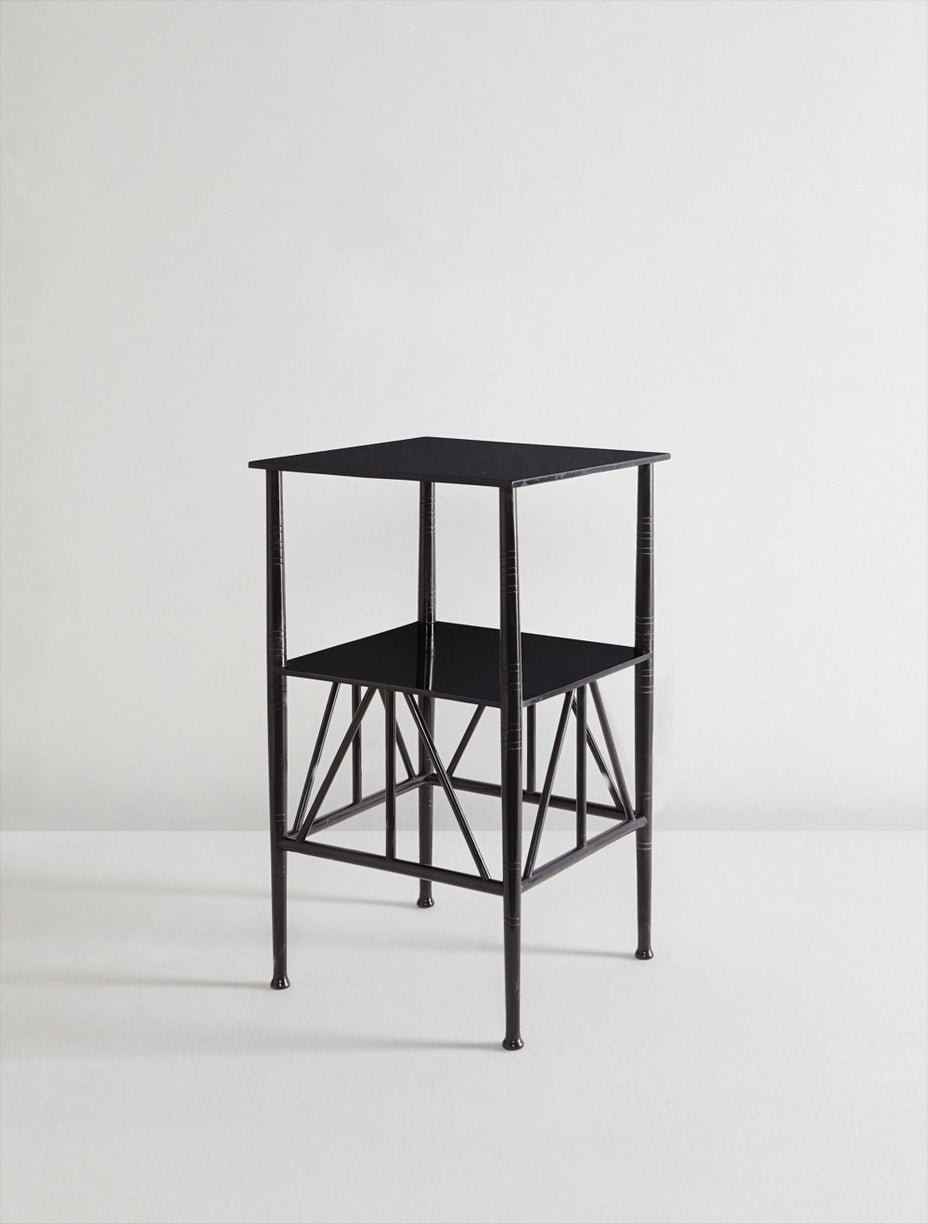
"Coffee table"
Estimate
$20,000–30,000
Sold For
$27,500
designed circa 1867, produced 1860s-1880s
Ebonized mahogany.
27 1/4 x 15 7/8 x 15 7/8 in. (69.2 x 40.3 x 40.3 cm)
Produced by William Watt, London.
Full-Cataloguing
The present model "coffee table" was originally designed by E.W. Godwin for his personal use, around 1866-1867, and later produced commercially by William Watt. Godwin created a number of table designs for William Watt during the 1860s and 1870s that gained popularity for their light forms and exotic designs. Produced until the 1880s, the present design was one of the most popular and illustrated often in William Watt advertisements, including the 1878 catalogue Art Furniture.
A leader in the aesthetic movement in England, Godwin drew on influences from India, the Middle East, China and Japan. Godwin’s furniture is characterized by an amalgamation of styles and reflects his varied antiquarian interests from eighteenth-century Jacobean and early English furniture to restrained Japanese forms. The present coffee table was inspired by depictions of Egyptian furniture that Godwin sketched at the British Museum, as evidenced by the angled stretchers that support the lower square shelf. In a typical pairing of Eastern and Near-Eastern influences, an ebonized finish mimics that of traditional Japanese furniture, and reflects the Aesthetic movement’s preference for a visible wood grain.
A leader in the aesthetic movement in England, Godwin drew on influences from India, the Middle East, China and Japan. Godwin’s furniture is characterized by an amalgamation of styles and reflects his varied antiquarian interests from eighteenth-century Jacobean and early English furniture to restrained Japanese forms. The present coffee table was inspired by depictions of Egyptian furniture that Godwin sketched at the British Museum, as evidenced by the angled stretchers that support the lower square shelf. In a typical pairing of Eastern and Near-Eastern influences, an ebonized finish mimics that of traditional Japanese furniture, and reflects the Aesthetic movement’s preference for a visible wood grain.