9
Egon Schiele
Das Graphische Werk von Egon Schiele
Estimate
$80,000–120,000
Sold For
$175,000
1914-18/1922
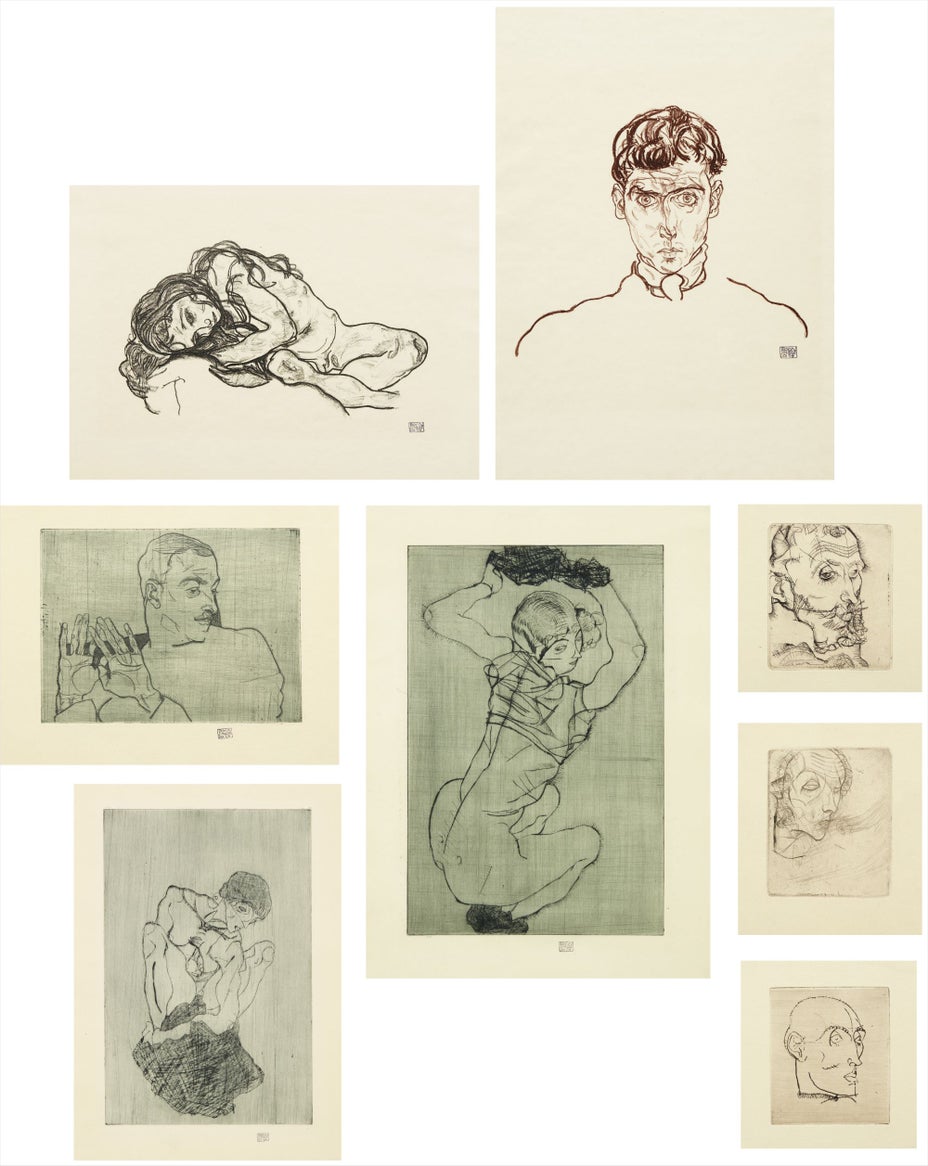
The complete set of eight prints, including five drypoints, one etching and two lithographs, on Japanese and wove papers, with full margins, title page, justification and introduction by Arthur Roessler in German, the sheets loose (as issued), held with paper corners within the original cardboard mounts, contained in the original green paper-covered portfolio with label on the front.
all I. various sizes
all S. various sizes
largest: S. 26 x 19 in. (66 x 48.3 cm)
all S. various sizes
largest: S. 26 x 19 in. (66 x 48.3 cm)
All with the artist's signature stamp, numbered 56. in ink on the justification (from the edition of 80), published by Rikola Verlag, Vienna, Berlin, Leipzig and Munich.
Full-Cataloguing
Including: Männliches Bildnis (K. 3b), 1914, etching; Selbstbildnis (K. 4b), 1914, drypoint; Bildnis Franz Hauer (K. 5c), 1914, drypoint; Kauernde (K. 6b), 1914, drypoint; Kümmernis (K. 7b), 1914, drypoint; Bildnis Arthur Roessler (K. 8b), 1914, drypoint; Bildnis Paris von Gütersloh (K. 16b), lithograph; and Mädchen (K. 17b), lithograph, 1918.
Egon Schiele here explored his typical genres, nudes and psychologically penetrating portraits, in the medium of printmaking. Schiele carefully manipulated the sinuous lines of Kauernde (Squatting woman) after observing nudes in the studio. The compositions of this print and Kümmernis (Sorrow) are closely related to two of his paintings of mothers, potent symbols for artistic creation in his work, while the portraits of Arthur Roessler and Franz Hauer honor two of his most important patrons. The portfolio includes two lithographs that Schiele made for a commission in 1918 and that were ultimately rejected, one of which, Mädchen (Girl), due to its graphic depiction of adolescent sexuality, another characteristic of his work.
Schiele made only seventeen prints during his abbreviated career. Roessler had encouraged him to try the medium, touting its financial rewards and the access it gave to the lucrative German art market. Roessler provided the plates for the prints in this portfolio, and Schiele incised them in 1914, although none were published during his lifetime. Four years after Schiele's untimely death from influenza in 1918 at age twenty-eight, Otto Nirenstein acquired the artist's prints for publication by the Verlag Neuer Graphik, the fine arts imprint of the Rikola Verlag in Vienna. Das Graphische Werk von Egon Schiele (The graphic work of Egon Schiele) contains Schiele's last two lithographs and his entire oeuvre of six drypoints.
Publication excerpt from Heather Hess, German Expressionist Digital Archive Project, German Expressionism: Works from the Collection. 2011. The Museum of Modern Art website
Egon Schiele here explored his typical genres, nudes and psychologically penetrating portraits, in the medium of printmaking. Schiele carefully manipulated the sinuous lines of Kauernde (Squatting woman) after observing nudes in the studio. The compositions of this print and Kümmernis (Sorrow) are closely related to two of his paintings of mothers, potent symbols for artistic creation in his work, while the portraits of Arthur Roessler and Franz Hauer honor two of his most important patrons. The portfolio includes two lithographs that Schiele made for a commission in 1918 and that were ultimately rejected, one of which, Mädchen (Girl), due to its graphic depiction of adolescent sexuality, another characteristic of his work.
Schiele made only seventeen prints during his abbreviated career. Roessler had encouraged him to try the medium, touting its financial rewards and the access it gave to the lucrative German art market. Roessler provided the plates for the prints in this portfolio, and Schiele incised them in 1914, although none were published during his lifetime. Four years after Schiele's untimely death from influenza in 1918 at age twenty-eight, Otto Nirenstein acquired the artist's prints for publication by the Verlag Neuer Graphik, the fine arts imprint of the Rikola Verlag in Vienna. Das Graphische Werk von Egon Schiele (The graphic work of Egon Schiele) contains Schiele's last two lithographs and his entire oeuvre of six drypoints.
Publication excerpt from Heather Hess, German Expressionist Digital Archive Project, German Expressionism: Works from the Collection. 2011. The Museum of Modern Art website