Property from a Distinguished Private Collection, New York
184
Elizabeth Murray
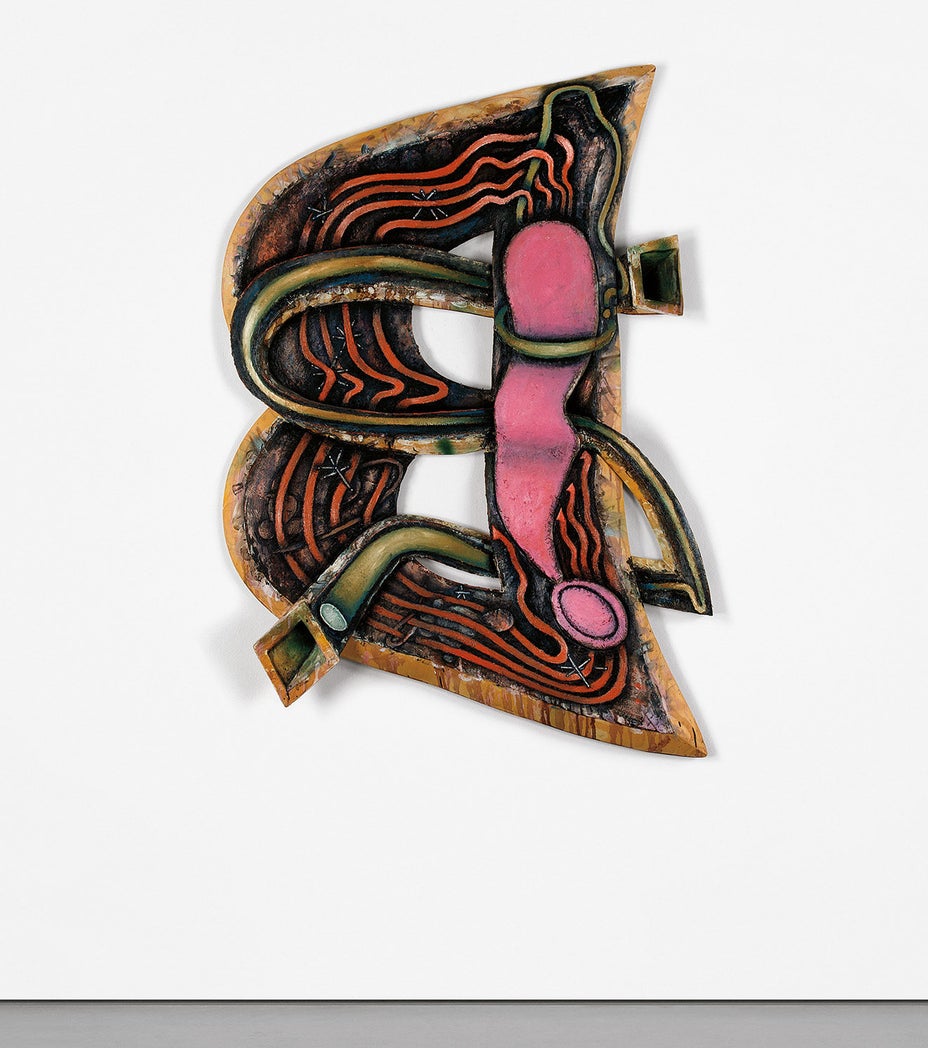
2. B.!
Estimate
$40,000–60,000
Sold For
$200,000
signed, titled, inscribed and dated "2B' Oct 1990 Elizabeth Murray" on the reverse
oil on canvas, on artist's constructed stretcher
68 1/4 x 49 x 3 1/2 in. (173.5 x 124.5 x 9 cm.)
Executed in October 1990.
Full-Cataloguing
2. B. !, 1990, belongs among a particular series of letter paintings inspired by and mimicking the bombing of bubbling letters and jagged tags of the graffiti flaring up across New York City during the 1980s and 1990s.
For Elizabeth Murray, graffiti was something “you couldn’t avoid in New York […] you couldn’t help but be excited by those big bloopy shapes,” as she told Robert Storr in an interview for her 2005 career retrospective at The Museum of Modern Art in New York. Murray seized on the potential of bubble-writing and quickly assimilated it into her art.
In 1990, the year this painting was made, Murray told filmmaker Michael Blackwood in his film Art in an Age of Mass Culture:
Popular culture is one part of teeming life that everybody, all of us, are involved in. Whether we know it or not, even if we try to withdraw ourselves from it, we are all really involved in it every day when we walk out into the streets and you hear a guy walking by with his box blasting a rap song at you. Or in the middle of the subway. Or walking up Broadway. I mean, it’s pouring out at you all the time.
Playfully animated, the painting’s title references the opening phrase of a soliloquy uttered in William Shakespeare’s Hamlet, Act 3, Scene 1. In his speech, Prince Hamlet contemplated death and suicide bemoaning the pain and unfairness of life but acknowledged that the alternative might be worse. 2. B. ! plays on this psychological tenor. Of particular interest is Murray’s unique use of matches in the painting used to portray open and grasping hands. Later that same year, Murray would create a pair to this painting titled Knot 2. B. thereby, in a way, completing Hamlet’s famous verse.
Jason Andrew, Director of the Estate of Elizabeth Murray
For Elizabeth Murray, graffiti was something “you couldn’t avoid in New York […] you couldn’t help but be excited by those big bloopy shapes,” as she told Robert Storr in an interview for her 2005 career retrospective at The Museum of Modern Art in New York. Murray seized on the potential of bubble-writing and quickly assimilated it into her art.
In 1990, the year this painting was made, Murray told filmmaker Michael Blackwood in his film Art in an Age of Mass Culture:
Popular culture is one part of teeming life that everybody, all of us, are involved in. Whether we know it or not, even if we try to withdraw ourselves from it, we are all really involved in it every day when we walk out into the streets and you hear a guy walking by with his box blasting a rap song at you. Or in the middle of the subway. Or walking up Broadway. I mean, it’s pouring out at you all the time.
Playfully animated, the painting’s title references the opening phrase of a soliloquy uttered in William Shakespeare’s Hamlet, Act 3, Scene 1. In his speech, Prince Hamlet contemplated death and suicide bemoaning the pain and unfairness of life but acknowledged that the alternative might be worse. 2. B. ! plays on this psychological tenor. Of particular interest is Murray’s unique use of matches in the painting used to portray open and grasping hands. Later that same year, Murray would create a pair to this painting titled Knot 2. B. thereby, in a way, completing Hamlet’s famous verse.
Jason Andrew, Director of the Estate of Elizabeth Murray