PROPERTY FROM AN IMPORTANT EUROPEAN COLLECTION
116
Émile Gallé
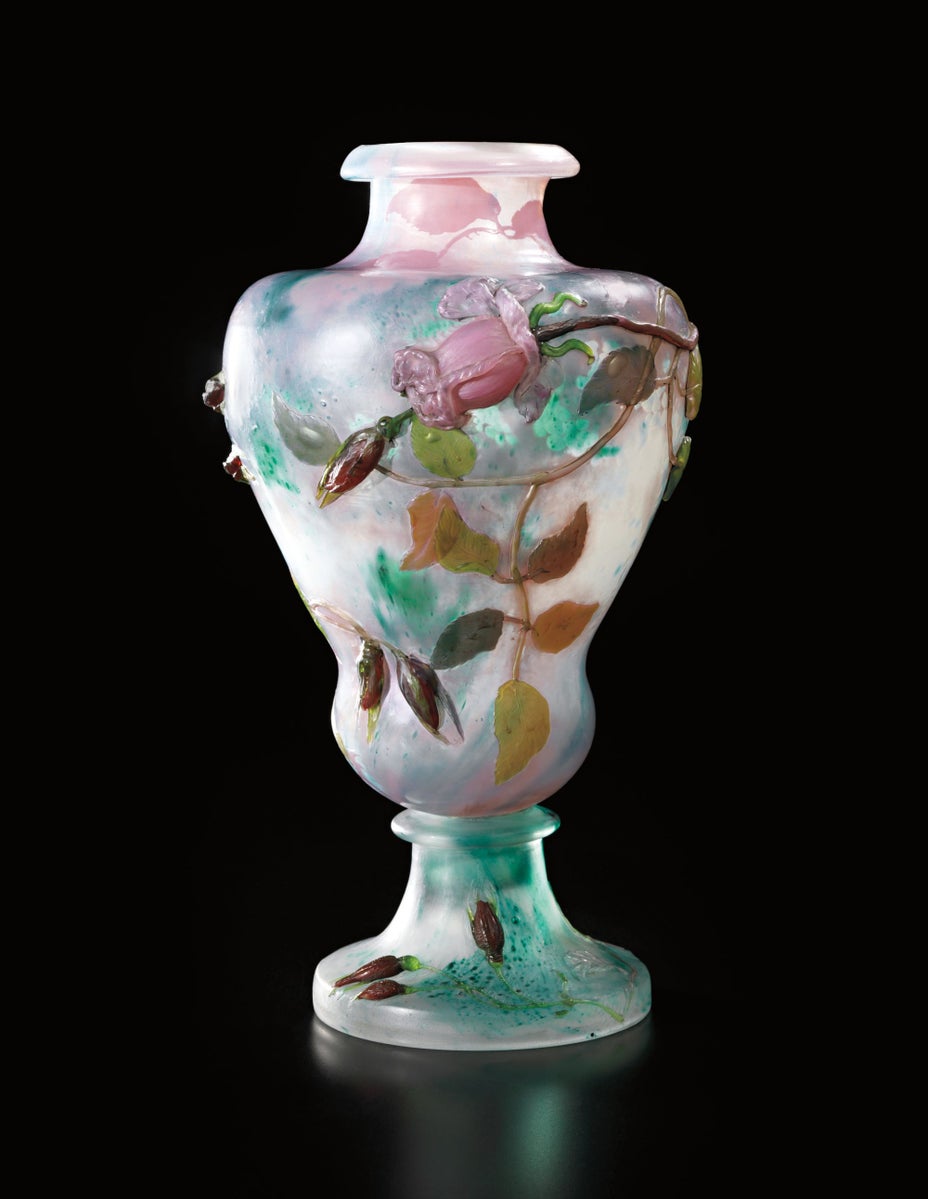
Important “Rose de France” vase
Estimate
$400,000–600,000
Sold For
$422,500
circa 1900
Applied, carved and marquetry cased glass.
17 1/4 in. (43.8 cm) high, 9 3/8 in. (23.8 cm) diameter
Engraved with Gallé.
Full-Cataloguing
A WILD AND METAPHYSIC ROSE
When old men wake to days gone by, and the trail meanders, the field whispers its welcome, and all that’s past floats in air.
At the end of their respective half centuries, both Emile Gallé (1846-1904) and Shiro Kuramata (1934-1991), titans of vastly different times, paid homage to fugitive beauty. These perfect strangers designed two masterworks which bloom at either side of the 20th century as reminders of a common cause: the promise of growth and the prospect of decay.
The present lot, Gallé’s famed double-baluster ‘Rose de France’ (circa 1900), from the artist’s late series of layered and marquetry glass vases by the same name, bristles with potential. Buds break to flowers, the most developed of which crests the shoulder of the vase, a form perfectly suited to mimic the blossom itself and to underscore the idea of upward growth, a conceit shared with the comparably large ‘Rose de France’ coupes in the permanent collections of the Musée de l’Ecole de Nancy and the Kitazawa Museum, Nagano. But the broad cups of those sisters fare open in fervid contrast to the restrained classicism of the present lot—calyxes not yet cracked. In her essay on Gallé’s botanical influences, Valérie Thomas, curator of the Musée de l’Ecole de Nancy, names the object of the artist’s affections: R. gallica, an ancient cultivar nurtured by Greeks and Romans and introduced by the latter to Gaul. Gallé’s twining rose roves back across the spectrum of the years outlining the forms of the past and overgrowing them.
Like many of his contemporaries, Gallé basked in the late 19th-century fashion for Japanese art, which had been promoted to great effect at the 1878 Exposition Universelle in Paris. “The Japanese artist knows uniquely how to translate very natural reproductions into evocative motifs,” Gallé wrote in his Écrits pour l’Art Floriculture. A century later, Shiro Kuramata, a master of “evocative motifs,” designed ‘Miss Blanche’ (1988), a paean to Tennessee Williams’s troubled heroine, who flounces her faded beauty up and down A Streetcar Named Desire. Kuramata’s chair comprises a cacophony of materials—artificial roses fixed in resin, garish aluminum. The effect is one of cruel reassurance, those floating roses constrained to bloom forever. “Function and pragmatism were not Kuramata’s primary aims…” as Deyan Sudjic, director of the London Design Museum, has said of the artist. “He was interested in ideas, emotions and memories, and he used them to create extraordinarily intense [works], full of a sense of
ambiguity about the relationship between surfaces and materials... ” Like Gallé, Kuramata avidly researched new methods and materials, and this principle of exploration lends ‘Miss Blanche’ a restless energy, as Gallé’s experiments with glass marquetry, which he had patented in 1898, roil the surface of his ‘Rose de France.'
“I don’t love flowers and I don’t like having them,” insisted Robert Mapplethorpe in the midst of his pistils, those late flower pictures of the 1980s. Mapplethorpe resisted the urge to sway to their stems, but then he shot them again and again; and the viewer flushes. As he brushed so close to ruin, Mapplethorpe continued to provoke: dangerous, endangered orchids, mums and roses startle with lurid force, “calling attention to the pictures that are hidden from view,” as John Ashbery has said of them. “They radiate anxiety”—and joy.
Gallé’s vase, Kuramata’s chair, and Mapplethorpe’s still life are vase, chair, and still life in name only, and they’re anything but still. To borrow further from Ashbery, the volume of these artists’s flowers, monumental compositions alike, are undermined by implied fragility, a principle characteristic of their shared subject, the bloom and fade of the fervid rose.
Alex Heminway
When old men wake to days gone by, and the trail meanders, the field whispers its welcome, and all that’s past floats in air.
At the end of their respective half centuries, both Emile Gallé (1846-1904) and Shiro Kuramata (1934-1991), titans of vastly different times, paid homage to fugitive beauty. These perfect strangers designed two masterworks which bloom at either side of the 20th century as reminders of a common cause: the promise of growth and the prospect of decay.
The present lot, Gallé’s famed double-baluster ‘Rose de France’ (circa 1900), from the artist’s late series of layered and marquetry glass vases by the same name, bristles with potential. Buds break to flowers, the most developed of which crests the shoulder of the vase, a form perfectly suited to mimic the blossom itself and to underscore the idea of upward growth, a conceit shared with the comparably large ‘Rose de France’ coupes in the permanent collections of the Musée de l’Ecole de Nancy and the Kitazawa Museum, Nagano. But the broad cups of those sisters fare open in fervid contrast to the restrained classicism of the present lot—calyxes not yet cracked. In her essay on Gallé’s botanical influences, Valérie Thomas, curator of the Musée de l’Ecole de Nancy, names the object of the artist’s affections: R. gallica, an ancient cultivar nurtured by Greeks and Romans and introduced by the latter to Gaul. Gallé’s twining rose roves back across the spectrum of the years outlining the forms of the past and overgrowing them.
Like many of his contemporaries, Gallé basked in the late 19th-century fashion for Japanese art, which had been promoted to great effect at the 1878 Exposition Universelle in Paris. “The Japanese artist knows uniquely how to translate very natural reproductions into evocative motifs,” Gallé wrote in his Écrits pour l’Art Floriculture. A century later, Shiro Kuramata, a master of “evocative motifs,” designed ‘Miss Blanche’ (1988), a paean to Tennessee Williams’s troubled heroine, who flounces her faded beauty up and down A Streetcar Named Desire. Kuramata’s chair comprises a cacophony of materials—artificial roses fixed in resin, garish aluminum. The effect is one of cruel reassurance, those floating roses constrained to bloom forever. “Function and pragmatism were not Kuramata’s primary aims…” as Deyan Sudjic, director of the London Design Museum, has said of the artist. “He was interested in ideas, emotions and memories, and he used them to create extraordinarily intense [works], full of a sense of
ambiguity about the relationship between surfaces and materials... ” Like Gallé, Kuramata avidly researched new methods and materials, and this principle of exploration lends ‘Miss Blanche’ a restless energy, as Gallé’s experiments with glass marquetry, which he had patented in 1898, roil the surface of his ‘Rose de France.'
“I don’t love flowers and I don’t like having them,” insisted Robert Mapplethorpe in the midst of his pistils, those late flower pictures of the 1980s. Mapplethorpe resisted the urge to sway to their stems, but then he shot them again and again; and the viewer flushes. As he brushed so close to ruin, Mapplethorpe continued to provoke: dangerous, endangered orchids, mums and roses startle with lurid force, “calling attention to the pictures that are hidden from view,” as John Ashbery has said of them. “They radiate anxiety”—and joy.
Gallé’s vase, Kuramata’s chair, and Mapplethorpe’s still life are vase, chair, and still life in name only, and they’re anything but still. To borrow further from Ashbery, the volume of these artists’s flowers, monumental compositions alike, are undermined by implied fragility, a principle characteristic of their shared subject, the bloom and fade of the fervid rose.
Alex Heminway