12
Eugène Atget
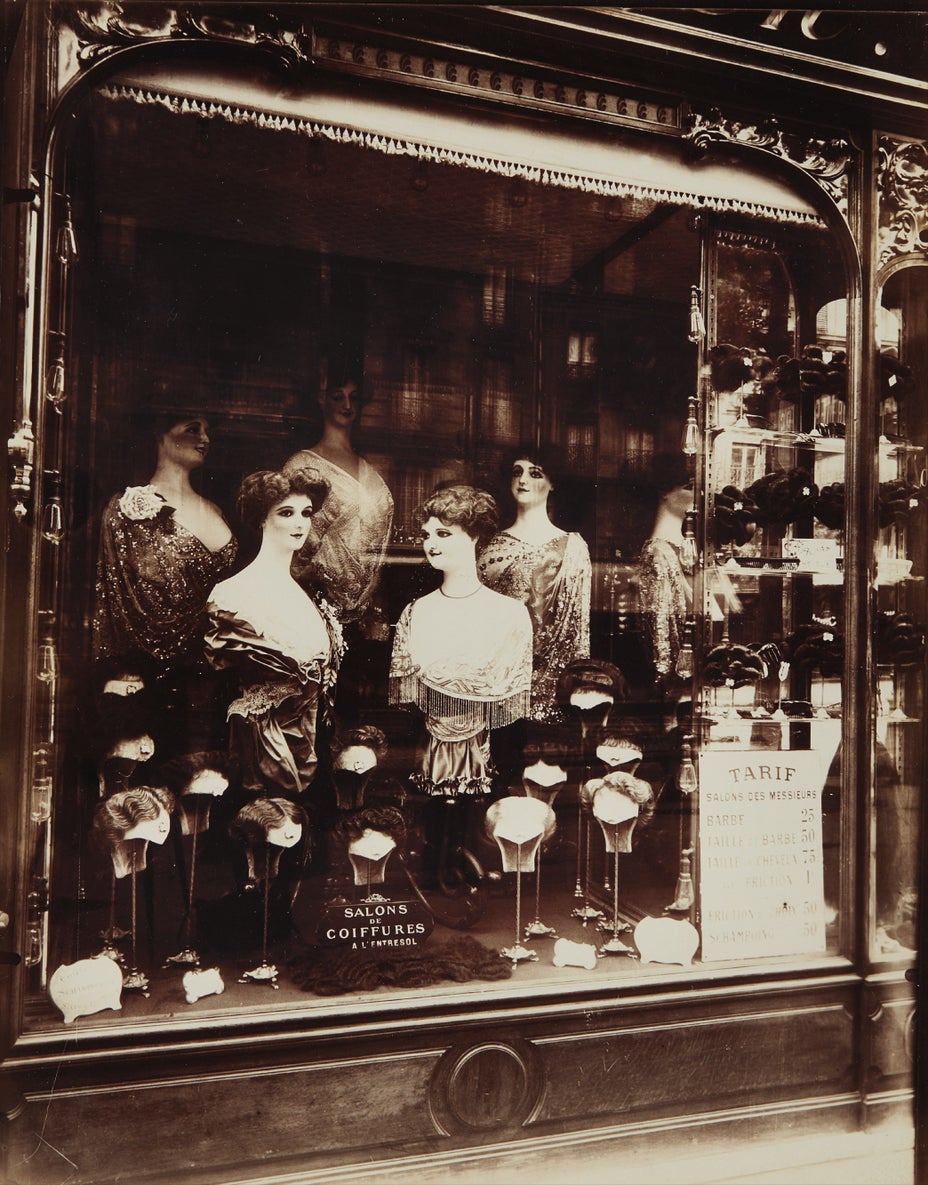
Boutique Coiffeur, Boulevard de Strasbourg
Estimate
$120,000–180,000
Sold For
$125,000
1912
Printing-out-paper print.
8 7/8 x 7 in. (22.5 x 17.8 cm)
Titled, numbered '878' in pencil and 'rue Campagne-Première' studio stamp on the verso.
Full-Cataloguing
The photograph offered here is one of the earliest of Atget’s shop window images, made in 1912, before the outbreak of the first World War. Like the window of a corset shop, also on the boulevard de Strasbourg and the subject of another Atget study from 1912, the Boutique Coiffeur exhibits an inherent surrealism: framed in their window setting, the wigs and mannequins, some with complete faces, some without, seem the heads of actual women floating in space. It is this unexpected, unreal quality that makes Atget’s store windows so attractive to the Post-Modern eye. And it was this aspect of the work that appealed to the Dadaists and Surrealists, inspiring them to appropriate the photographer’s work for their journal La Révolution Surréaliste.
After these 1912 studies, Atget would not return to windows again, in any significant way, until 1925, when he made new photographs of store windows. Contrasting the Boutique Coiffeur and other early store windows with ones made over a decade later, John Szarkowski and Maria Morris Hambourg write, “The earlier windows give us a poetry of unmodulated, surreal fact; the latter ones clarify—triumph over—a raw content of hallucinatory complexity” (The Work of Atget, Vol. IV: Modern Times, p. 174).
The photograph offered here was at one time in the collection of Dada poet Tristan Tzara, who moved from Zurich to Paris after the first World War. In Paris, Tzara lived at the Hôtel Istria, 29 rue Campagne Première, next door to his friend and colleague Man Ray, and down the street from Atget. It is fitting that Tzara—whose introduction to Man Ray’s portfolio of Rayographs, Les Champs Délicieux, heralded the transformation of ordinary objects into images of the unconscious—would have owned this poetic image of “unmodulated, surreal fact."
Additional prints of this image are in the collections of the George Eastman Museum, Rochester and The J. Paul Getty Museum, Los Angeles.
After these 1912 studies, Atget would not return to windows again, in any significant way, until 1925, when he made new photographs of store windows. Contrasting the Boutique Coiffeur and other early store windows with ones made over a decade later, John Szarkowski and Maria Morris Hambourg write, “The earlier windows give us a poetry of unmodulated, surreal fact; the latter ones clarify—triumph over—a raw content of hallucinatory complexity” (The Work of Atget, Vol. IV: Modern Times, p. 174).
The photograph offered here was at one time in the collection of Dada poet Tristan Tzara, who moved from Zurich to Paris after the first World War. In Paris, Tzara lived at the Hôtel Istria, 29 rue Campagne Première, next door to his friend and colleague Man Ray, and down the street from Atget. It is fitting that Tzara—whose introduction to Man Ray’s portfolio of Rayographs, Les Champs Délicieux, heralded the transformation of ordinary objects into images of the unconscious—would have owned this poetic image of “unmodulated, surreal fact."
Additional prints of this image are in the collections of the George Eastman Museum, Rochester and The J. Paul Getty Museum, Los Angeles.