37
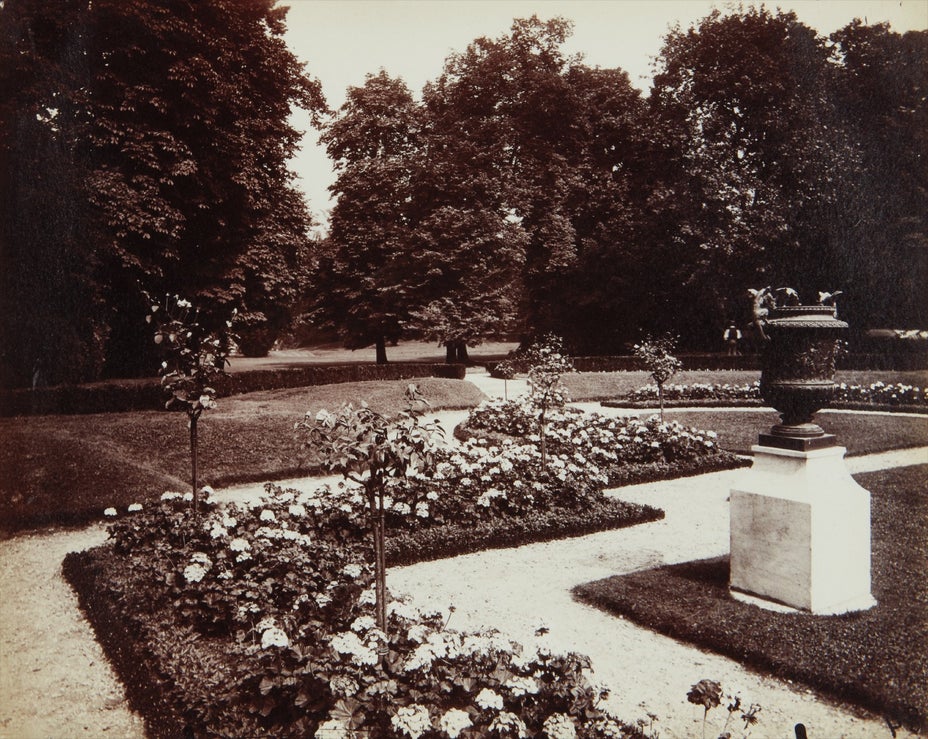
Eugène Atget
Bagatelle
Estimate
$10,000–15,000
Sold For
$15,000
1919-1921
Albumen print.
7 x 8 3/8 in. (17.8 x 21.3 cm)
Titled, annotated '984' by the artist in pencil and Museum of Modern Art deaccession notations in unidentified hands in pencil on the verso.
Full-Cataloguing
The photographs in lots 37 through 39 come from the group of Eugène Atget prints acquired just after his death in 1927 by photographer Berenice Abbott and pioneering gallerist Julien Levy. Abbott had been introduced to Atget by Man Ray, for whom she worked as a darkroom assistant. Abbott befriended Atget, and the portraits she made of him are some of the few images we have of the enigmatic photographer. After Atget’s death, the survival of his work was far from certain. Abbott and Levy purchased the thousands of photographs and glass negatives left in his apartment, saving the work from likely destruction. In 1968, Abbott and Levy sold their collection to The Museum of Modern Art. In 2002, MoMA began a program of deaccessioning duplicates from this vast collection.
Julien Levy devotes a chapter to Atget in his Memoir of an Art Gallery (New York, 1977), one of the few first-person accounts of this prolific but reclusive figure. Levy wrote: “He told me he was simply preserving carefully the vanishing world that he loved, and keeping an archive of important classified documents. He was a remarkably simple man, extremely modest. In truth, he was unaware of his achievement. He left 10,000 photographs in hundreds of series, but each individual picture was an essential pearl in the string that was his Paris. And he was making a new statement with every picture, transcending the document and creating poetry that outlived his Paris and will outlive us all.”
Julien Levy devotes a chapter to Atget in his Memoir of an Art Gallery (New York, 1977), one of the few first-person accounts of this prolific but reclusive figure. Levy wrote: “He told me he was simply preserving carefully the vanishing world that he loved, and keeping an archive of important classified documents. He was a remarkably simple man, extremely modest. In truth, he was unaware of his achievement. He left 10,000 photographs in hundreds of series, but each individual picture was an essential pearl in the string that was his Paris. And he was making a new statement with every picture, transcending the document and creating poetry that outlived his Paris and will outlive us all.”