122
Fernand Léger
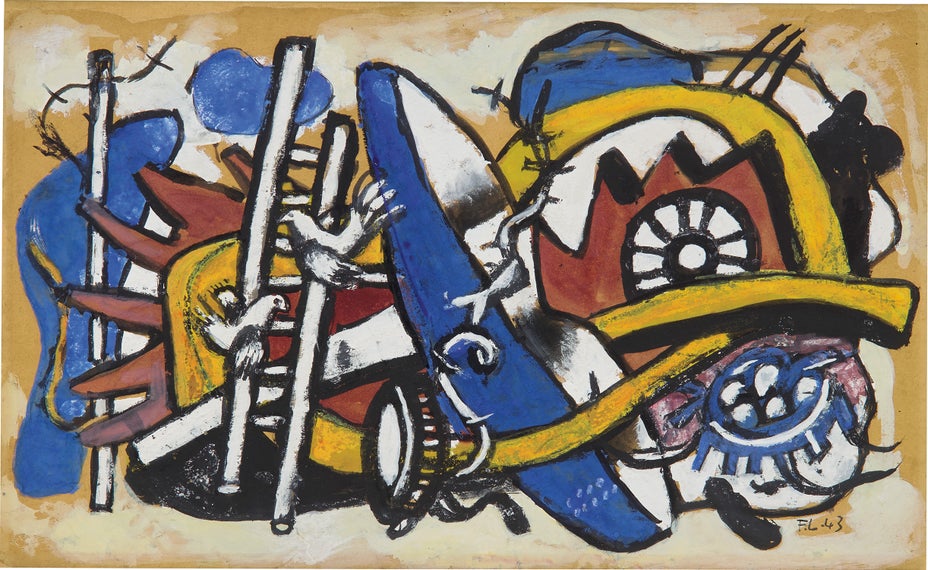
Les oiseaux sur l’échelle
Estimate
£50,000–70,000♠︎
Sold For
£75,000
signed with the artist's initials and dated 'F.L. ’43' lower right
gouache on paper
28 x 45.6 cm (11 x 17 7/8 in.)
Painted in 1943.
Full-Cataloguing
'...The abandoned farm discovered at Rouses Point, near the Canadian border, while travelling to the exhibition of his work in Montreal the following year, seemed to manifest this difference. Here discarded farm implements, broken wagon wheels, barbed wire fencing and fallen branches overgrown with vegetation, become the motifs used in a series of canvases which develop the theme of decay and generation...Léger returned to the Rouses Point farm in the summers of 1944 and '45, mainly working on small gouache studies.' (Simon Willmoth, 'Léger and America', in Fernand Léger. The Later Years, exh. cat., Whitechapel Art Gallery, London, 1987-88, p. 53).
Fernand Léger first visited America in 1931 and subsequently relocated there for several years during World War II. This transition inspired a refreshed artistic focus on the themes of abundance and possibility that he observed around him. Léger’s artistic productivity found parallels in concurrent industrial changes; he picked out the by-products of profuse manufactured production as motifs in his work by incorporating discarded farm materials and obsolete mechanical objects within tableaus of vibrant, colourful motion. Léger also incorporated elements of contrast in his work by interspersing depictions of birds and nature alongside the remnants of industry. A forceful energy persists in Léger’s work from this period, explored most recently in Tate Liverpool’s seminal exhibition Fernand Léger: New Times, New Pleasure which focuses on his vibrant depictions of modern life and the everyday.
Fernand Léger first visited America in 1931 and subsequently relocated there for several years during World War II. This transition inspired a refreshed artistic focus on the themes of abundance and possibility that he observed around him. Léger’s artistic productivity found parallels in concurrent industrial changes; he picked out the by-products of profuse manufactured production as motifs in his work by incorporating discarded farm materials and obsolete mechanical objects within tableaus of vibrant, colourful motion. Léger also incorporated elements of contrast in his work by interspersing depictions of birds and nature alongside the remnants of industry. A forceful energy persists in Léger’s work from this period, explored most recently in Tate Liverpool’s seminal exhibition Fernand Léger: New Times, New Pleasure which focuses on his vibrant depictions of modern life and the everyday.