47Ο︎◆︎
Fernando Botero
Fin de Fiesta
Full-Cataloguing
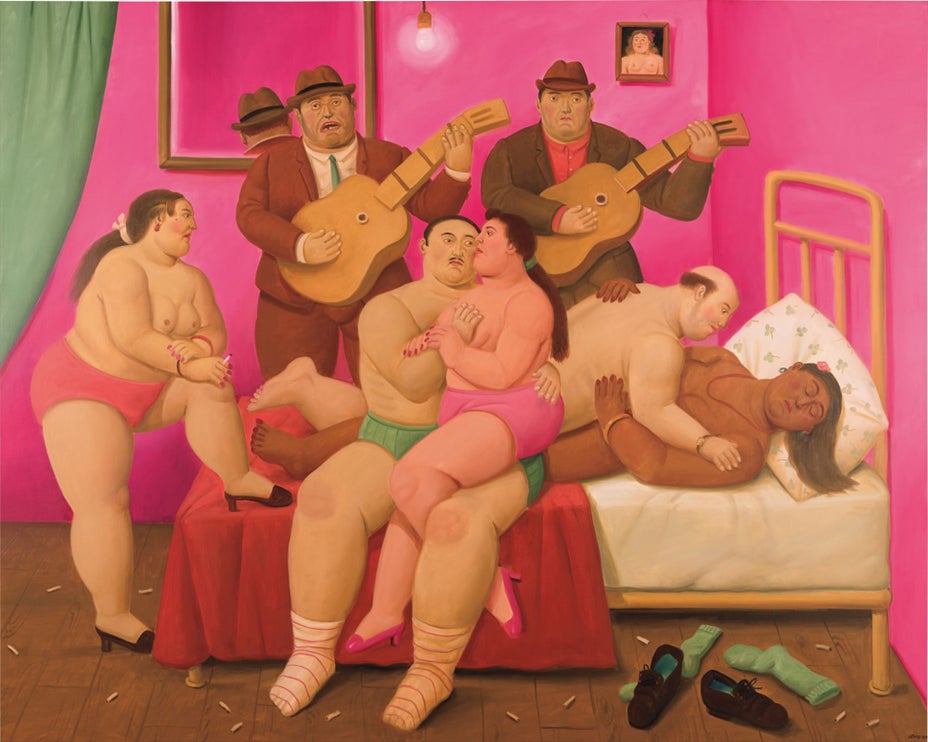
In the mid-2000s, Botero ventured into starkly political terrain with a series of paintings, but in the past decade he has returned to a more innocuous iconography of circus performers, family groups, and female nudes. The candy-colored Fin de fiesta reprises the brothel scenes that have long been a fixture in his work, among them House of Mariduque (1970) and House of Amanda Ramírez (1988), and which may have a more distant source in 17th century Dutch paintings of the same subject. Two guitar players preside over a strangely dispassionate bacchanalia, its pairs of lovers pneumatic and lifeless; a bare-breasted woman props her foot on the edge of the bed, a cigarette between her fingers. The scattered cigarette butts and single, exposed lightbulb are familiar embellishments in Botero’s paintings; here, they accent the enveloping, roseate palette of the room, which spreads from the bubble-gum pink walls to the ruddy flesh of its occupants. The tonal harmony is minimally interrupted by slight, faintly ironic contrasts of green: the drawn curtain, the guitarist’s necktie, the man’s briefs, the discarded socks, the cloverleaf-patterned pillowcase. Indeed, the painting’s sensuality derives less from its naked eroticism than from the intensity and equilibrium of its color, which reconciles the makeshift messiness and outlandishness of the scene. “Colors experience friendship, and they produce an atmosphere. And, when there is atmosphere, there is poetry,” Botero once remarked (Fernando Botero, quoted in Marie Pierre Colle, “Fernando Botero,” in Latin American Artists in their Studios, New York, 1994, p. 42). “I am looking for poetry in improbability.”(Fernando Botero, quoted in Ana María Escallón, “From the Inside Out: An Interview with Fernando Botero,” Botero: New Works on Canvas, New York, 1997, p.28.)
Fernando Botero
Colombian | 1932Colombian artist Fernando Botero is known for his voluptuous and exaggerated paintings, sculptures and drawings. He studied under Roberto Longhi, a renowned authority on Italian Renaissance and Baroque art, obtaining a remarkable art historical knowledge of Western Classicism. This dialogue between an erudite education and religious art for the masses is the key in the development of his aesthetic.
Botero was also influenced by Mexican muralism, with which he became acquainted while living in Mexico City. The monumental scale of the human forms in the murals gave rise to the voluminous figures for which he is best known. Botero's works make mordant comments on society's shortcomings; they also incorporate classical elements and are imbued with political satire and caricature.