Property from a Private Collection, Manhattan
86
Friedrich Otto Schmidt
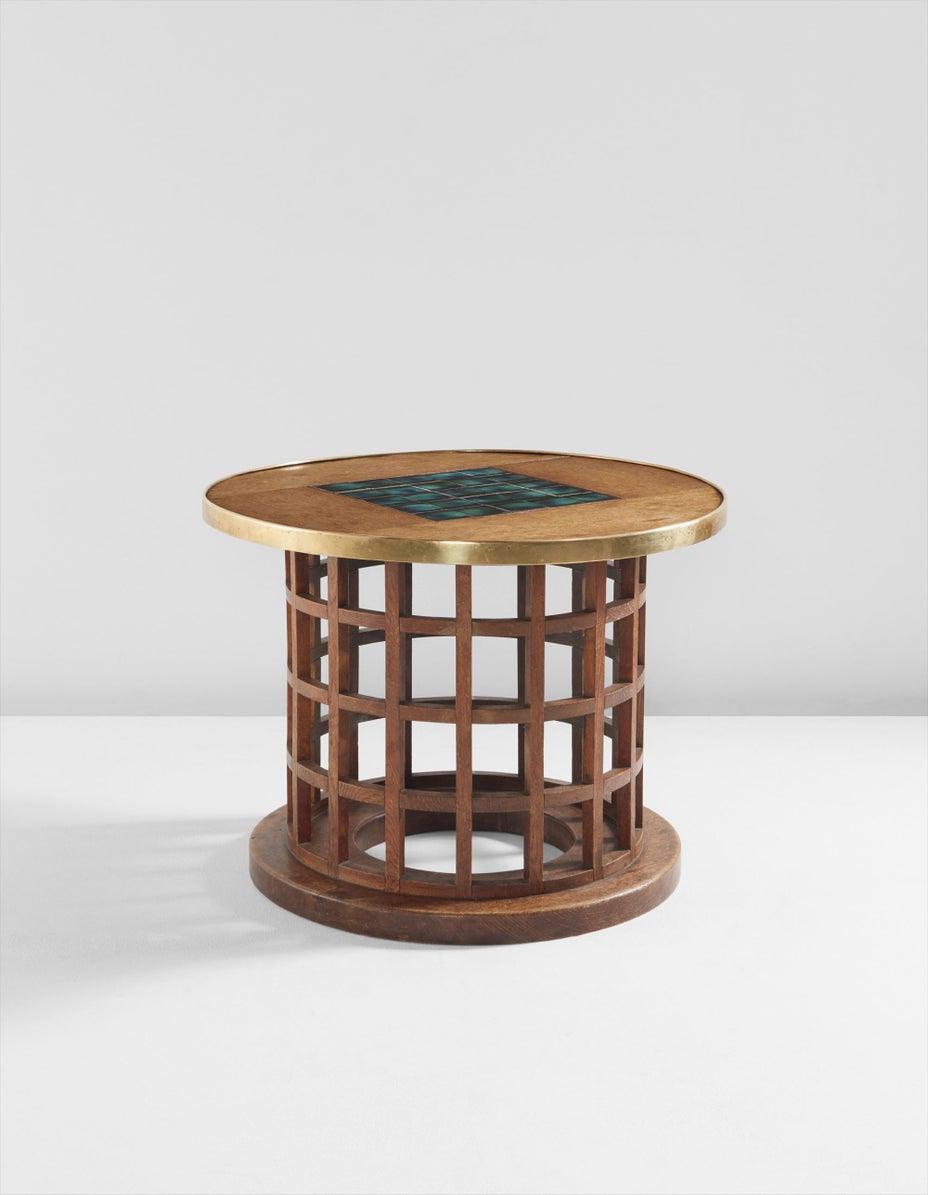
Table
Estimate
$12,000–18,000
Sold For
$27,500
circa 1905
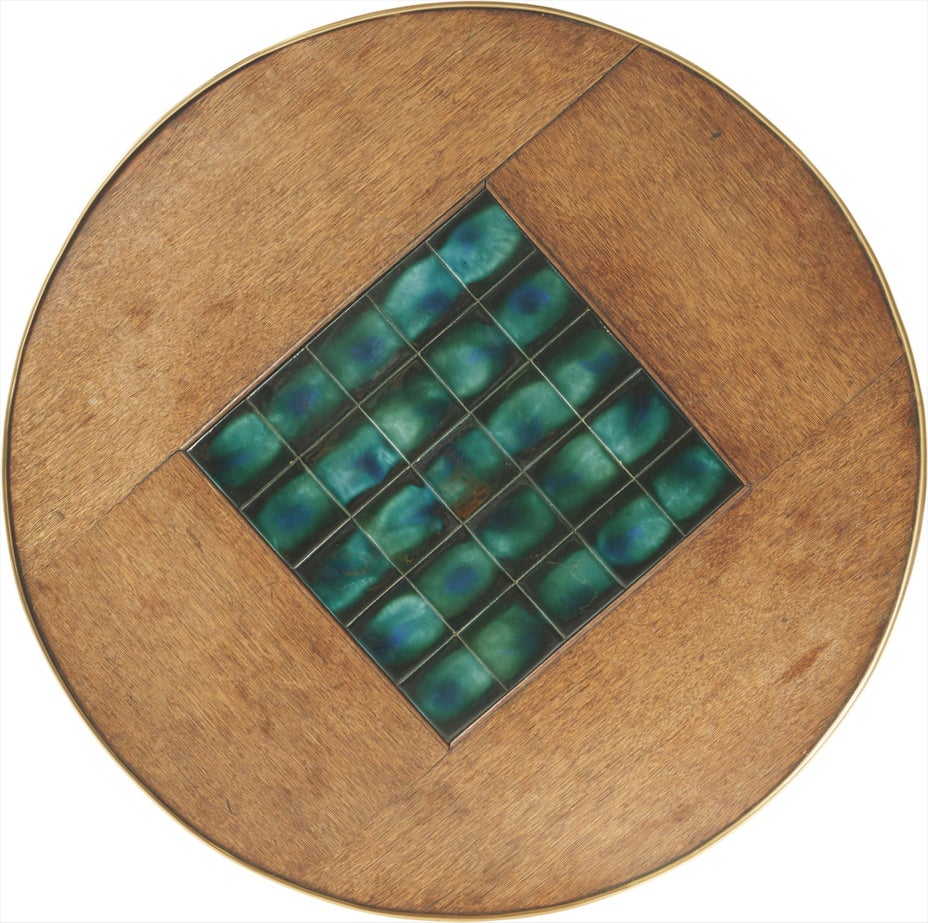
Oak, brass, glazed earthenware.
25 1/2 in. (64.8 cm) high, 33 3/4 in. (85.7 cm) diameter
Produced by Friedrich Otto Schmidt, Vienna, Austria. Tiles executed by Thonbrand Kunstwerkstätte Gebrüder Meinhold, Schweinsburg, Saxony. Underside of tiles with manufacturer's raised boar logo.
Full-Cataloguing
Phillips would like to thank Claus Lorenz at Friedrich Otto Schmidt and Dr. Christian Witt-Dörring for their assistance cataloguing the present lot.
“À la Loos”
Since 1853, the Viennese furniture company Friedrich Otto Schmidt has been designing and producing interiors and furniture to the highest manufacturing standards. The company excelled around the turn of the nineteenth century under the supervision of the brothers Max, Otto and Leo Schmidt. The brothers were closely associated with artists and architects of the time, including Adolf Loos, at whose wedding in 1902 Max and Leo served as witnesses.
The Schmidt brothers' forte was the optimization of the already existing, which resonated with Loos’s decorating philosophy, as he believed that once an object was created and solved a certain problem, reinventing it would be superfluous. Rather, the existing object could be copied, varied and improved endlessly.
Based on this philosophy, Loos would frequently use preexisting designs in his interiors, which were often produced, and in certain instances also designed by Friedrich Otto Schmidt, such as the present model table. Loos very much saw his role as an interior decorator and as an advisor to his clients, rather than the designer of individual objects. As such, to categorically attribute objects of his interiors to Loos is incorrect. As the company Friedrich Otto Schmidt put it, the furniture was designed “à la Loos."
“À la Loos”
Since 1853, the Viennese furniture company Friedrich Otto Schmidt has been designing and producing interiors and furniture to the highest manufacturing standards. The company excelled around the turn of the nineteenth century under the supervision of the brothers Max, Otto and Leo Schmidt. The brothers were closely associated with artists and architects of the time, including Adolf Loos, at whose wedding in 1902 Max and Leo served as witnesses.
The Schmidt brothers' forte was the optimization of the already existing, which resonated with Loos’s decorating philosophy, as he believed that once an object was created and solved a certain problem, reinventing it would be superfluous. Rather, the existing object could be copied, varied and improved endlessly.
Based on this philosophy, Loos would frequently use preexisting designs in his interiors, which were often produced, and in certain instances also designed by Friedrich Otto Schmidt, such as the present model table. Loos very much saw his role as an interior decorator and as an advisor to his clients, rather than the designer of individual objects. As such, to categorically attribute objects of his interiors to Loos is incorrect. As the company Friedrich Otto Schmidt put it, the furniture was designed “à la Loos."