186
Georg Baselitz
Teolie
Estimate
$200,000–300,000
Sold
oil on canvas
57 3/8 x 44 7/8 in. (145.6 x 114 cm.)
Signed, titled and numbered "G. Baselitz 6.III.2 'Teolie'"on the reverse.
Full-Cataloguing
Georg Baselitz's name is synonymous with severity in art; his approach cannot be disjoined from his overwhelming influences—namely those of the historical and cultural circumstances in which he has lived. Particularly, Baselitz’s work creates brilliant political statements about the realities of German life following World War II. But, rather than offering blatant cultural criticism or critiquing specific institutions, Baselitz instead gives the viewer a wealth of symbol and image, which work together in his sculptures and paintings to achieve a somewhat disturbing yet wholly cathartic end. As a German, a Neo-Expressionist, and first and foremost, as a creator, Baselitz shows us the cracks in our world through the lens of artistic invention.
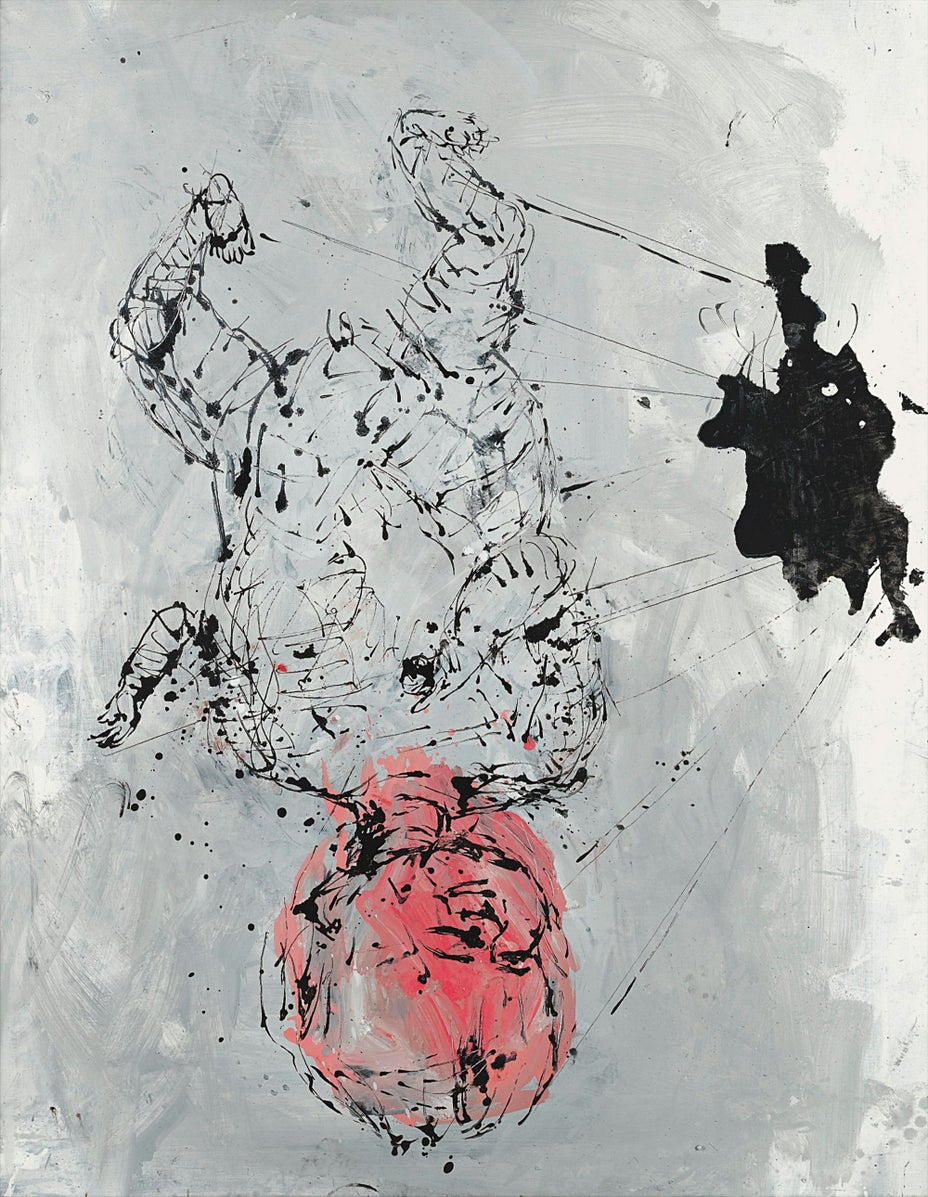
In Teolie, 2000, we observe one of his most fascinating reflections on an earlier period. Baselitz’s “upside-down” paintings of the 1970s inverted the commonplace features of the urban landscape into an unrecognizable scene of shape and image. Yet in the present lot, Baselitz works with only one recognizable figure—the inverted child at left—crafting along side of it a web that links to a dark, sinister mass. It would be difficult not to observe the violence in Teolie, 2000, especially given the red coloring of the figure’s head and Baselitz’s splattering technique. Yet we must remind ourselves that he is not simply crafting a picture of a victim of war or tragedy, but rather assembling many visual components into an illusion, further exploring the ability to find abstraction in a subject. Teolie is a marvelous testament to Baselitz’s decades-long dedication to the realm of visual possibility.
In Teolie, 2000, we observe one of his most fascinating reflections on an earlier period. Baselitz’s “upside-down” paintings of the 1970s inverted the commonplace features of the urban landscape into an unrecognizable scene of shape and image. Yet in the present lot, Baselitz works with only one recognizable figure—the inverted child at left—crafting along side of it a web that links to a dark, sinister mass. It would be difficult not to observe the violence in Teolie, 2000, especially given the red coloring of the figure’s head and Baselitz’s splattering technique. Yet we must remind ourselves that he is not simply crafting a picture of a victim of war or tragedy, but rather assembling many visual components into an illusion, further exploring the ability to find abstraction in a subject. Teolie is a marvelous testament to Baselitz’s decades-long dedication to the realm of visual possibility.