216
George Condo
Last Days of Enron
Estimate
$350,000–450,000
Sold For
$413,000
oil on canvas
48 x 48 in. (122 x 122 cm.)
Signed, titled and dated "Condo 04, Last Days of Enron" on the reverse.
Full-Cataloguing
Occupying a position as preeminent painter and provocateur, George Condo has upheld the torch of American figure painting for nearly three decades. With influences ranging from masters of the renaissance period to Picasso and Willem de Kooning, Condo’s practice has long emphasized the greater tradition of portraiture as much it presents us with the opportunity to glimpse at psychological fragmentation. While one can clearly identify some of Condo’s predecessors, it is imperative to recognize the artist’s contributions in the resurgence of this painterly tradition, exemplified in the reception of contemporary artists like Glenn Brown and John Currin.
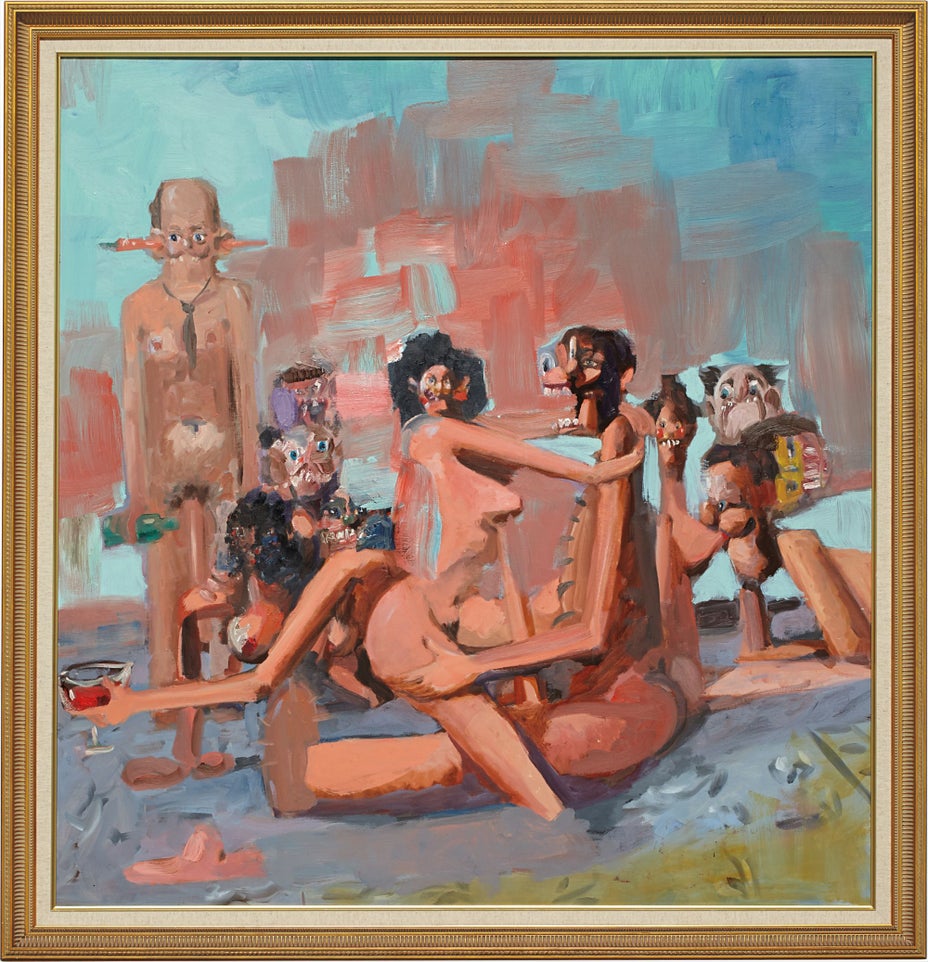
The present lot, The Last Days of Enron, 2004, depicts the fall of a business empire, the sudden collapse of a façade that has since become an example of greed and corruption—an era of excess. Never before has Condo’s use of the grotesque seemed as appropriate as in the present context. Indeed, “Condo identifies in paintings’ inherent elasticity and multivalence a locus for the uncertainly that underpins our willfully dumb cultural moment.” (M. Herbert, “George Condo: Simon Lee London,” ArtReview, issue 10, April 2007, pp. 136-137).
Drawing from the sixteenth and seventeenth century, Condo samples from Titian and Sebastiano Ricci’s Bacchanal paintings by taking on a similar composition and loading the scene with psychotic absurdity. With a background reminiscent of Philip Guston’s early abstract paintings, Condo’s debaucherous scene is enraptured with hues of light blue, coral and pink flesh tones. The figures appear transfixed in a momentof depravity, their mask-like faces turned towards the viewer as though they’ve suddenly been interrupted- or caught in the act. Here, Condo’s figures bask in their own self-indulgence, suggesting the timelessness of Bacchanal paintings and the timeliness of Condo’s approach.
George Condo
AmericanPicasso once said, "Good artists borrow, great artists steal." Indeed, American artist George Condo frequently cites Picasso as an explicit source in his contemporary cubist compositions and joyous use of paint. Condo is known for neo-Modernist compositions staked in wit and the grotesque, which draw the eye into a highly imaginary world.
Condo came up in the New York art world at a time when art favored brazen innuendo and shock. Student to Warhol, best friend to Basquiat and collaborator with William S. Burroughs, Condo tracked a different path. He was drawn to the endless inquiries posed by the aesthetics and formal considerations of Caravaggio, Rembrandt and the Old Masters.