Property from the Miles and Shirley Fiterman Collection
133Ο︎
George Segal
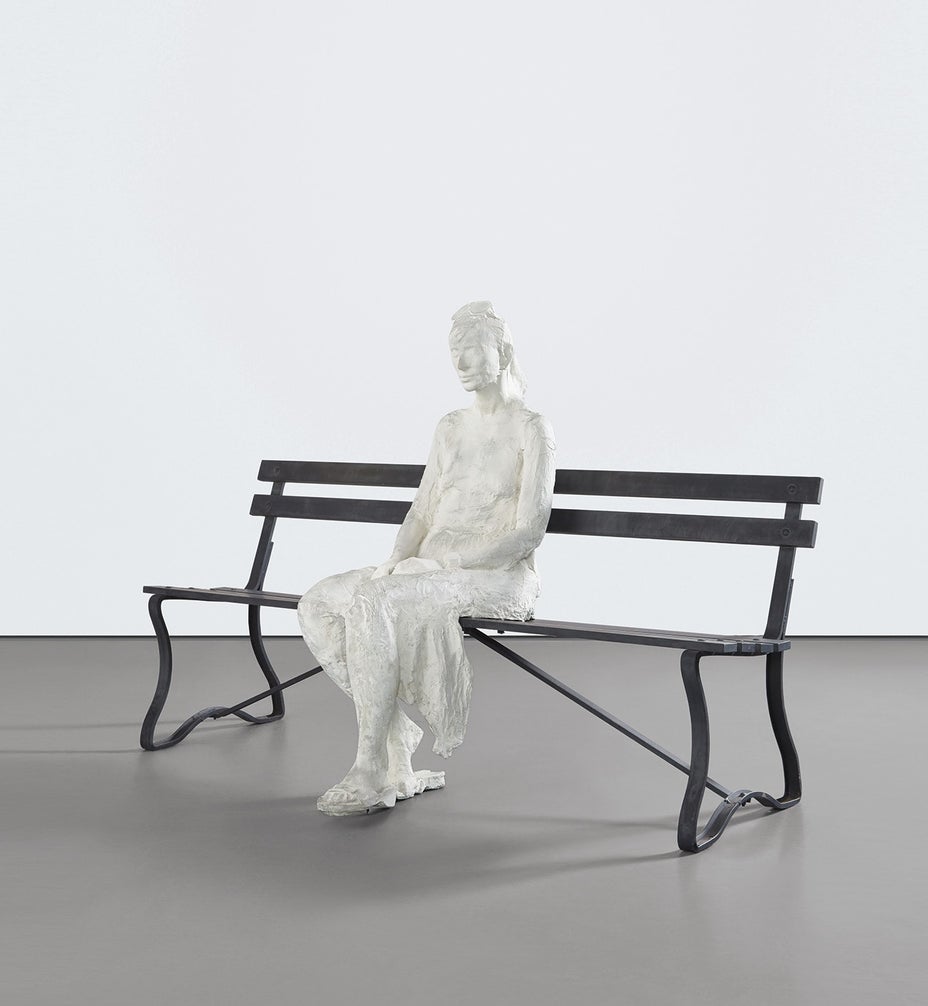
Woman with Sunglasses on Bench
Estimate
$250,000–350,000
Sold For
$275,000
painted bronze on cast iron bench
figure 47 x 40 x 39 in. (119.4 x 101.6 x 99.1 cm.)
bench 31 3/4 x 71 7/8 x 22 in. (80.6 x 182.7 x 55.9 cm.)
overall 47 x 71 7/8 x 39 in. (119.4 x 182.7 x 99.1 cm.)
bench 31 3/4 x 71 7/8 x 22 in. (80.6 x 182.7 x 55.9 cm.)
overall 47 x 71 7/8 x 39 in. (119.4 x 182.7 x 99.1 cm.)
Conceived in 1983, this work is from an edition of 5 plus 2 artist's proofs.
Full-Cataloguing
“For me to decide to make a cast of a human being broke all the rules of fine art. - George Segal
Executed in 1987, George Segal’s Woman with Sunglasses on Bench is a striking example of the artist's acclaimed exploration of figurative sculpture. Whereas fellow Pop sculptors such as Claes Oldenburg found inspiration in everyday mass-market products, Segal, in contrast, turned inwards to the consumers of culture themselves. Depicting figures frozen in their everyday rituals, Segal’s iconic white figures emanate echoes of existential longing which elevate the simple and banal to new heights of artistic expression.
With a sly nod to the tradition of plaster casts in classical sculpture, Segal pioneered the use of plaster bandages - typically designed for making orthopedic casts - as a sculptural medium. To create his lifelike plaster sculptures, Segal would wrap his sitters in plaster-soaked gauze, working the thin, flexible material assiduously as it dried on the body, then again after the model was cut free from the cast. An expressionist painter for twenty years prior to taking up sculpture, a fact that becomes evident in his delicate painterly approach to the plaster in defining select features, while blurring others – Segal constructed portraits that are always deeply personal and individualistic. Reminding us that art can reflect rather than perfect those fleeting elements of life which might otherwise go unnoticed, Segal's white sculptures are infused with the artist’s respect for the fragile beauty of human life. As Segal noted perceptively in a 1979 interview, “People have attitudes locked up in their bodies… A person may reveal nothing of himself and then, suddenly, make a movement that contains a whole autobiography” (George Segal, quoted in Jan van der Marck, George Segal, New York, 1979, p. 33).
Executed in 1987, George Segal’s Woman with Sunglasses on Bench is a striking example of the artist's acclaimed exploration of figurative sculpture. Whereas fellow Pop sculptors such as Claes Oldenburg found inspiration in everyday mass-market products, Segal, in contrast, turned inwards to the consumers of culture themselves. Depicting figures frozen in their everyday rituals, Segal’s iconic white figures emanate echoes of existential longing which elevate the simple and banal to new heights of artistic expression.
With a sly nod to the tradition of plaster casts in classical sculpture, Segal pioneered the use of plaster bandages - typically designed for making orthopedic casts - as a sculptural medium. To create his lifelike plaster sculptures, Segal would wrap his sitters in plaster-soaked gauze, working the thin, flexible material assiduously as it dried on the body, then again after the model was cut free from the cast. An expressionist painter for twenty years prior to taking up sculpture, a fact that becomes evident in his delicate painterly approach to the plaster in defining select features, while blurring others – Segal constructed portraits that are always deeply personal and individualistic. Reminding us that art can reflect rather than perfect those fleeting elements of life which might otherwise go unnoticed, Segal's white sculptures are infused with the artist’s respect for the fragile beauty of human life. As Segal noted perceptively in a 1979 interview, “People have attitudes locked up in their bodies… A person may reveal nothing of himself and then, suddenly, make a movement that contains a whole autobiography” (George Segal, quoted in Jan van der Marck, George Segal, New York, 1979, p. 33).