
PROPERTY FROM THE DIEPENHORST FAMILY, THE NETHERLANDS
241
Gerrit Thomas Rietveld
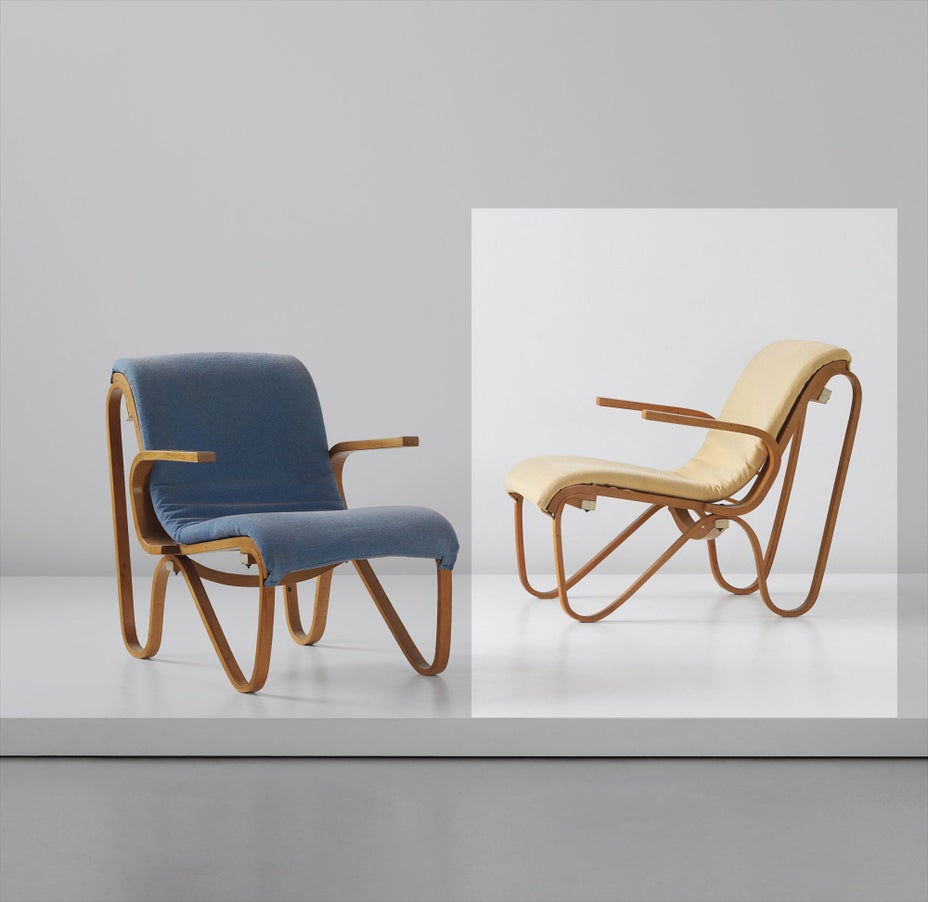
Armchair, model no. R54
- Estimate
- $20,000 - 30,000
$18,750
Lot Details
Bent beechwood, plastic-covered springs, brass, fabric cushion.
designed 1942, produced 1942-1946
29 x 23 5/8 x 34 1/4 in. (73.7 x 60 x 87 cm)
Produced and retailed by Metz & Co, Amsterdam, the Netherlands.
Specialist
Full-Cataloguing
Catalogue Essay
The present rare armchairs from the 1940s form a link between Gerrit Thomas Rietveld's prewar and postwar works. The white-stained short sides of the stretcher are an echo of Rietveld's youthful flirtation with De Stijl while the model is closely related to the metal "Beugelstoel" from 1927. The slender frame of bentwood shows the influence of Scandinavian and American design which would become the leading trend in Europe in the postwar years. Because of the metal shortage during and directly after the war, wooden furniture became a popular alternative. This design by Rietveld however did not become a success; only four armchairs and a settee of this model are known. This complete set was purchased in 1946 at Metz & Co in Amsterdam by Professor Diepenhorst, together with furniture pieces by Alvar Aalto. Two armchairs and the settee were later acquired by Stedelijk Museum, Amsterdam and Centraal Museum, Utrecht. The remaining two armchairs have remained in the collection of the Diepenhorst family up to this date.
-Rob Driessen
-Rob Driessen
Provenance
Literature
Gerrit Thomas Rietveld
Dutch | B. 1888 D. 1964Gerrit Thomas Rietveld began as an apprentice in his father's cabinetmaking workshop, going on to train and work as a draftsman. In 1917 he started his own furniture-making workshop in Utrecht. Positive critical review by Theo van Doesburg in his journal De Stijl resulted in near-instantaneous influence on broader developments in European modernism. This connection to the De Stijl movement also inspired him to introduce color to the posts, rails and terminals of his furniture. His resulting "Red-blue" armchair is among the most iconic chair designs of the twentieth century.
From the beginning, Rietveld embraced modernist principles of functionalism, simplicity of form and mass-production, and eventually moved away from De Stijl to become a member of the Congrès Internationaux d'Architecture Moderne (CIAM). Rietveld worked through the post-war years, completing a number of private residences, housing developments and institutions. He continued to design furniture for these commissions as well as for retailers like Metz & Co.
Browse ArtistFrom the beginning, Rietveld embraced modernist principles of functionalism, simplicity of form and mass-production, and eventually moved away from De Stijl to become a member of the Congrès Internationaux d'Architecture Moderne (CIAM). Rietveld worked through the post-war years, completing a number of private residences, housing developments and institutions. He continued to design furniture for these commissions as well as for retailers like Metz & Co.