25Ο︎
Giorgio de Chirico
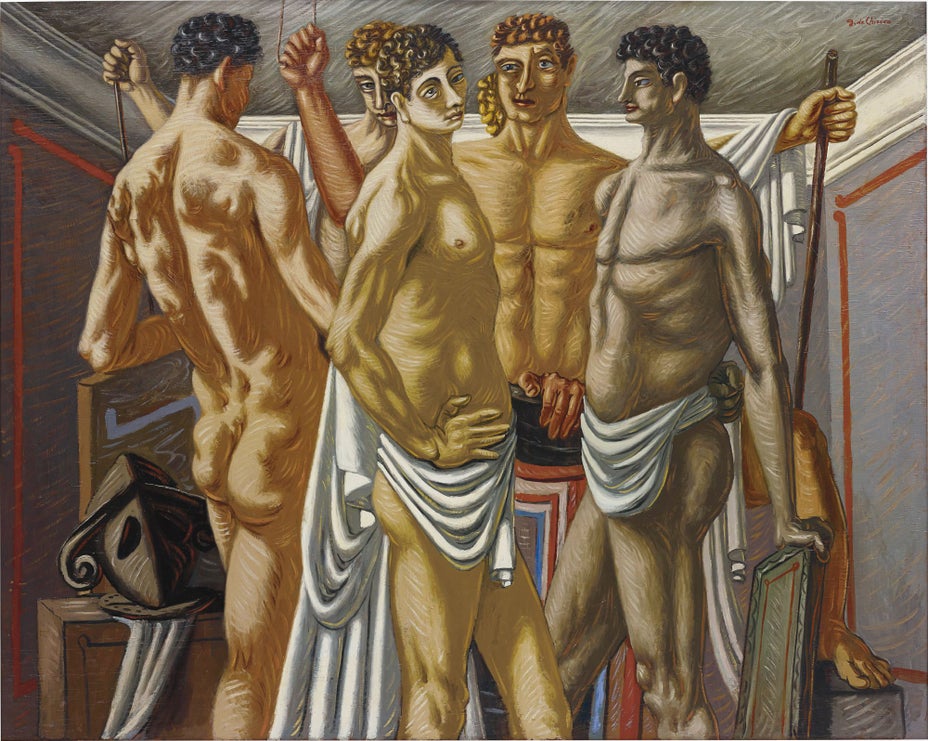
Gladiateurs au Repos
Estimate
$4,000,000–6,000,000
Sold For
$3,973,000
oil on canvas
62 1/2 x 78 1/4 in. (158.8 x 198.8 cm)
Signed "G. de Chirico" upper right; further signed and titled "'Gladiatori' Giorgio de Chirico" on the reverse of the burlap cover.
Full-Cataloguing
[QUOTE}: Gladiators! There's an enigma in that word.
Gladiateurs au repos is a large-scale, historical painting by Giorgio de Chirico, dating from 1928-29 and celebrating the gladiators who had become one of his key pictorial themes. This painting, with its armed figures looming larger than life and full of color, was one of three that dominated the celebrated Hall des gladiateurs in the home of de Chirico's dealer, Léonce Rosenberg, the founder of the famous avant garde Galerie de l'Effort Moderne. The room featured a total of eleven canvases by the artist; of this group, several are now in museum collections. Since it was painted, Gladiateurs au repos had a distinguished history, featuring in a wide range of exhibitions and publications. The picture has seldom changed hands: it was acquired by the writer and diplomat Filippo Anfuso in the 1930s, and remained in the collection of his heirs until just over a decade ago.
Rosenberg's apartment was decorated by a number of artists with whom he had worked, alongside de Chirico. Others including Max Ernst, Fernand Léger, Francis Picabia, Gino Severini and de Chirico's own brother, Alberto Savinio, were all invited to create works for the interior, which became a showcase in its own right. In de Chirico's room, the theme of the gladiator dominated: the two other large-scale paintings showed a combat and a triumph, with Gladiateurs au repos placed between them. Elsewhere, other images included gladiators racing or training. In L'intelligence de deux époques, published in 1930, Waldemar George celebrated the way this modern take on a classical theme resonated with the Empire period furnishings in the room.
By the time de Chirico painted Gladiateurs au repos, he was living in Paris, having returned there after a sojourn in Italy. de Chirico had returned to Paris in part because of the enthusiasm the Surrealists had shown his pictures. de Chirico's paintings tapped into a mysterious universe, in which the past appeared vivid and real, continuing to unfold parallel to our own existence. These gladiators, which appeared in de Chirico's work at the end of the 1920s, tap into that theme: they are classical fighters, champions of battles enacted solely for the entertainment of their spectators. In de Chirico's novel Hebdomeros, published in 1929, around the time that he painted Gladiateurs au repos, his eponymous alter ego viewed a tableau vivant featuring such gladiators, which he viewed in terms that relate to this painting:
"That evening, surrounded by his friends, he attended the performance and understood everything. The riddle of this ineffable composition of warriors, of pugilists, difficult to describe and forming in a corner of the drawing room a block, many-coloured and immobile in its gestures of attack and defence, was at bottom understood by himself alone." (Giorgio de Chirico, Hebdomeros, trans. J. Ashbery, Cambridge, 1992, p. 93)
The mystery of the gladiator lies in part in the fascination with violence, a pull that de Chirico himself discussed in Hebdomeros and in his memoirs. In a sense, it was a rebound from the near-puritanical atmosphere of his childhood, when references to violence were completely expunged: "In our house the words dagger, pistol, revolver, gun, etc., were never uttered. The only one which could be mentioned by name was the cannon, probably because it was not usual to keep cannons in the house" (de Chirico, The Memoirs of Giorgio de Chirico, trans. M. Crosland, Milan, 1994, p. 39). The gladiators, standing among their discarded weapons, helmets and shields, therefore have an aspect of the forbidden to them, a notion that is only heightened by the intense focus on the rippling flesh and musculature of these supreme athletes.
In Gladiateurs au repos, de Chirico has painted the different gladiators in various colors, using a polychrome scheme that adds a visual rhythm to the composition. They have been rendered with richly-feathered brushstrokes, with some of the details highlighted with bright ribbons of orange paint, as though the men are illuminated by an unseen fire, adding a phosphorescent, unreal quality to their looming figures. These stylistic devices heighten the visual drama of Gladiateurs au repos while also tapping into numerous layers of time: de Chirico has taken a wide range of influences, conflating and combining them, from Roman mosaics to Impressionism. In particular, Luca Signorelli's murals in the Cathedral at Orvieto, with their tumult of figures shown in various tints and colors, are echoed here. In this way, de Chirico has heightened the sense of synchronicity that underpins Gladiateurs au repos, revealing the importance of this monumental painting within the arc of his wider oeuvre.
Gladiateurs au repos is a large-scale, historical painting by Giorgio de Chirico, dating from 1928-29 and celebrating the gladiators who had become one of his key pictorial themes. This painting, with its armed figures looming larger than life and full of color, was one of three that dominated the celebrated Hall des gladiateurs in the home of de Chirico's dealer, Léonce Rosenberg, the founder of the famous avant garde Galerie de l'Effort Moderne. The room featured a total of eleven canvases by the artist; of this group, several are now in museum collections. Since it was painted, Gladiateurs au repos had a distinguished history, featuring in a wide range of exhibitions and publications. The picture has seldom changed hands: it was acquired by the writer and diplomat Filippo Anfuso in the 1930s, and remained in the collection of his heirs until just over a decade ago.
Rosenberg's apartment was decorated by a number of artists with whom he had worked, alongside de Chirico. Others including Max Ernst, Fernand Léger, Francis Picabia, Gino Severini and de Chirico's own brother, Alberto Savinio, were all invited to create works for the interior, which became a showcase in its own right. In de Chirico's room, the theme of the gladiator dominated: the two other large-scale paintings showed a combat and a triumph, with Gladiateurs au repos placed between them. Elsewhere, other images included gladiators racing or training. In L'intelligence de deux époques, published in 1930, Waldemar George celebrated the way this modern take on a classical theme resonated with the Empire period furnishings in the room.
By the time de Chirico painted Gladiateurs au repos, he was living in Paris, having returned there after a sojourn in Italy. de Chirico had returned to Paris in part because of the enthusiasm the Surrealists had shown his pictures. de Chirico's paintings tapped into a mysterious universe, in which the past appeared vivid and real, continuing to unfold parallel to our own existence. These gladiators, which appeared in de Chirico's work at the end of the 1920s, tap into that theme: they are classical fighters, champions of battles enacted solely for the entertainment of their spectators. In de Chirico's novel Hebdomeros, published in 1929, around the time that he painted Gladiateurs au repos, his eponymous alter ego viewed a tableau vivant featuring such gladiators, which he viewed in terms that relate to this painting:
"That evening, surrounded by his friends, he attended the performance and understood everything. The riddle of this ineffable composition of warriors, of pugilists, difficult to describe and forming in a corner of the drawing room a block, many-coloured and immobile in its gestures of attack and defence, was at bottom understood by himself alone." (Giorgio de Chirico, Hebdomeros, trans. J. Ashbery, Cambridge, 1992, p. 93)
The mystery of the gladiator lies in part in the fascination with violence, a pull that de Chirico himself discussed in Hebdomeros and in his memoirs. In a sense, it was a rebound from the near-puritanical atmosphere of his childhood, when references to violence were completely expunged: "In our house the words dagger, pistol, revolver, gun, etc., were never uttered. The only one which could be mentioned by name was the cannon, probably because it was not usual to keep cannons in the house" (de Chirico, The Memoirs of Giorgio de Chirico, trans. M. Crosland, Milan, 1994, p. 39). The gladiators, standing among their discarded weapons, helmets and shields, therefore have an aspect of the forbidden to them, a notion that is only heightened by the intense focus on the rippling flesh and musculature of these supreme athletes.
In Gladiateurs au repos, de Chirico has painted the different gladiators in various colors, using a polychrome scheme that adds a visual rhythm to the composition. They have been rendered with richly-feathered brushstrokes, with some of the details highlighted with bright ribbons of orange paint, as though the men are illuminated by an unseen fire, adding a phosphorescent, unreal quality to their looming figures. These stylistic devices heighten the visual drama of Gladiateurs au repos while also tapping into numerous layers of time: de Chirico has taken a wide range of influences, conflating and combining them, from Roman mosaics to Impressionism. In particular, Luca Signorelli's murals in the Cathedral at Orvieto, with their tumult of figures shown in various tints and colors, are echoed here. In this way, de Chirico has heightened the sense of synchronicity that underpins Gladiateurs au repos, revealing the importance of this monumental painting within the arc of his wider oeuvre.