PROPERTY FROM A PRIVATE AMERICAN COLLECTION
23Ο︎
Hans Hofmann
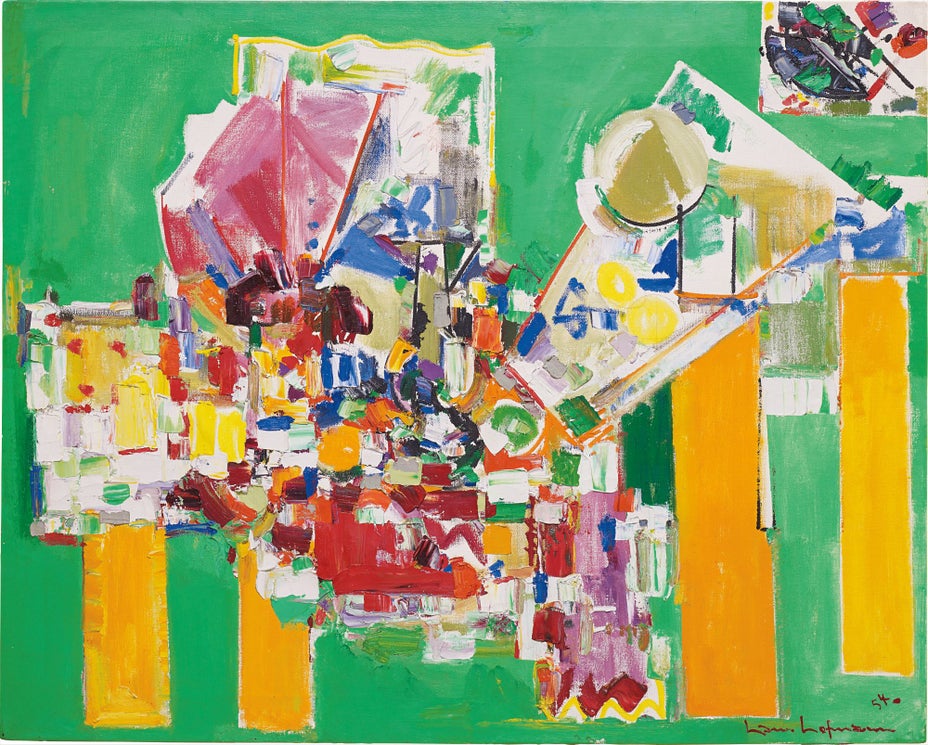
Orchestral Dominance in Green
Estimate
$2,000,000–3,000,000
Sold For
$2,405,000
oil on canvas
48 3/8 x 60 1/8 in. (123.8 x 152.7 cm)
Signed, titled and dated “orchestral dominance in green 1954 Hans Hofmann” on the reverse; further signed and dated "Hans Hofmann 54" lower right.
Full-Cataloguing
"Painters must speak through paint, not through words." Hans Hofmann, 1959
Vibrantly resonant and boldly avant-garde, Hans Hofmann’s Orchestral Dominance in Green from 1954 engages a profound dialogue between color, form and medium, synthesizing Cubist and Expressionist theories in an exquisite symphony of painterly experimentation. Reinterpreting his technique, style and guiding theory with each blank canvas, Hofmann’s artistic practice transcended the physical limits of his picture plane in a spiritual interplay of the perceived world and its pictorial representation. Dating from the zenith of the artist’s prolific career, Orchestral Dominance in Green is a masterful composition - the energetic and enthralling embodiment of Hofmann’s enduring artistic legacy.
Initially a student of science, Hofmann’s artistic education truly began in his early twenties, when he relocated to the artist’s quarters of his native Munich and initiated his study of the fine arts alongside Wassily Kandinsky and the important Slovenian teacher, Anton Ažbe. Concerned in these early days with the formalist elements of form and color, Hofmann devoted himself to these foundational artistic and geometric theories – a sustaining interest that informed and evolved with the artist’s practice. Later studying in Paris with the students of Paul Cézanne and Henri Matisse, Hofmann expanded upon his earlier training, weaving into his aesthetic theory elements of his scientific education, and developing the “push and pull” theory of composition for which he is known. As he explained to his own students in the early 1920s, static elements within the painterly composition could be animated through “…a balanced state of expansion and contraction…a positive produces a negative-a high, a low, a right, a left – a push a pull and vice versa.” (P. Morrin, “The Education of Hans Hofmann,” in Hans Hofmann: Catalogue Raisonné of Paintings, 2014, p. 33)
Indeed, Hofmann’s early teachings and influences owe much to the master Cézanne, whom the artist quoted in his own writings: “In nature you see everything that is in perspective in relation to the cylinder, the sphere, and the cone in such a way that each side-each surface of the object-moves in depth in relation to a central point.” (M. Polednik, “In Search of Equipoise: Hofmann’s Artistic Negotiations, 1940-1958, in Hans Hofmann: Catalogue Raisonné of Paintings, 2014, p. 34) Hofmann’s concern with the two-dimensional plane and its ability to evoke light and movement explicitly reflects the ideology of this early Cubist master. Commenting on the two-dimensional form and its careful execution, Hofmann himself noted, “…the act of creation agitates the picture plane, but if the two-dimensionality is lost, the picture reveals holes and the result is not pictorial, but a naturalistic imitation of nature.” (P. Morrin, “The Education of Hans Hofmann,” in Hans Hofmann: Catalogue Raisonné of Paintings, 2014, p. 33)
Though Hofmann immersed himself in and developed his own theories of abstraction during these early years, he produced few paintings, instead becoming a teacher and moving to the United States, where he became one of the most respected leaders of the New York Abstractionists. It was not until the early 1940s that Hofmann’s artistic genius truly awakened, driving him to enact the theories he had for decades espoused. From his early interactions with the German Expressionists, Post-Impressionists and Cubists, the artist drew upon his technical skill and ideologies, inaugurating a period of robust growth and artistic development. Elaborating upon the “push and pull” dialogue established in Munich, Hofmann’s experimentation with the color, form and compositional balance developed and reinterpreted by various modern masters propagated this artistically transformative period, leading to and culminating in his masterworks – namely, Orchestral Dominance in Green.
Describing his desire to view each canvas afresh, Hofmann noted, “When I start to paint – I want to forget all I know about painting….What I would hate most is to repeat myself over and over again-to develop a false style.” (Polednik p. 34) Embodying an energetic and almost gestural treatment of the picture plane, Orchestral Dominance in Green is a careful yet passionately rendered expression of color and form, contrasting Hofmann’s reliance upon the shifting geometric forms of Cubism with the vigorous, impastoed brushstrokes of the Fauves, resulting in a rhythmic interplay of geometric tension and chromatic harmony. Noting the importance of Orchestral Dominance in Green both in the context of Hofmann’s oeuvre and the history of Abstract Expressionism, Polednik asserts, “Hofmann’s continual deployment of Cubism as a set of tools for pictorial reinvention is nowhere more apparent than in Orchestral Dominance in Green – a work that shows both the artist’s allegiance to the most canonical elements of the movement as well as decisively signaling his redeployment of its practice.” (IBID, p. 38)
Exhibiting an almost architectural use of form, Orchestral Dominance in Green transcends the physical representation of reality, grounded by four thick, golden blocks of color, reminiscent of Pablo Picasso’s early Cubist tabletops, such as Still Life, 1912, in the Museo Nacional Centro de Arte Reina Sofia, Madrid. Upon this geometric “table top,” Hofmann further stabilizes this perceived reality with his foundational spherical and rectangular forms, rendered sparingly, allowing the absence of color to intimate the desired projection. Speaking to this spatial tension, the artist elucidated, in his essay “Plastic Creation,” “Space is imbued with movement; space vibrates and resounds and with it vibrates form to the rhythm of life.” (in Hans Hofmann, ed. Sam Hunter, 1963, p. 38) In Orchestral Dominance in Green, the vibrating harmony of tertiary color radiates from the canvas – a simultaneously fervent yet thoughtful treatment of spirited, colorful movement.
Hofmann’s other Orchestral Dominance works – one in yellow and one in red – provide useful points of comparison to the present work. These works, all produced in 1954 and of the same scale, illustrate the broad range of Hofmann’s artistic experimentation, as well his ability to reinterpret the foundational forms of the Cubists and Abstract Expressionists. Orchestral Dominance in Yellow, in the permanent collection of the Whitney Museum of American Art, intimates Hofmann’s gestural, earnest approach to the brushstroke, and its ability to transform his composition - a form as essential to the dynamism of the picture as its “dominant” golden ground. Tracing the creation of Orchestral Dominance in Red, Orchestral Dominance in Yellow, and, finally, Orchestral Dominance in Green, Hofmann’s treatment of his compositions suggests a growing embrace of his Cubist mentors. While Hofmann explored in these canvases color’s power to harmonize seemingly disparate elements, Orchestral Dominance in Green, more than that in red or yellow, marks a seminal passage in Hofmann’s career, marrying undulating linearity with geometric form and bold declarations of color in an orchestral crescendo of artistic experimentation.
Orchestral Dominance in Green generates a sensory rhythm unrivalled by Hofmann’s contemporaries. Balancing chromatic volumes and abstract form with negative space in a lyrical liveliness of surface, Hofmann challenges, in this masterpiece, the adherence to and training of the modern artist in any one school of thought. It is perhaps this depth of theoretical dialogue and artistic practice that attracted the New York School artists such as Jackson Pollock and Helen Frankenthaler to his teachings, and resulted in the endurance of Hofmann’s legacy as one of the most important artists of the 20th Century. In the words of the noted critic, Clement Greenberg, “[Hofmann] could be said to take the easel tradition into regions of chromatic experience it never before penetrated. In these regions he preserves the easel picture's identity by showing how oppositions of pure color can by themselves, and without help of references to nature, establish a pictorial order as firm as any that depends on conspicuousness of contour and value contrast.” (Paris: Editions Georges Fall, 1961)
The compositional tension between blocks of vibrant color and their non-objective representation present in Hofmann’s works from his creative zenith in the mid-1950s can be summated in the artist’s declaration that “…form exists only through color and color only exists through form.” (Polednik p. 39) The energy and light brought forth from the canvas – most essentially in Orchestral Dominance in Green – perfectly illustrates Hofmann’s mastery of the transposition of reality to the spiritual, captured in abstract two-dimensional form. Thickly layered brushstrokes dynamically applied to the canvas enhance, rather than detract from, the artist’s utilization of Kandinsky-like sphere and line – the confluence of Hofmann’s both pedagogic and emotive approach to painting.
Indeed, Hofmann’s titular homage to the symphonic blend of art historical theory and experimental practice in Orchestral Dominance in Green represents a profound realization of the artist’s most personal vision. Writing in his later teachings that, “In nature light creates the color; in the picture, color creates light,” Hofmann expounded upon the theories of his artistic predecessors, noting the burden of the artist to utilize color in a careful and balanced manner – the artist as visual mediator of the spiritual painterly experience. (K. Wilkin, “Hans Hofmann: Tradition and Invention,” in Hans Hofmann: Catalogue Raisonné of Paintings, 2014, p. 47) In no other work of the artist’s multifaceted career does the rhythm of form, color, and compositional tension intimate such lively and enlightened presence as in Orchestral Dominance in Green, where Hofmann’s role as mediator elevated the canvas to pure visual rhapsody.