37
Hans J. Wegner
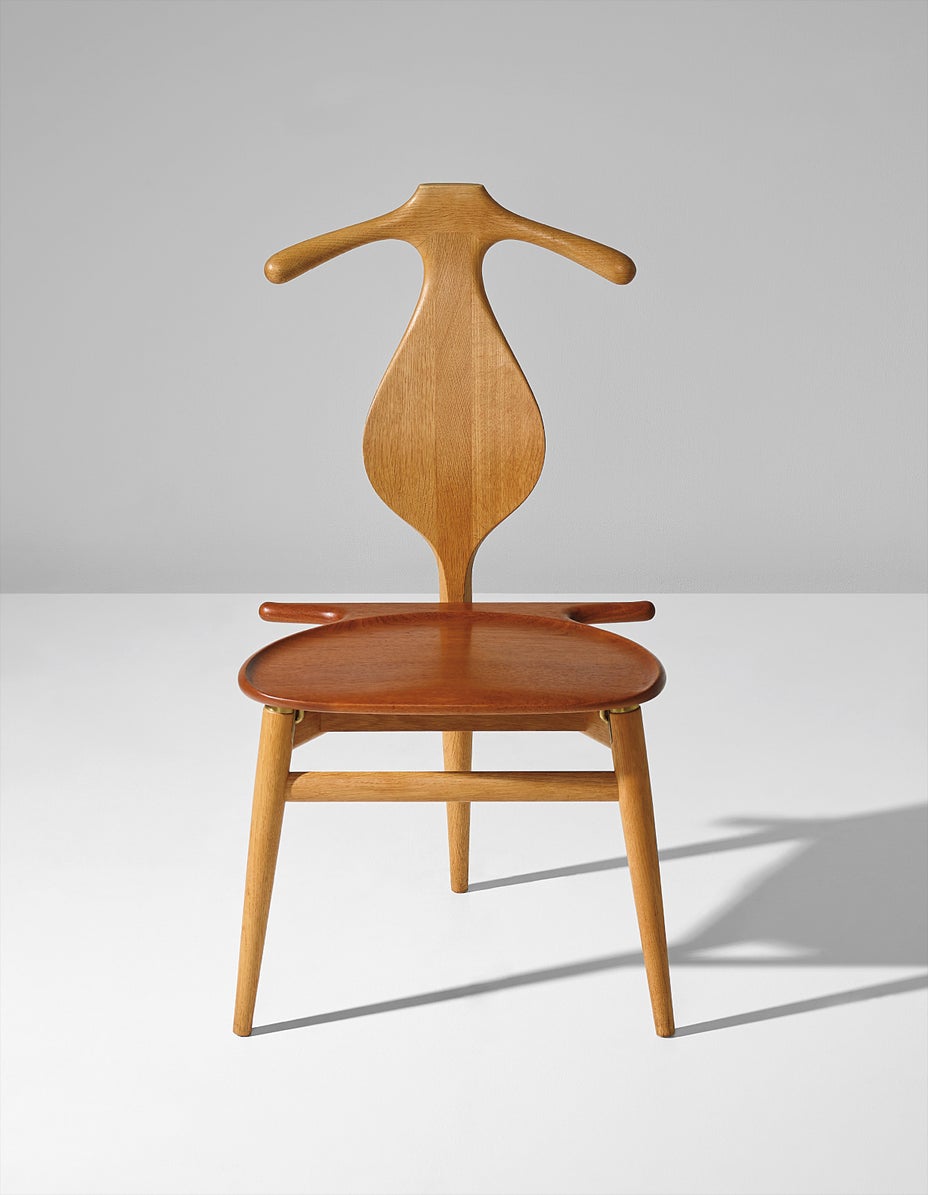
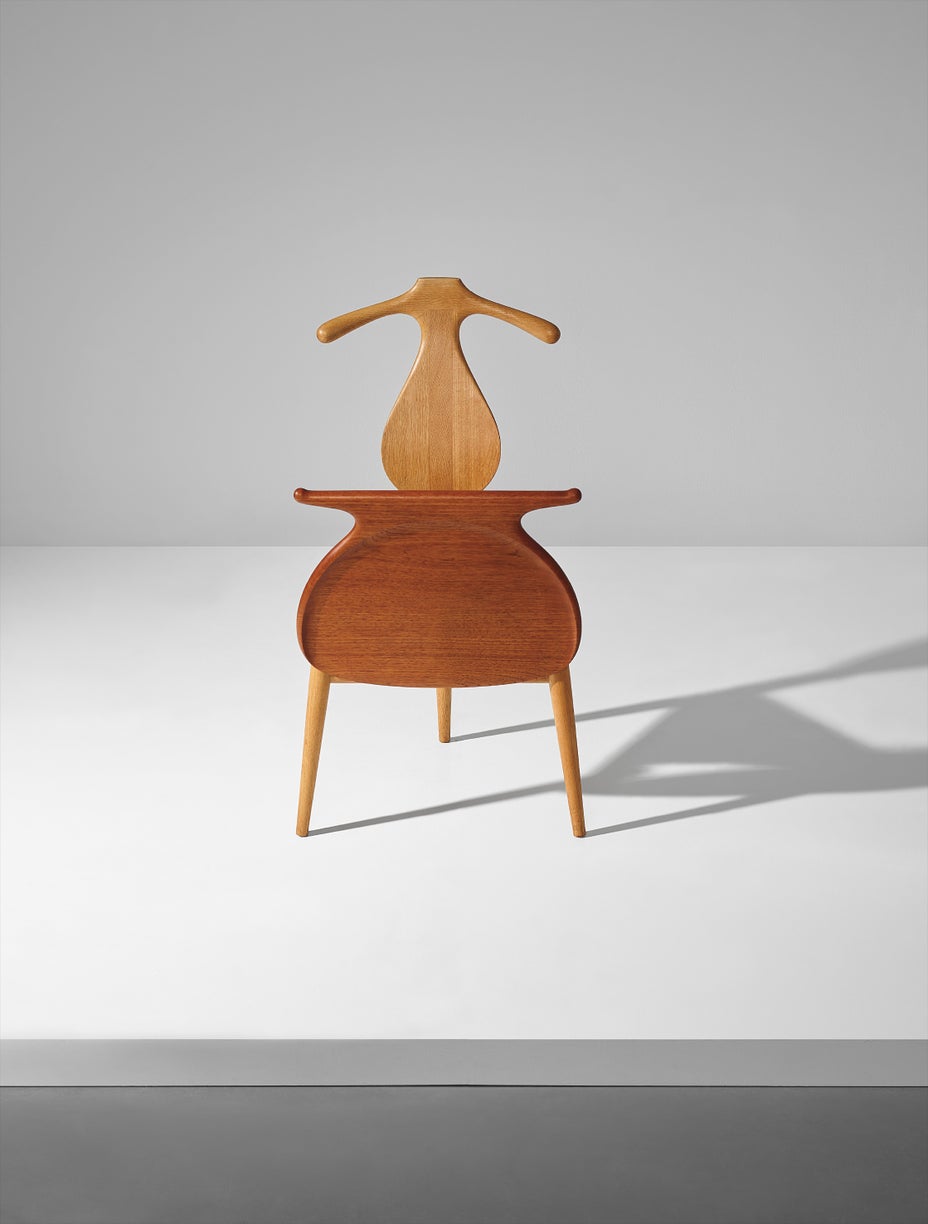
‘Valet’ chair, model no. JH540
Estimate
HK$60,000–80,000
€6,500–8,600
$7,700–10,300
Sold For
HK$106,250
teak, oak, brass, leather
94.5 x 50 x 50 cm. (37 1/4 x 19 5/8 x 19 5/8 in.)
Executed by master cabinetmaker Johannes Hansen, Copenhagen, Denmark. Underside branded with manufacturer’s mark and JOHANNES HANSEN/COPENHAGEN/DENMARK. Designed in 1953.
Full-Cataloguing
Designed by architect Hans J. Wegner in 1953, the organic form of the present lot playfully synthesises multiple functions. Reflecting the inspiration behind its name, the innovative chair is simply transformed into a stand to rest items of clothing, whilst revealing a box to store small personal belongings. As Wegner explained, ‘the chair is the piece of furniture that is closest to human beings. You can give it the personal touch’. One account of the chair’s origins describe a conversation between Wegner, architecture professor Steen Eiler Rasmussen, and silversmith and designer Kay Bojesen discussing the trouble of storing one’s suit whilst they slept.
Handcrafted by master cabinetmaker Johannes Hansen, the ‘Valet’ chair’s sculptural form is equally constructive as it is aesthetic. Whilst illustrating the expressive possibilities of the material, the chair’s organic form, which fully integrates the curved back support, demonstrates a pragmatism and ‘insistence of usefulness’ inherent to twentieth-century Danish design. The curved form and integrated construction of the chair’s back support reflects Wegner’s study of Chinese chairs dating to the eighteenth and nineteenth-centuries, an example of which the Designmuseum Denmark had acquired in 1937.
In 1951, Wegner presented his first version of the ‘Valet’ chair with four legs at the Spring Exhibition of the School of Arts and Crafts. Upon seeing this early version, King Frederick IX of Denmark immediately placed an order for the chair. However, dissatisfied with the design, Wegner reworked his initial version to create the present three-legged model, of which King Frederick acquired ten for his collection.
Handcrafted by master cabinetmaker Johannes Hansen, the ‘Valet’ chair’s sculptural form is equally constructive as it is aesthetic. Whilst illustrating the expressive possibilities of the material, the chair’s organic form, which fully integrates the curved back support, demonstrates a pragmatism and ‘insistence of usefulness’ inherent to twentieth-century Danish design. The curved form and integrated construction of the chair’s back support reflects Wegner’s study of Chinese chairs dating to the eighteenth and nineteenth-centuries, an example of which the Designmuseum Denmark had acquired in 1937.
In 1951, Wegner presented his first version of the ‘Valet’ chair with four legs at the Spring Exhibition of the School of Arts and Crafts. Upon seeing this early version, King Frederick IX of Denmark immediately placed an order for the chair. However, dissatisfied with the design, Wegner reworked his initial version to create the present three-legged model, of which King Frederick acquired ten for his collection.