7
Henri Cartier-Bresson
Barcelona
Full-Cataloguing
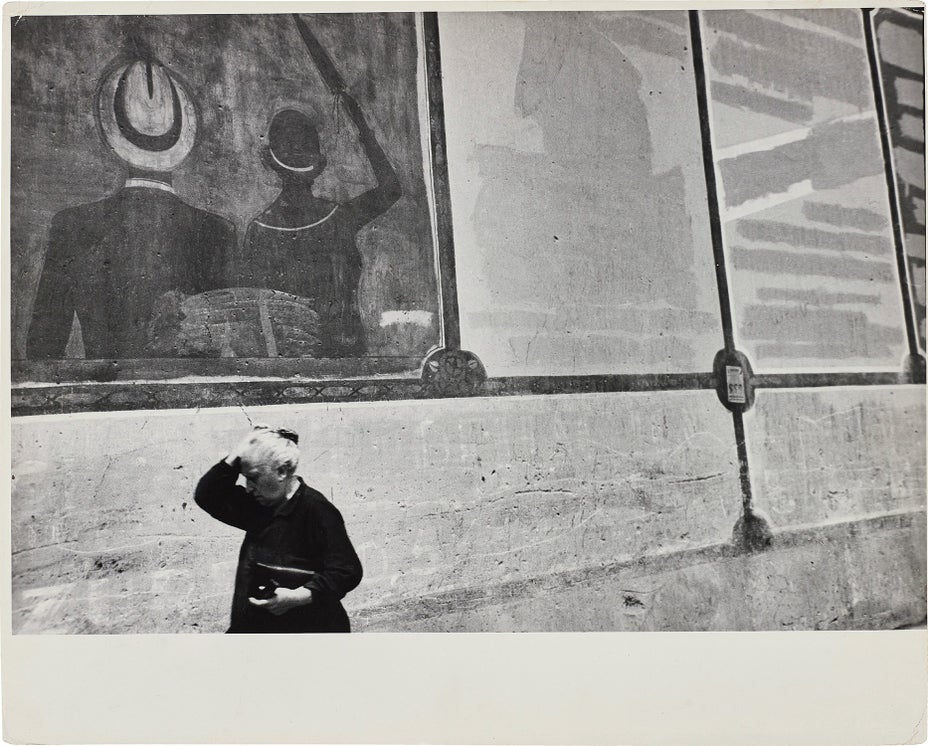
In the work offered here, we see a wall with painted lines creating a grid of geometric shapes and a mural depicting a man and a woman. Placed directly beneath it is a passing woman whose raised right arm echoes that of the painted woman. This photograph taken in Barcelona bears the Surrealistic hallmarks of Cartier-Bresson’s earlier work before World War II. The juxtaposition of the painted woman and the real one is heightened by his choice of framing and oblique angles. His flattened picture plane gives the impression that the passing figure has become a part of the painted wall. Cartier-Bresson’s process of first selecting a graphically interesting background then waiting for something striking to move into the frame is evident in this image.
The combination of rigorous composition and significant content was what he would later coin the ‘decisive moment’, a term borrowed from Cardinal de Retz, a 17th century French priest. The Surrealists regarded composition and chance as a duality, and for Cartier-Bresson, the appeal of Surrealism was located in this openness to chance: ‘It is to Surrealism that I owe my allegiance and because it taught me to let the camera lens delve into the detritus of the unconscious and chance.’
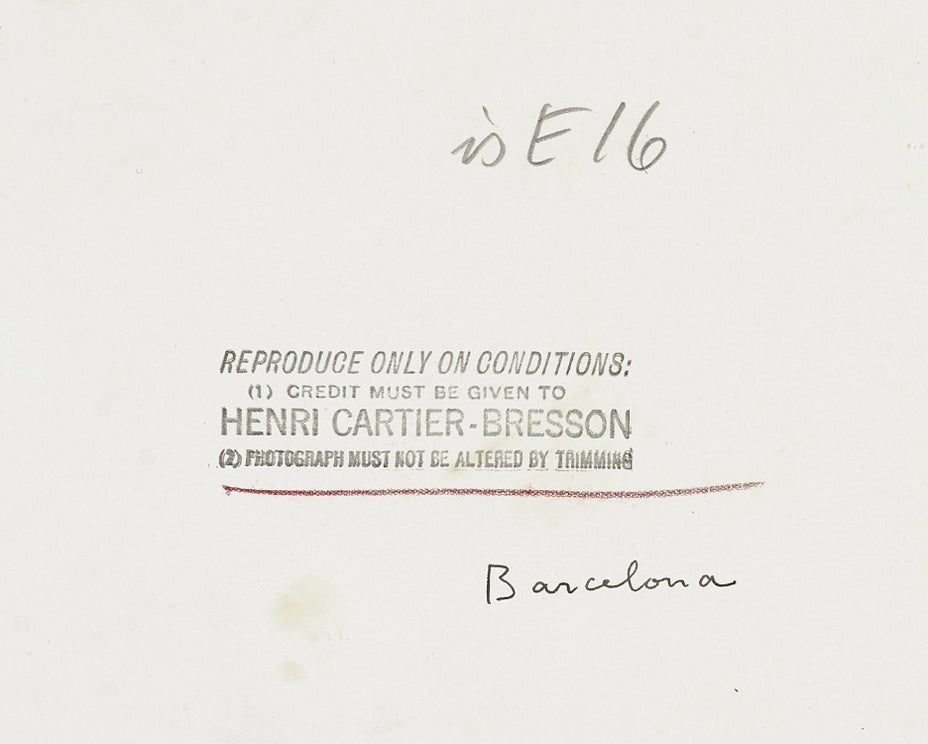
The present lot is a glossy ferrotyped print and was printed in New York at David (Chim) Seymour’s lab in 1946 or 1947 while Cartier-Bresson was preparing for his 1947 Museum of Modern Art exhibition The Photographs of Henri Cartier-Bresson in which another print of this image was exhibited. As of this writing, only five early prints of this image, printed in 1946-47, are known.
Phillips Photographs extend our sincere thanks to Aude Raimbault at the Fondation Henri Cartier-Bresson for her assistance in our research.
Henri Cartier-Bresson
French | B. 1908 D. 2004Candidly capturing fleeting moments of beauty among the seemingly ordinary happenings of daily life, Henri Cartier-Bresson's work is intuitive and observational. Initially influenced by the Surrealists' "aimless walks of discovery," he began shooting on his Leica while traveling through Europe in 1932, revealing the hidden drama and idiosyncrasy in the everyday and mundane. The hand-held Leica allowed him ease of movement while attracting minimal notice as he wandered in foreign lands, taking images that matched his bohemian spontaneity with his painterly sense of composition.
Cartier-Bresson did not plan or arrange his photographs. His practice was to release the shutter at the moment his instincts told him the scene before him was in perfect balance. This he later famously titled "the decisive moment" — a concept that would influence photographers throughout the twentieth century.