192
Henry Moore
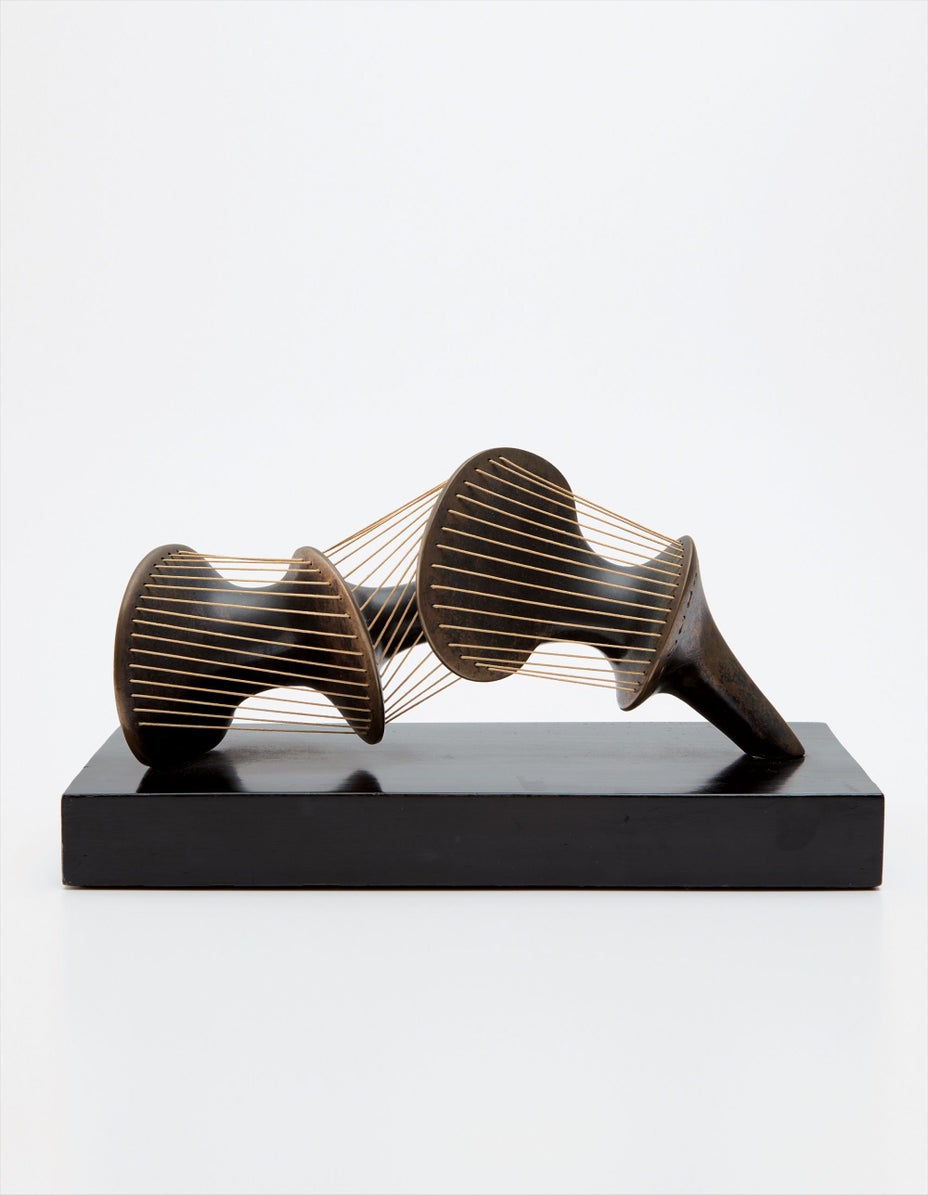
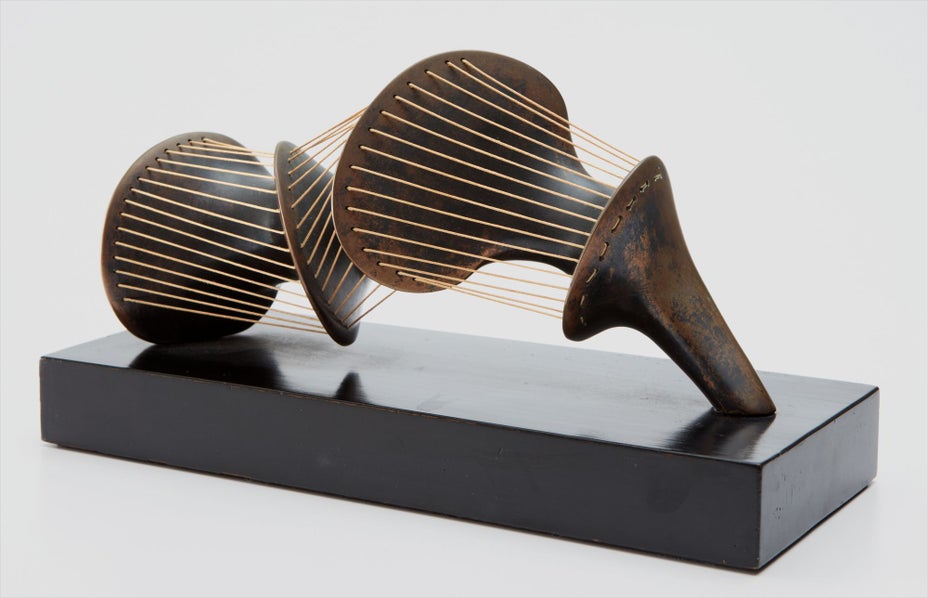
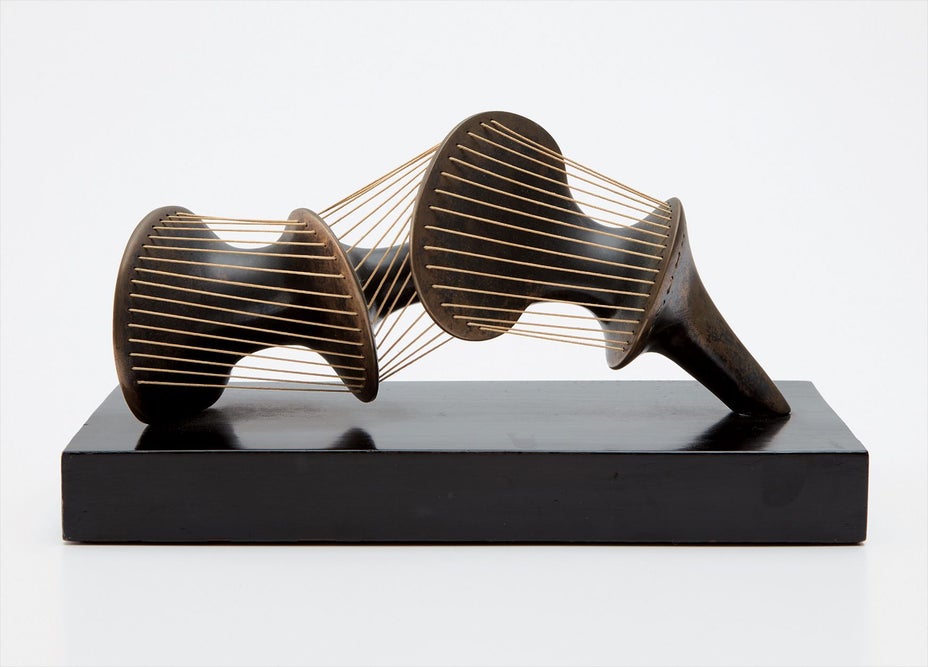
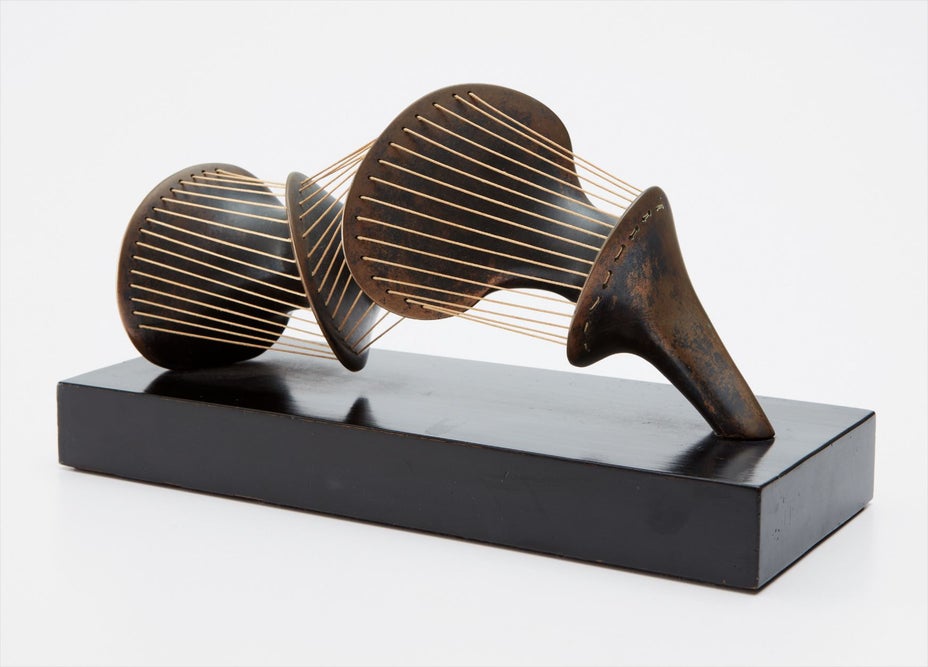
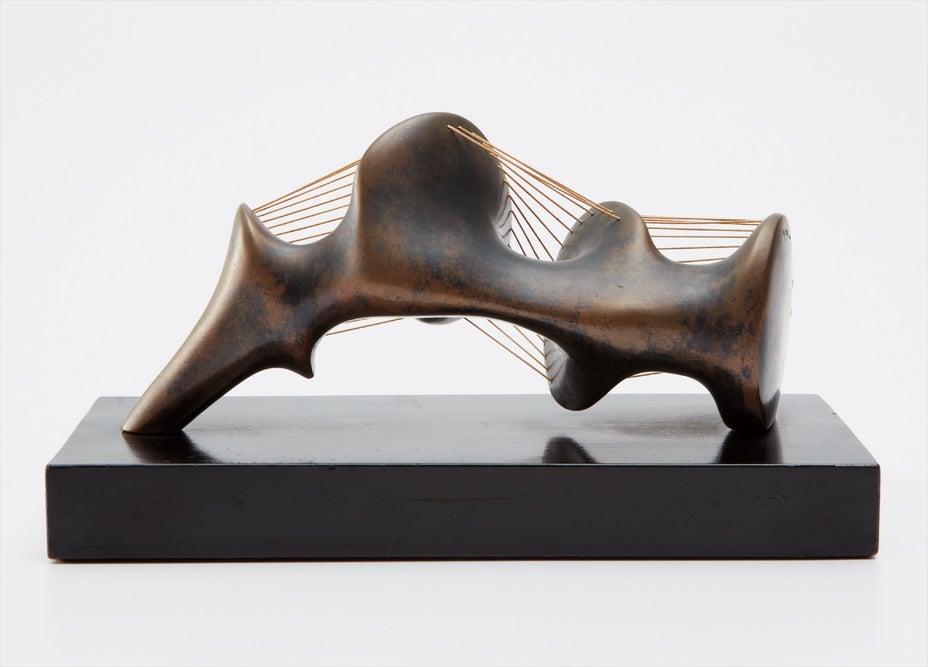
Stringed Figure
Estimate
$150,000–200,000
Sold For
$312,500
bronze with brown patina and string
sculpture 4 3/8 x 10 1/4 x 3 in. (11.1 x 26 x 7.6 cm.)
base 1 3/8 x 11 1/2 x 4 5/8 in. (3.5 x 29.2 x 11.7 cm.)
overall 5 3/4 x 11 1/2 x 4 5/8 in. (14.6 x 29.2 x 11.7 cm.)
base 1 3/8 x 11 1/2 x 4 5/8 in. (3.5 x 29.2 x 11.7 cm.)
overall 5 3/4 x 11 1/2 x 4 5/8 in. (14.6 x 29.2 x 11.7 cm.)
Conceived in 1939, this work is from an edition of 9 plus 1 artist's proof.
This work is recorded in the archives of the Henry Moore Foundation.
This work is recorded in the archives of the Henry Moore Foundation.
Full-Cataloguing
Conceived between the years of 1937 and 1940, Henry Moore’s remarkable stringed figures are among the most abstract works in his oeuvre and demonstrate a bond with the contemporaneous movements of surrealism and constructivism. Moore recalled: "Undoubtedly the source of my stringed figures was the Science Museum… I was fascinated by the mathematical models I saw there, which had been made to illustrate the difference of form that is halfway between a square and a circle… It wasn’t the scientific study of these models but the ability to look through the strings as with a bird cage and to see one form within another which excited me” (The Artist, quoted in Henry Moore: Sculptures, Drawings, Graphics 1921-1981, exh. cat., The British Council, Madrid, 1981, p. 81).
These mathematical models became widely known in European artistic circles when similar models from the Poincaré Institute were included in the Galerie Ratton’s exhibition of surrealist objects, Exposition surréaliste d’objets, in Paris in May 1936. Photographs of these models by Man Ray that highlight their architectural and sculptural characteristics through use of extreme shadow were published in the art journal Cahiers d’Art that same year, displaying them as found surrealist objects. Beyond these likely influences, formal affinities are also evident between Moore’s stringed figures and the contemporaneous works of Barbara Hepworth and Russian émigré Naum Gabo. Moore and Hepworth were neighbors in Hampstead, London in the 1930s prior to the outbreak of World War II, and exchanges between Moore, Hepworth and Gabo (who collaborated with Hepworth’s husband, Ben Nicholson on the 1937 publication Circle: International Survey of Constructive Art) certainly impacted their individual use of strings.
Combining Moore’s interest in the surrealist transformation of found objects and the linearity of constructivism, the taut elastic strings threaded across the curvilinear bronze form of Stringed Figure highlight the interconnectedness of its elements to each other and to the negative space. In the exhibition catalogue for Moore’s 1968 show at the Tate Gallery, London, David Sylvester described: “Movement of the eye along the length of the strings sharpens awareness of the space the sculpture encloses, especially when one set of strings can be seen through another, so that a counterpoint of movement is created which quickens the vibration of the space” (David Sylvester, Henry Moore, exh. cat., Tate Gallery, London, 1968, p. 105). Reflecting the artist’s endless inventiveness in his career-long exploration of organic form, the stringed figures held a particular interest for Moore and he in fact returned to these works in the 1960s when he cast many of his earlier designs.
These mathematical models became widely known in European artistic circles when similar models from the Poincaré Institute were included in the Galerie Ratton’s exhibition of surrealist objects, Exposition surréaliste d’objets, in Paris in May 1936. Photographs of these models by Man Ray that highlight their architectural and sculptural characteristics through use of extreme shadow were published in the art journal Cahiers d’Art that same year, displaying them as found surrealist objects. Beyond these likely influences, formal affinities are also evident between Moore’s stringed figures and the contemporaneous works of Barbara Hepworth and Russian émigré Naum Gabo. Moore and Hepworth were neighbors in Hampstead, London in the 1930s prior to the outbreak of World War II, and exchanges between Moore, Hepworth and Gabo (who collaborated with Hepworth’s husband, Ben Nicholson on the 1937 publication Circle: International Survey of Constructive Art) certainly impacted their individual use of strings.
Combining Moore’s interest in the surrealist transformation of found objects and the linearity of constructivism, the taut elastic strings threaded across the curvilinear bronze form of Stringed Figure highlight the interconnectedness of its elements to each other and to the negative space. In the exhibition catalogue for Moore’s 1968 show at the Tate Gallery, London, David Sylvester described: “Movement of the eye along the length of the strings sharpens awareness of the space the sculpture encloses, especially when one set of strings can be seen through another, so that a counterpoint of movement is created which quickens the vibration of the space” (David Sylvester, Henry Moore, exh. cat., Tate Gallery, London, 1968, p. 105). Reflecting the artist’s endless inventiveness in his career-long exploration of organic form, the stringed figures held a particular interest for Moore and he in fact returned to these works in the 1960s when he cast many of his earlier designs.