The Modern Form: Property from the Collection of Betty and Stanley Sheinbaum
2Ο︎
Henry Moore
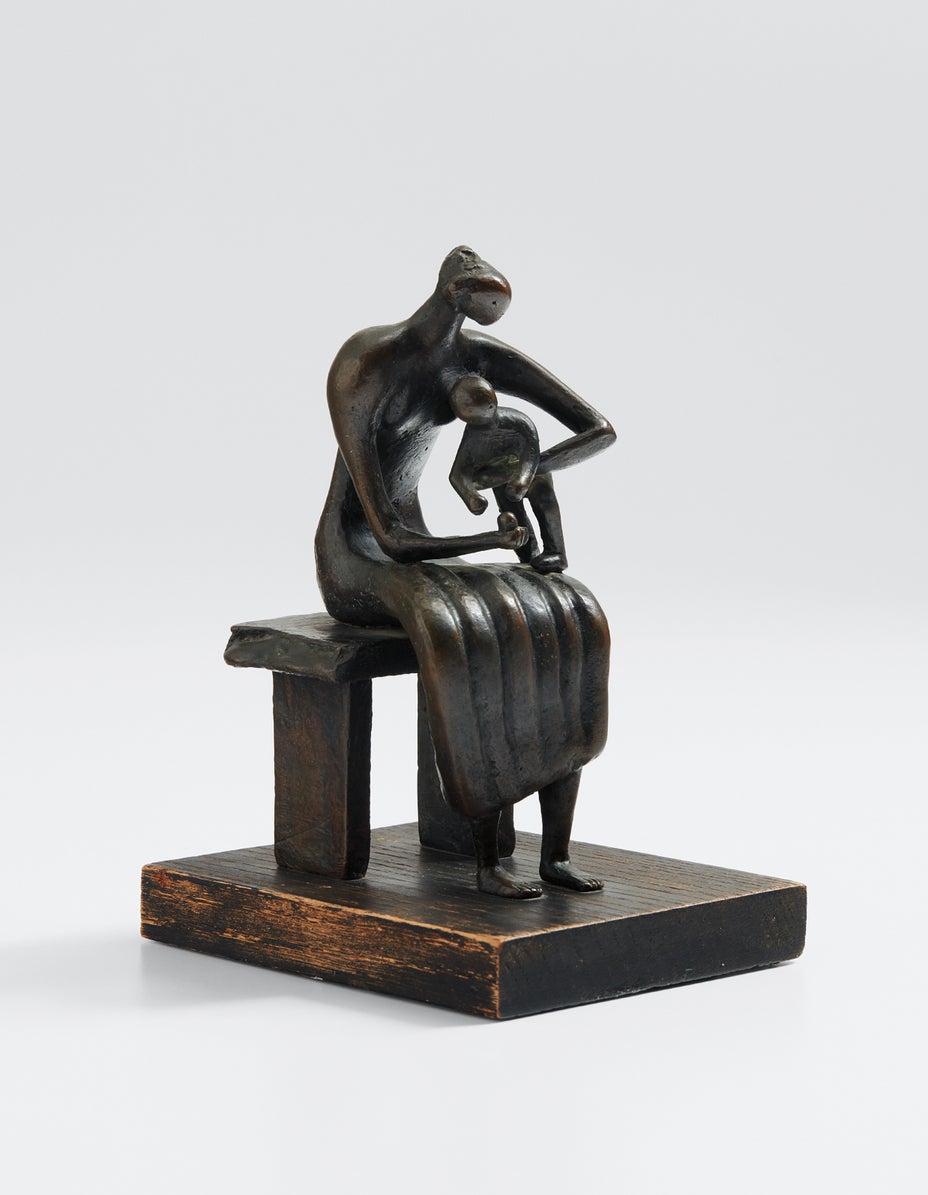
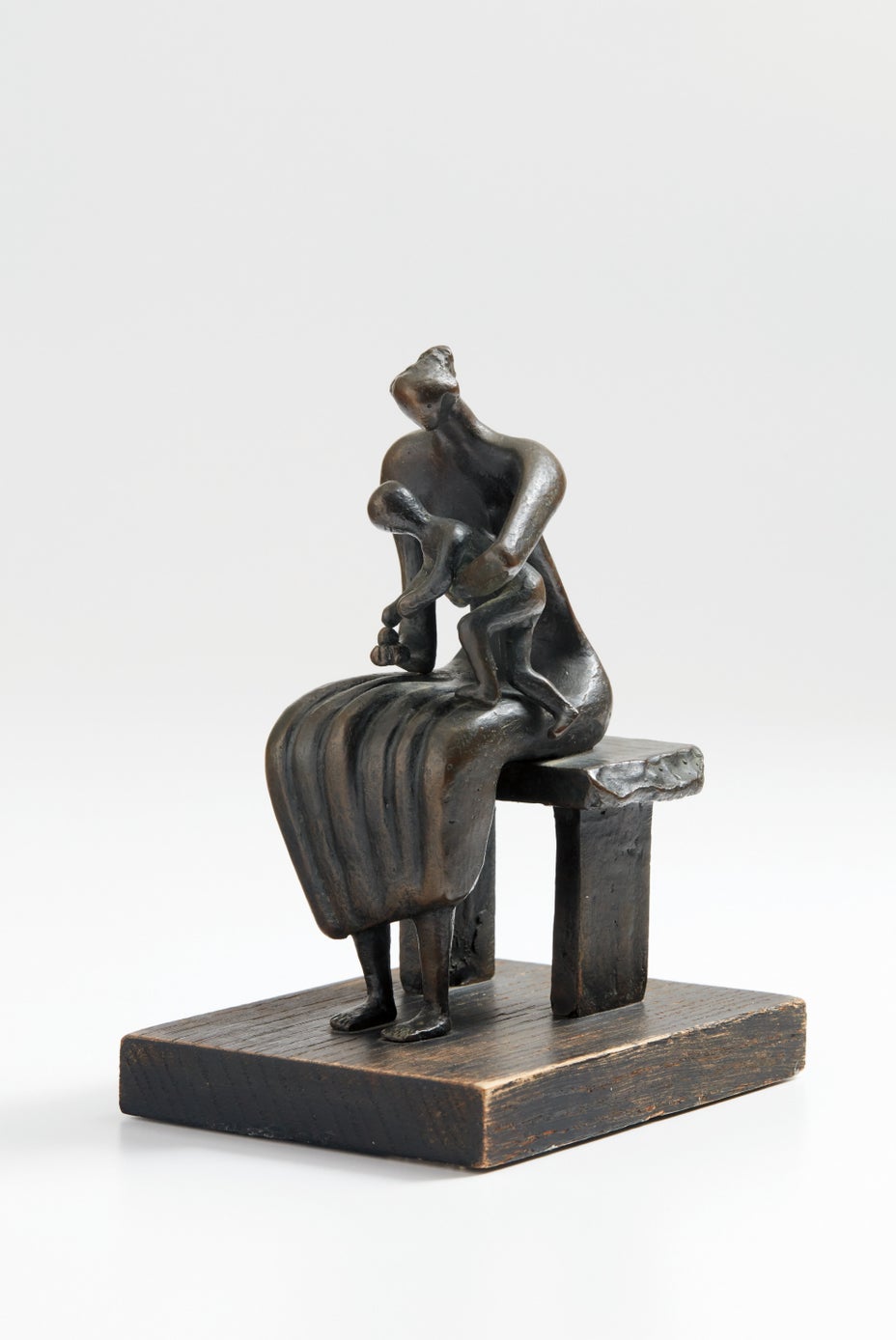
Maquette for Mother and Child with Apple
Estimate
$400,000–600,000
Sold For
$591,000
bronze with reddish brown patina, on wood base
sculpture 7 x 3 1/2 x 4 in. (17.8 x 8.9 x 10.2 cm.)
base 3/4 x 4 1/2 x 5 1/2 in. (1.9 x 11.4 x 14 cm.)
overall 7 3/4 x 4 1/2 x 5 1/2 in. (19.7 x 11.4 x 14 cm.)
base 3/4 x 4 1/2 x 5 1/2 in. (1.9 x 11.4 x 14 cm.)
overall 7 3/4 x 4 1/2 x 5 1/2 in. (19.7 x 11.4 x 14 cm.)
Conceived in 1956, this work is from an edition of 9 plus 1 artist's proof. This work is recorded in the archives of the Henry Moore Foundation.
Full-Cataloguing
Conceived in 1956 as a model for Henry Moore’s famed large-scale sculpture Mother and Child with Apple, the present maquette puts forward one of the most iconic and highly sought after motifs in the British sculptor’s oeuvre. Epitomizing the artist's masterful approach to the sculptural depiction of the human figure, Maquette for Mother and Child with Apple depicts a tender portrait of a mother supporting an infant in her lap – its arms reaching out towards the apple she holds in her hand. Cast in bronze and patinated by Moore himself, this intimate work demonstrates the intrinsic quality of immediacy with which Moore formed the figure in clay with his own hands as a way of working through ideas for his more monumental sculptures. A deeply personal and universal meditation on the bond between a mother and child, this exquisite work was acquired by Betty and Stanley Sheinbaum from the great British art dealer Eric Estorick of the Grosvenor Gallery in London. Distinguished by this exceptional provenance, Maquette for Mother and Child with Apple was notably also showcased in the Los Angeles County Museum of Art’s landmark Moore exhibition in 1973 and in the seminal traveling Mother and Child exhibition at the Baltimore Museum of Art from 1987, amongst others.
The symbol-laden subject matter of a mother and child, together with that of the reclining figure, occupied Moore throughout his over six-decade long career – giving rise to some of his very first sculptures in the early 1920s. As he explained, “From very early on I have had an obsession with the Mother and Child theme. It has been a universal theme from the beginning of time and some of the earliest sculptures we’ve found from the Neolithic Age are of a Mother and Child…So that I was conditioned, as it were, to see it in everything. I suppose it could be explained as a 'Mother complex’” (Henry Moore, quoted in My Ideas, Inspiration and Life as an Artist, London, 1986, p. 155). The semi-abstract sculptural form of Maquette for Mother and Child with Apple specifically builds on Moore’s seminal Mother and Child commission for the Church of St. Matthew in Northampton in 1943-1944. While evoking the iconographic Virgin and Child tradition, Mother and Child with Apple and its related maquette articulates Moore’s emphasis on the mother’s nurturing role – a response to the human suffering of the Second World War, but also to the birth of Moore’s only child, Mary, in 1946. Though Moore acknowledged the grand iconographic and religious tradition within which was working with, the subject also provided him with a platform for his pioneering experiments in space and form. As he indeed noted, ”The subject itself is eternal and unending, with so many sculptural possibilities in it – a small form in relation to a big form, the big form protecting the small one, and so on. It is such a rich subject, both humanly and compositionally, that I will always go on using it” (Henry Moore, 1979, quoted in Alan Wilkinson, Henry Moore: Writings and Conversations, Berkeley, 2002, p. 213).
In its organic, highly abstracted form – appearing almost as a rock polished by wind and water – Maquette for Mother and Child with Apple offers a more universal formal exploration. Indeed, as curator Gail Gelburd concluded, "Mother and child motif goes beyond the image to a primal motif based on the theme of life and birth, for Moore it means creativity. The art is reminiscent of some of the earliest primitive images due to its conceptual base. Moore's work is an attempt to get at the essential nature and to shape it from within.... He breathes life and vitality into the inanimate object. The mother and child sculptures are not only a symbol of maternity but of creativity itself” (Gail Gelburd, Mother and Child: The Art of Henry Moore, exh. cat., Hofstra Museum, New York, 1987, p. 27).
The symbol-laden subject matter of a mother and child, together with that of the reclining figure, occupied Moore throughout his over six-decade long career – giving rise to some of his very first sculptures in the early 1920s. As he explained, “From very early on I have had an obsession with the Mother and Child theme. It has been a universal theme from the beginning of time and some of the earliest sculptures we’ve found from the Neolithic Age are of a Mother and Child…So that I was conditioned, as it were, to see it in everything. I suppose it could be explained as a 'Mother complex’” (Henry Moore, quoted in My Ideas, Inspiration and Life as an Artist, London, 1986, p. 155). The semi-abstract sculptural form of Maquette for Mother and Child with Apple specifically builds on Moore’s seminal Mother and Child commission for the Church of St. Matthew in Northampton in 1943-1944. While evoking the iconographic Virgin and Child tradition, Mother and Child with Apple and its related maquette articulates Moore’s emphasis on the mother’s nurturing role – a response to the human suffering of the Second World War, but also to the birth of Moore’s only child, Mary, in 1946. Though Moore acknowledged the grand iconographic and religious tradition within which was working with, the subject also provided him with a platform for his pioneering experiments in space and form. As he indeed noted, ”The subject itself is eternal and unending, with so many sculptural possibilities in it – a small form in relation to a big form, the big form protecting the small one, and so on. It is such a rich subject, both humanly and compositionally, that I will always go on using it” (Henry Moore, 1979, quoted in Alan Wilkinson, Henry Moore: Writings and Conversations, Berkeley, 2002, p. 213).
In its organic, highly abstracted form – appearing almost as a rock polished by wind and water – Maquette for Mother and Child with Apple offers a more universal formal exploration. Indeed, as curator Gail Gelburd concluded, "Mother and child motif goes beyond the image to a primal motif based on the theme of life and birth, for Moore it means creativity. The art is reminiscent of some of the earliest primitive images due to its conceptual base. Moore's work is an attempt to get at the essential nature and to shape it from within.... He breathes life and vitality into the inanimate object. The mother and child sculptures are not only a symbol of maternity but of creativity itself” (Gail Gelburd, Mother and Child: The Art of Henry Moore, exh. cat., Hofstra Museum, New York, 1987, p. 27).