The Modern Form: Property from the Collection of Betty and Stanley Sheinbaum
107Ο︎
Henry Moore
Family Group
Estimate
$400,000–600,000
Sold For
$447,000
bronze with brown patina, on wood base
sculpture 5 3/4 x 4 1/4 x 3 in. (14.6 x 10.8 x 7.6 cm.)
base 3/4 x 5 x 3 3/4 in. (1.9 x 12.7 x 9.5 cm.)
overall 6 1/2 x 5 x 3 3/4 in. (16.5 x 12.7 x 9.5 cm.)
base 3/4 x 5 x 3 3/4 in. (1.9 x 12.7 x 9.5 cm.)
overall 6 1/2 x 5 x 3 3/4 in. (16.5 x 12.7 x 9.5 cm.)
Executed circa 1945, this work is from an edition of 9 plus 1 artist's proof.
This work is recorded in the archives of the Henry Moore Foundation.
This work is recorded in the archives of the Henry Moore Foundation.
Full-Cataloguing
Betty Sheinbaum started her remarkable collection with maquettes by modern master Henry Moore, whose trailblazing work she had discovered nearly twenty years earlier on a trip to England as a young woman. By the time she acquired the following works in 1959-1960 from the great British dealer Eric Estorick, who founded the Grosvenor Gallery in London, Moore’s reputation was growing, but he was still very much a radical contemporary artist. The following selection of bronzes demonstrates important themes in the artist’s oeuvre and a number influences on his signature exploration of figural forms.
Executed in the early to mid-1950s, Maquette for Draped Reclining Woman and Maquette for Warrior without Shield are delightful examples of Moore’s dedication to the human form and his life-long interest in nature. Moore began exploring the subject of the reclining figure at the beginning of his career in the 1920s, and the pose became the artist’s most frequently recurring subject. In Maquette for Draped Reclining Woman, this archetypal pose is articulated with a graceful study of the female figure with expressive drapery emphasizing the form of her legs, likely influenced by the artist’s recent trip to Greece in 1951. Moore’s continued inspiration from nature is evident in Maquette for Warrior without Shield, the idea for which evolved from a pebble he found on the seashore in 1952. Reflecting on the inception of his group of Warrior sculptures, Moore recalled: “Just as Leonardo says somewhere in his notebooks that a painter can find a battle scene in the lichen marks on a wall, so this gave me the start of The Warrior idea. First I added the body, leg and one arm and it became a wounded warrior... A day or two later I added a shield and altered its position and arrangement into a seated figure and so it changed from an inactive pose into a figure which, though wounded, is still defiant” (Henry Moore, quoted in Philip James, ed., Henry Moore on Sculpture: a collection of the sculptor's writings and spoken words, London, 1966, p. 250).
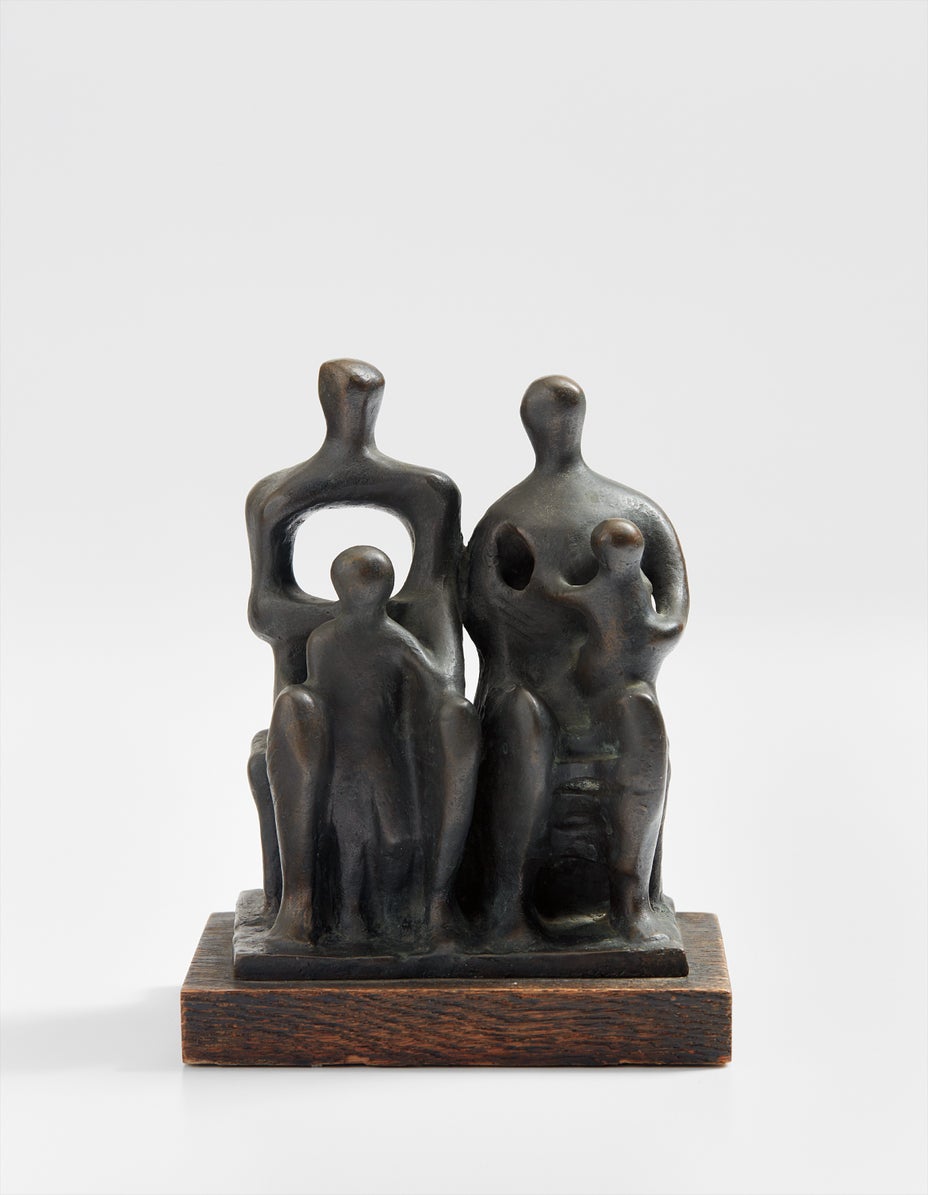
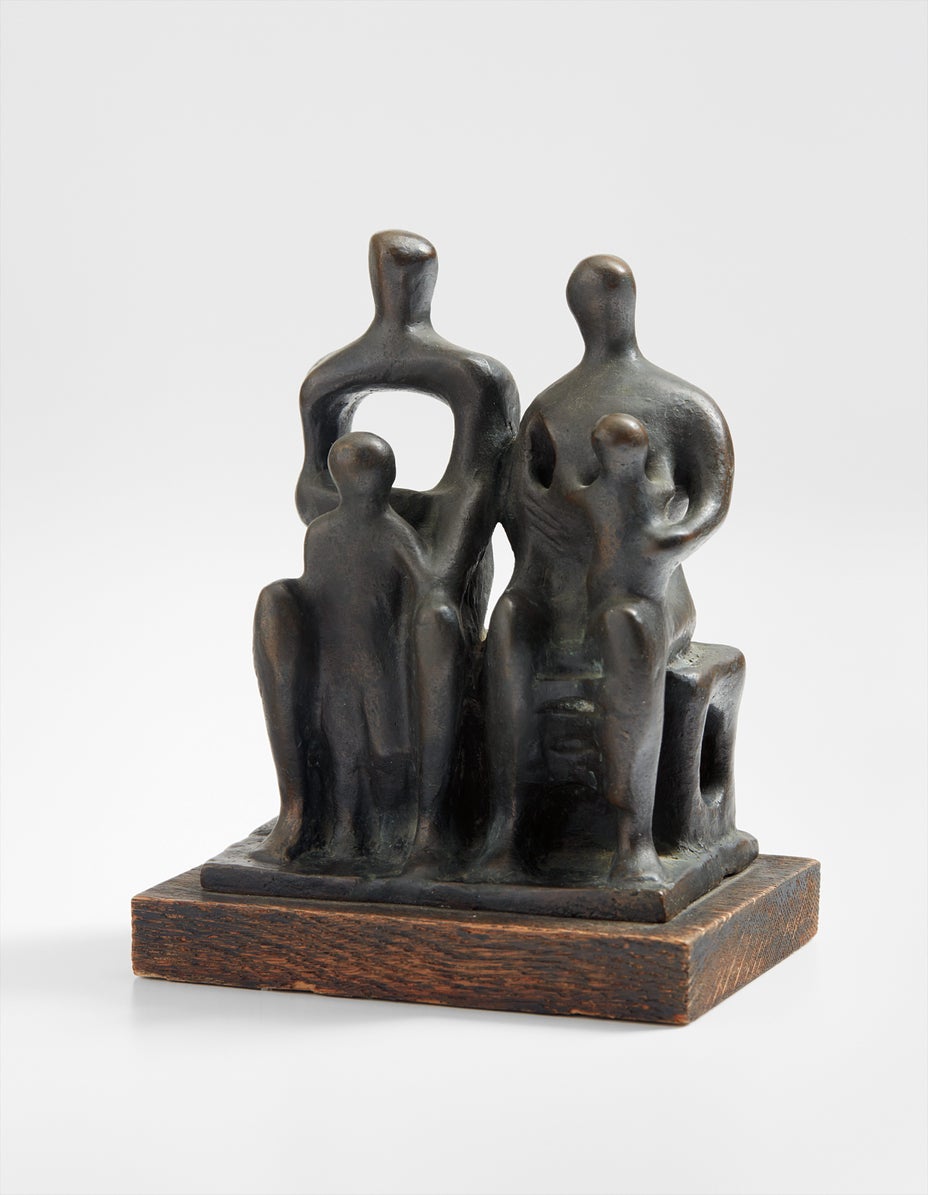
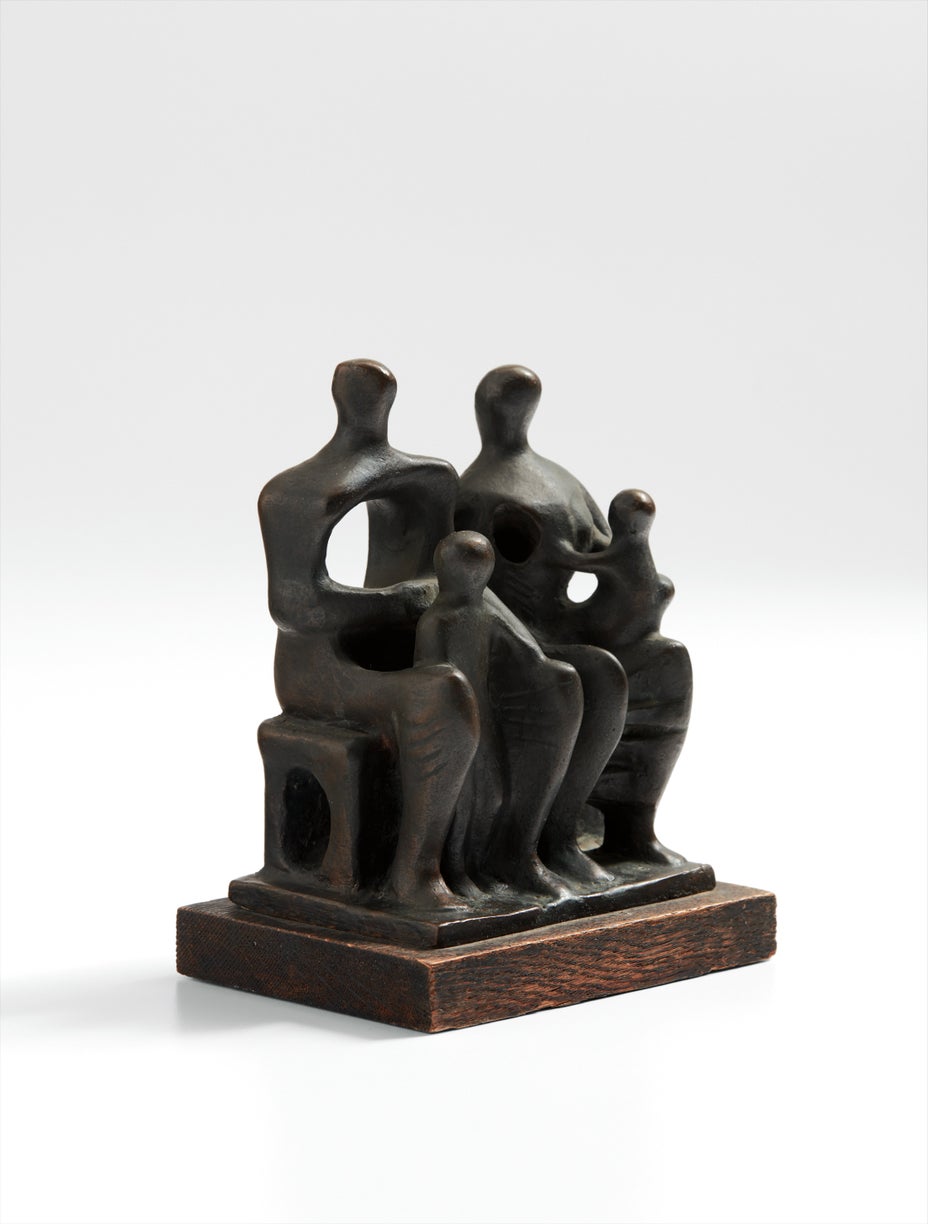
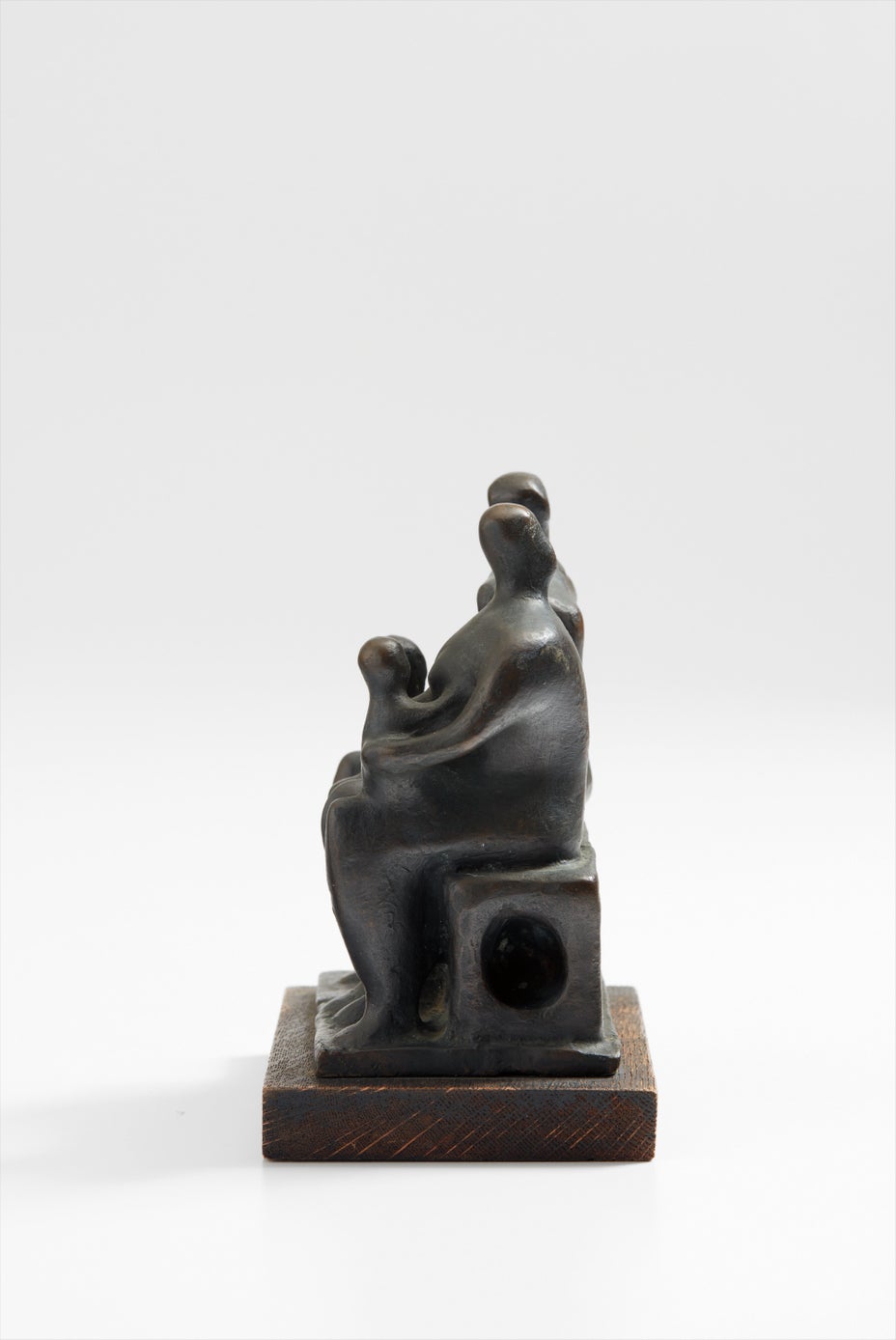
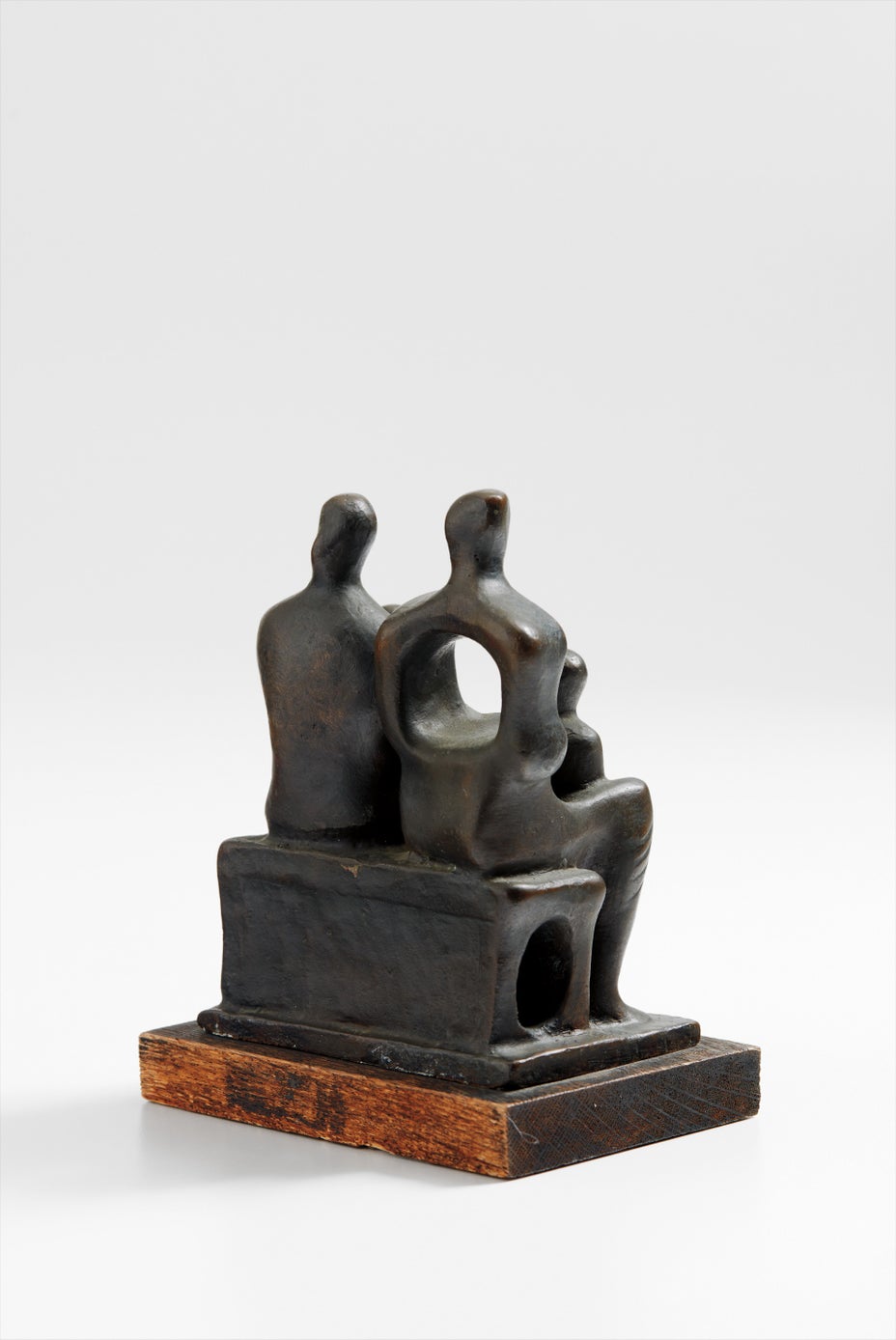
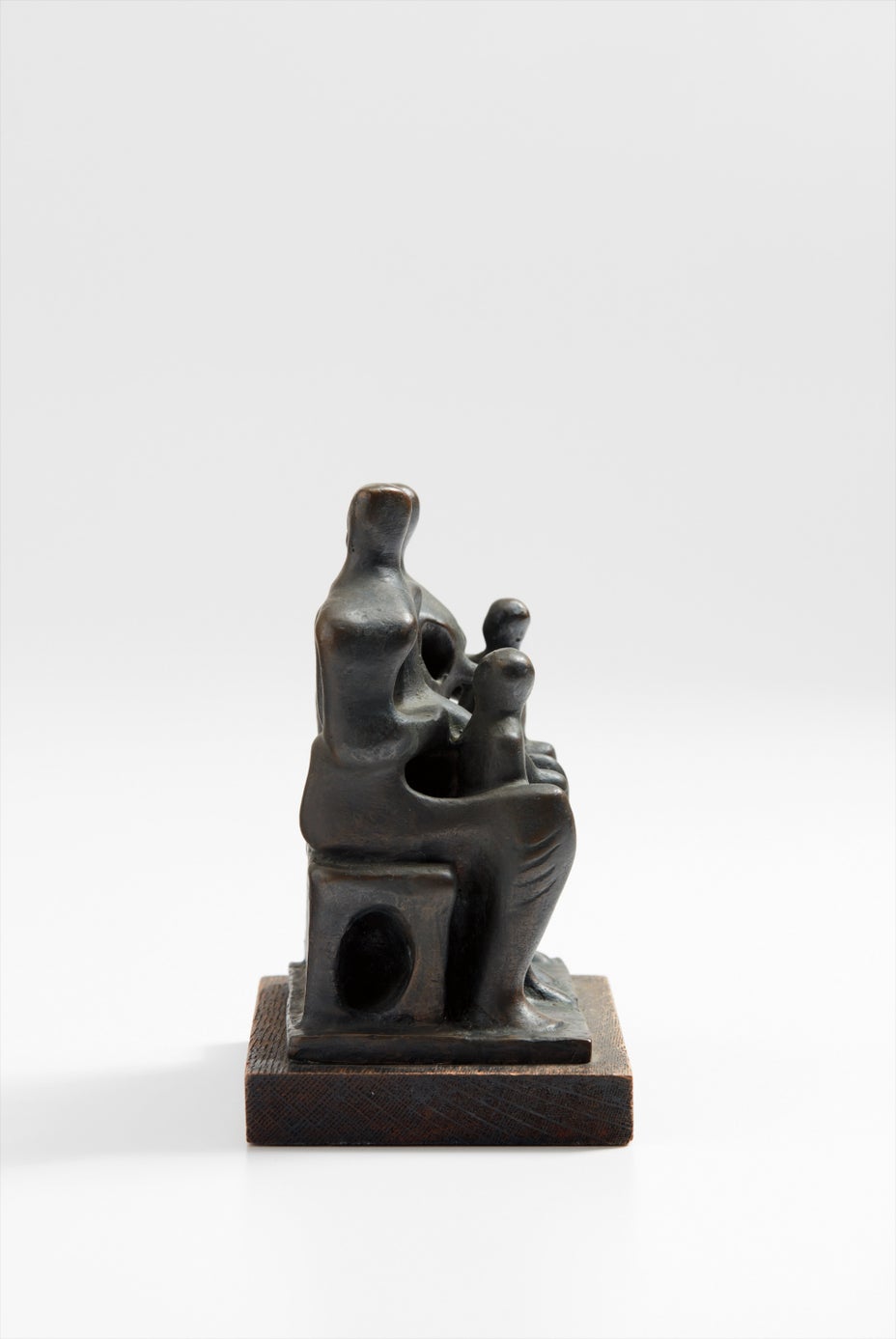
An intimate scene amongst a family unit, Family Group from 1945 encapsulates one of the most celebrated subjects in Moore’s artistic practice, which remains an enduring and universal motif of warmth and affection. The idea of the Family Group first came to Moore in the mid-1930s when invited to complete a large-scale sculpture for the new Village College in Impington, which was designed by Walter Gropius and Maxwell Fry. With the goal of creating a work that would resonate with both children and adults for the school commission in mind, Moore produced many preparatory drawings of families in different arrangements, a number of which were also modeled in clay and later cast in bronze. In the present work, a mother and father sit beside one another on a bench, each affectionately holding a small, loosely defined child. Executed in 1945, Family Group also dates to the period in which Moore was creating his celebrated Shelter Drawings that captured the tenacious spirit of Londoners during the Blitz and led to his appointment as the official war artist by Kenneth Clark. Encapsulating the tender resolve of families who clung together through the darkness of wartime, these drawings were certainly pivotal in his sculptural realization of the family unit.
Betty Sheinbaum was one of the earliest American collectors of Henry Moore and the acquisition of such a superb and varied group of his works was a sign of a collector with a remarkable vision.
Executed in the early to mid-1950s, Maquette for Draped Reclining Woman and Maquette for Warrior without Shield are delightful examples of Moore’s dedication to the human form and his life-long interest in nature. Moore began exploring the subject of the reclining figure at the beginning of his career in the 1920s, and the pose became the artist’s most frequently recurring subject. In Maquette for Draped Reclining Woman, this archetypal pose is articulated with a graceful study of the female figure with expressive drapery emphasizing the form of her legs, likely influenced by the artist’s recent trip to Greece in 1951. Moore’s continued inspiration from nature is evident in Maquette for Warrior without Shield, the idea for which evolved from a pebble he found on the seashore in 1952. Reflecting on the inception of his group of Warrior sculptures, Moore recalled: “Just as Leonardo says somewhere in his notebooks that a painter can find a battle scene in the lichen marks on a wall, so this gave me the start of The Warrior idea. First I added the body, leg and one arm and it became a wounded warrior... A day or two later I added a shield and altered its position and arrangement into a seated figure and so it changed from an inactive pose into a figure which, though wounded, is still defiant” (Henry Moore, quoted in Philip James, ed., Henry Moore on Sculpture: a collection of the sculptor's writings and spoken words, London, 1966, p. 250).
An intimate scene amongst a family unit, Family Group from 1945 encapsulates one of the most celebrated subjects in Moore’s artistic practice, which remains an enduring and universal motif of warmth and affection. The idea of the Family Group first came to Moore in the mid-1930s when invited to complete a large-scale sculpture for the new Village College in Impington, which was designed by Walter Gropius and Maxwell Fry. With the goal of creating a work that would resonate with both children and adults for the school commission in mind, Moore produced many preparatory drawings of families in different arrangements, a number of which were also modeled in clay and later cast in bronze. In the present work, a mother and father sit beside one another on a bench, each affectionately holding a small, loosely defined child. Executed in 1945, Family Group also dates to the period in which Moore was creating his celebrated Shelter Drawings that captured the tenacious spirit of Londoners during the Blitz and led to his appointment as the official war artist by Kenneth Clark. Encapsulating the tender resolve of families who clung together through the darkness of wartime, these drawings were certainly pivotal in his sculptural realization of the family unit.
Betty Sheinbaum was one of the earliest American collectors of Henry Moore and the acquisition of such a superb and varied group of his works was a sign of a collector with a remarkable vision.