Property of a Gentleman, Boston
12
Henry Moore
Torso
Estimate
$600,000–800,000
Sold For
$1,085,000
white marble
height 31 in. (78.7 cm)
This work is unique.
Full-Cataloguing
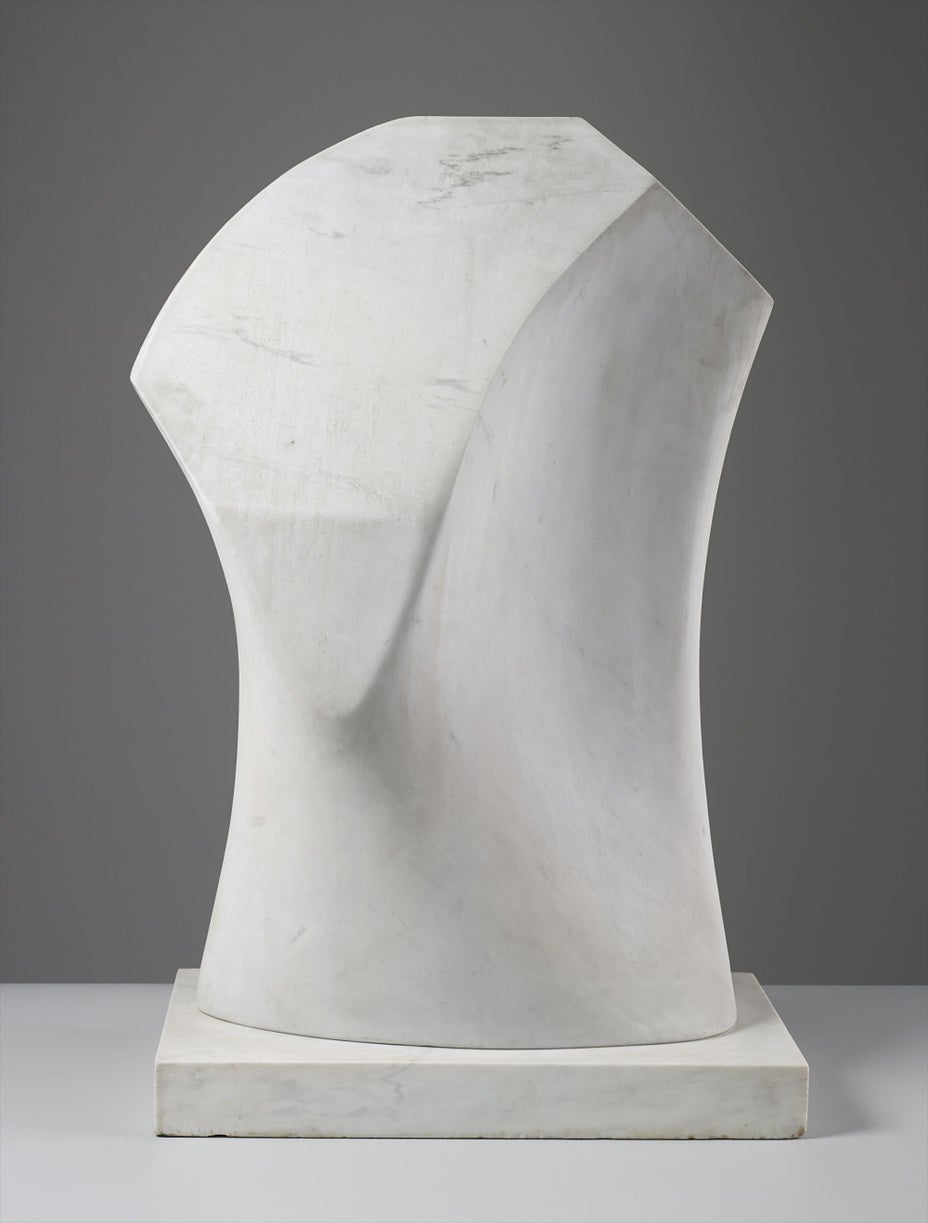
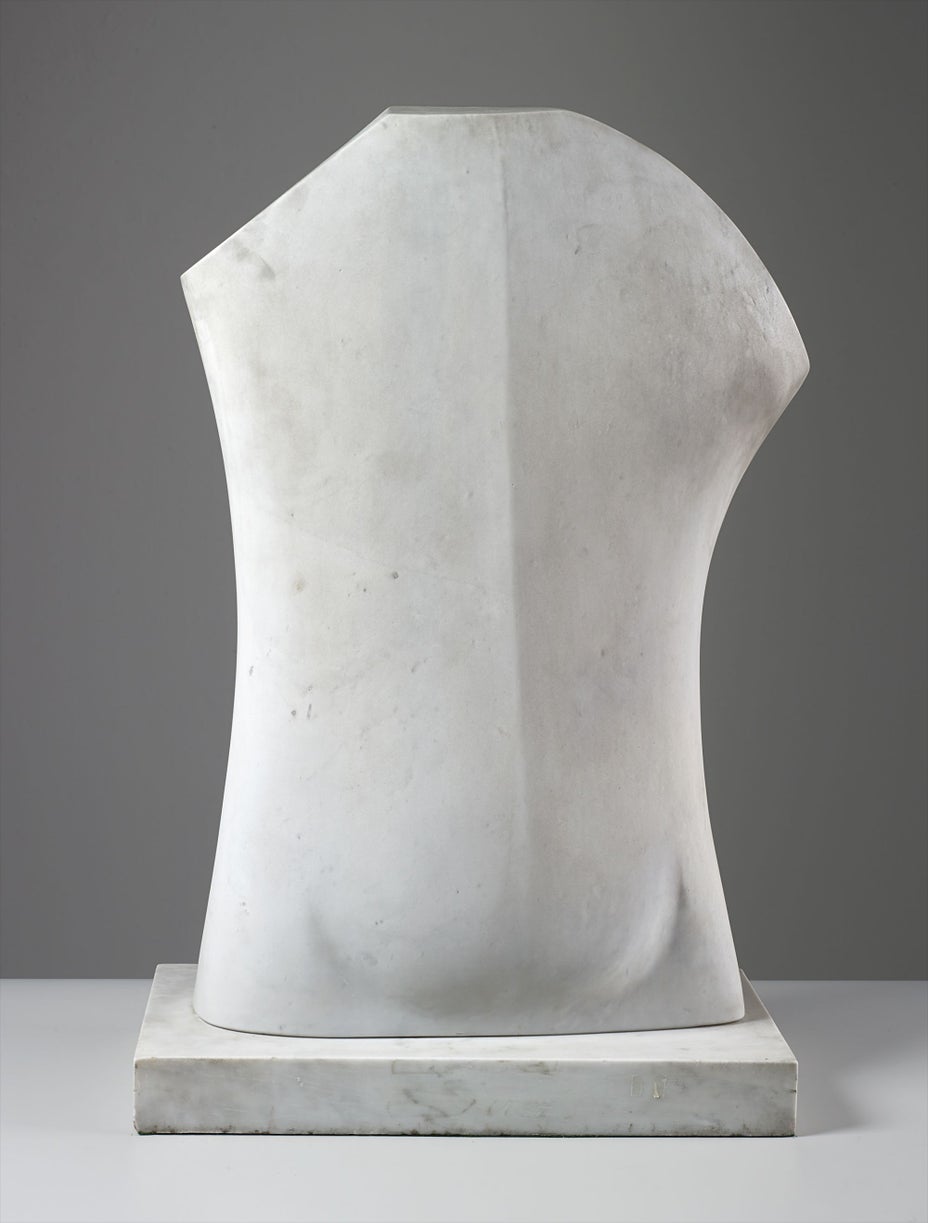
Henry Moore’s exemplary sculptures are characterized by his mastery and inherent understanding of his mediums and techniques. Throughout his oeuvre he continued to delve into the abstraction of the human form. Seemingly growing organically from his natural materials, his sculptures are defined by curving lines that bring into dialogue areas of mass and void in a manner that is as elegant as it is imposing. Torso, 1966 rendered in marble shows Moore’s re-evaluation of the subject matter that had first arisen over a decade earlier as a result of Draped Reclining Figure.
The present lot is an example of Moore’s most abstract portfolio of sculptures and as such brings to light the core ideas that lie at the heart of his artistic developments. Born out of a distinct Modernist mindset the pieces are indebted to the thoughts propagated by artists such as Pablo Picasso, Joan Miro and Alexander Archipenko who tested the boundaries of figurative art through a reductive process. Though the title Torso, certainly aids our understanding of the work’s subject matter, upon closer inspection the identifiable inward curve of a waist becomes evident just as the broadening back suggests the space for emerging shoulders. Equally as important as the form, is the smooth iridescent texture of the marble Moore devotedly polishes here. In this way the surface of his sculpture echoes a tactile sensuousness so intrinsic to the bodily subject he depicts here. Moore explains, “There have been two major influences on my work. The main one, perhaps, is drawing and modelling from the human figure – I have looked at the nude for half my life. Our own bodies, our own make up, have the greatest influence on art.” (Henry Moore in Henry Moore: Sculpture, London 1978, p.15)
Inspiration for Torso, 1966 was drawn from the extensive process of creating Draped Reclining Figure, 1953. As Moore reveals, “A large work like the Draped Reclining Figure (1953) has to be cast in several pieces which are then welded together. That figure was cast in about five sections – the head, two arms, the torso and the legs. I have to see, of course, the sections in wax before they are cast and when I saw the torso part, separate from the rest, even I, who had done it, was struck by its completeness and impressiveness just as a thing on its own. It was then that I thought of making the part, a work in its own." (Henry Moore quoted in T. Walsh, The Dark Matter of Words: Absence, Unknowing, and Emptiness in Literature, p. 22)
The present lot is an example of Moore’s most abstract portfolio of sculptures and as such brings to light the core ideas that lie at the heart of his artistic developments. Born out of a distinct Modernist mindset the pieces are indebted to the thoughts propagated by artists such as Pablo Picasso, Joan Miro and Alexander Archipenko who tested the boundaries of figurative art through a reductive process. Though the title Torso, certainly aids our understanding of the work’s subject matter, upon closer inspection the identifiable inward curve of a waist becomes evident just as the broadening back suggests the space for emerging shoulders. Equally as important as the form, is the smooth iridescent texture of the marble Moore devotedly polishes here. In this way the surface of his sculpture echoes a tactile sensuousness so intrinsic to the bodily subject he depicts here. Moore explains, “There have been two major influences on my work. The main one, perhaps, is drawing and modelling from the human figure – I have looked at the nude for half my life. Our own bodies, our own make up, have the greatest influence on art.” (Henry Moore in Henry Moore: Sculpture, London 1978, p.15)
Inspiration for Torso, 1966 was drawn from the extensive process of creating Draped Reclining Figure, 1953. As Moore reveals, “A large work like the Draped Reclining Figure (1953) has to be cast in several pieces which are then welded together. That figure was cast in about five sections – the head, two arms, the torso and the legs. I have to see, of course, the sections in wax before they are cast and when I saw the torso part, separate from the rest, even I, who had done it, was struck by its completeness and impressiveness just as a thing on its own. It was then that I thought of making the part, a work in its own." (Henry Moore quoted in T. Walsh, The Dark Matter of Words: Absence, Unknowing, and Emptiness in Literature, p. 22)