19
Irving Penn
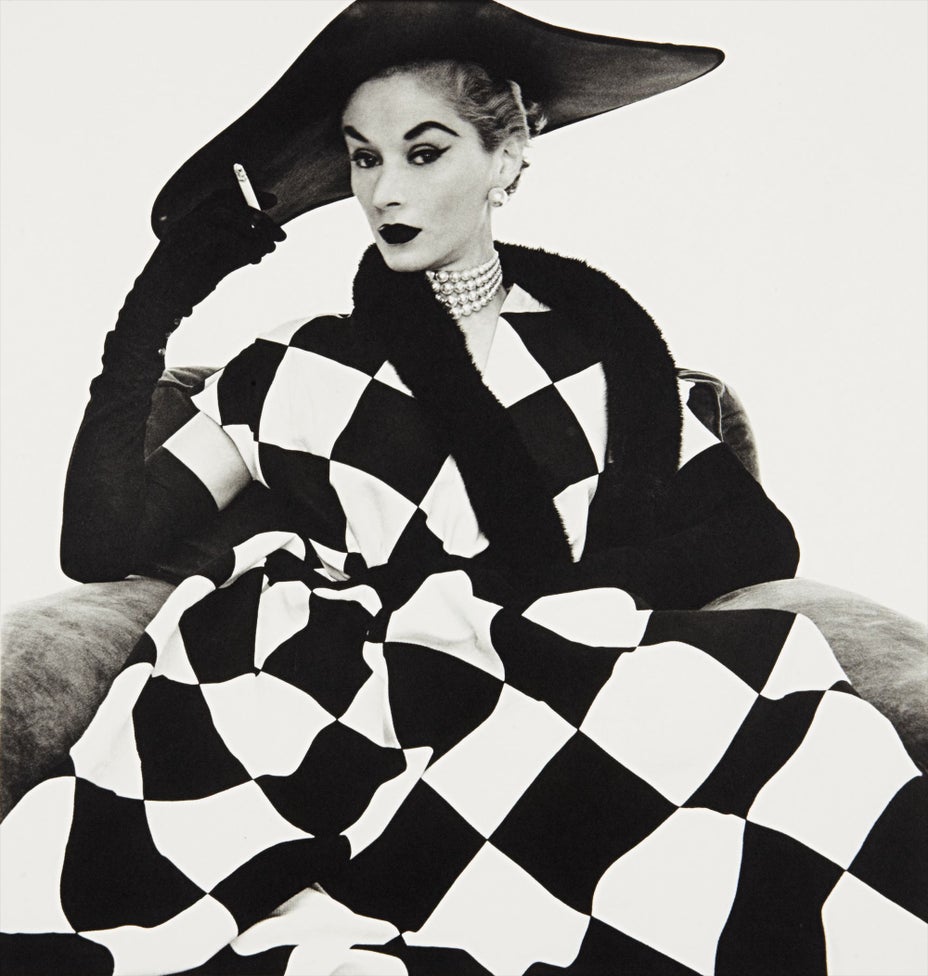
Harlequin Dress (Lisa Fonssagrives-Penn)
Full-Cataloguing
is a prime example. By the time the image was taken in 1950, Penn had cemented his reputation as a leader in the feld of fashion photography at Vogue, which Penn
joined in 1943. During his early days at the magazine under the guidance of Alexander Liberman, Penn’s responsibilities were confned to creating the sketches for the
covers. However, following the favorable reception for the first Vogue cover that he had been assigned to photograph, Penn was subsequently trusted with additional
editorial work, ultimately developing an innovative style, marked for its refreshing minimalism, timeless beauty and seamless elegance. Interestingly, Penn has credited
his lack of formal training in photography or savoir-faire in styling to have led him to adopt a clean and understated approach.
Harlequin Dress (Lisa Fonssagrives-Penn), published in the April 1950 issue, was featured prominently as the opening image in the fashion editorial, The Black and White Idea. In it, Fonssagrives is clad in a diamond-patterned dress by Jerry Parnis for Everlast. She is seen leisurely nestled in a chaise, a slim mink lei adorning her torso,
her coiffure tucked under a Lily Daché hat, her arms wrapped by opera-length gloves by Beautydoe. The triangular composition bestows her with a commanding, imperial
look, which is further accentuated by her confident gaze and the cigarette—then a symbol of modern times—wedged between her fngers. This stands in strong contrast to
the typical depictions of models at the time— demure, coy, unassuming. Under Penn’s directorship, Fonssagrives is not merely selling the dress, but the entire narrative
that Penn meticulously constructed around her—a new, empowered woman, confidently occupying her surrounding, enjoying the finer guilty pleasures in life. Over half a
century later, Penn’s Harlequin Dress (Lisa Fonssagrives-Penn), has retained its iconic status as an image of indisputable strength and seductive beauty.
Another print of this image is in the collection of the Art Institute of Chicago.
Irving Penn
American | B. 1917 D. 2009Irving Penn was one of the 20th century’s most significant photographers, known for his arresting images, technical mastery, and quiet intensity. Though he gained widespread acclaim as a leading Vogue photographer for over sixty years, Penn remained a private figure devoted to his craft. Trained under legendary art director Alexey Brodovitch in Philadelphia, he began his career assisting at Harper’s Bazaar before joining Vogue in 1943, where editor and artist Alexander Liberman recognized Penn’s distinctive eye and encouraged him to pursue photography. Penn’s incomparably elegant fashion studies reset the standard for the magazine world, and his portraits, still lifes, and nude studies broke new ground. His 1960 book Moments Preserved redefined the photographic monograph with its dynamic layout and high-quality reproductions. In 1964, Penn began printing in platinum and palladium, reviving this 19th-century process to serve his own distinct vision. An innovator in every sense, Penn’s approach to photography was endlessly adventurous. Few photographers of his generation experimented as widely with both conventional and historic print processes, and none achieved Penn’s level of excellence in all.