101
Irving Penn
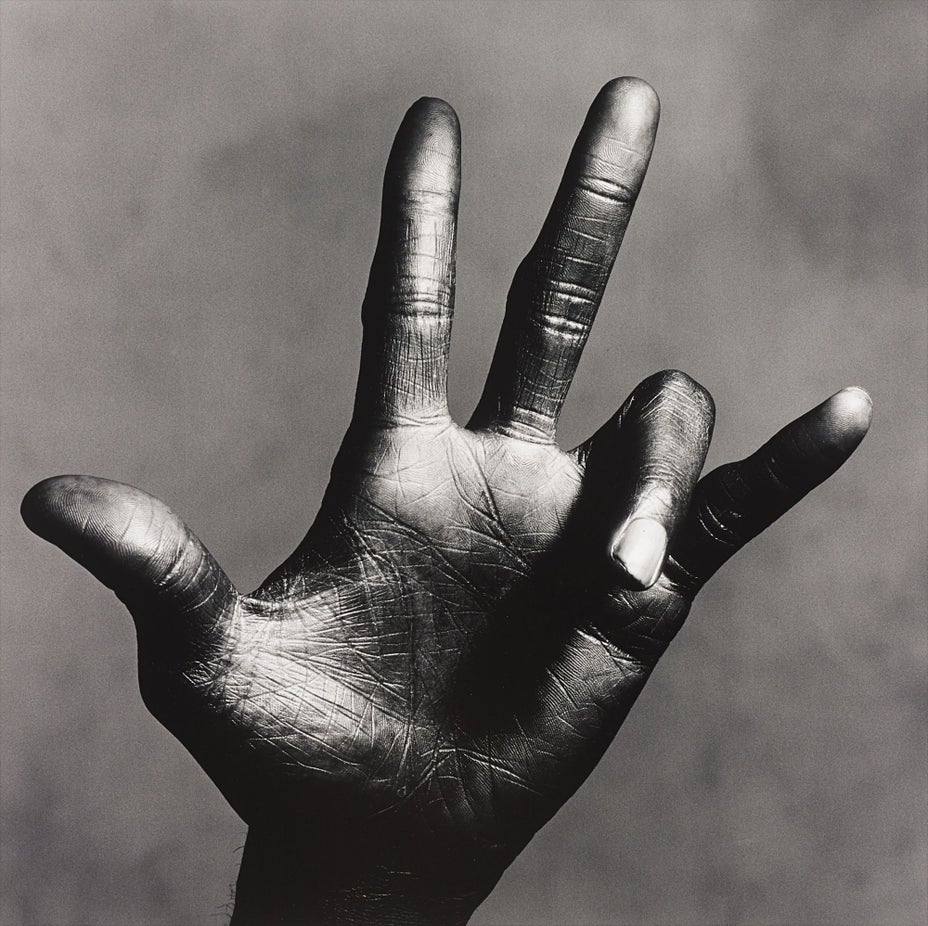
The Hand of Miles Davis (C), New York
Full-Cataloguing
‘...when I opened the front door. I was frozen by three giant photos of open hands of the great Miles Davis at the entrance, blown up tenfold against a white wall. Penn was known to capture the essence of who or what he shot, to simplify the subject down to the truth. There was the truth about Miles, right at the front door, right in front of me.
Miles had opened wide his palm for Penn. This was the hand that made the music we all fell in love with as Miles sounded like no other. Penn's had shot the tragedy. Miles heart line was riddled with islands, tragedy after tragedy. I knew him well and if you, like me believe in your palm telling your life story, it was there open wide at the door. There was more proof in Penn's photo of Miles tragedy as I never knew a man who got it so wrong. After his first marriage to his beloved wife, Frances, Miles romantically went down the tubes. The tragedy of his heart made his music sweeter.’
(V. Tiel, ‘My recent visit to the Irving Penn exhibit', ‘Assignment’, The Huffington Post, 15 October 2013)
Irving Penn
American | B. 1917 D. 2009Irving Penn was one of the 20th century’s most significant photographers, known for his arresting images, technical mastery, and quiet intensity. Though he gained widespread acclaim as a leading Vogue photographer for over sixty years, Penn remained a private figure devoted to his craft. Trained under legendary art director Alexey Brodovitch in Philadelphia, he began his career assisting at Harper’s Bazaar before joining Vogue in 1943, where editor and artist Alexander Liberman recognized Penn’s distinctive eye and encouraged him to pursue photography. Penn’s incomparably elegant fashion studies reset the standard for the magazine world, and his portraits, still lifes, and nude studies broke new ground. His 1960 book Moments Preserved redefined the photographic monograph with its dynamic layout and high-quality reproductions. In 1964, Penn began printing in platinum and palladium, reviving this 19th-century process to serve his own distinct vision. An innovator in every sense, Penn’s approach to photography was endlessly adventurous. Few photographers of his generation experimented as widely with both conventional and historic print processes, and none achieved Penn’s level of excellence in all.