16
Irving Penn
Bedside Lamp, New York
Full-Cataloguing
Irving Penn
Walking past a junk shop in the early 1940s, Irving Penn spotted a brass lamp on the sidewalk and immediately snapped it up. This common household item remained with him for the rest of his life. In 1992 after his wife Lisa Fonssagrives-Penn died and he moved back to New York City, the lamp was the first thing he set up in his new home. In Penn’s own words: ‘If I’m in bed, it’s always next to me. It’s a warm light, and somewhat warm in giving off heat. It’s a wonderful thing’.
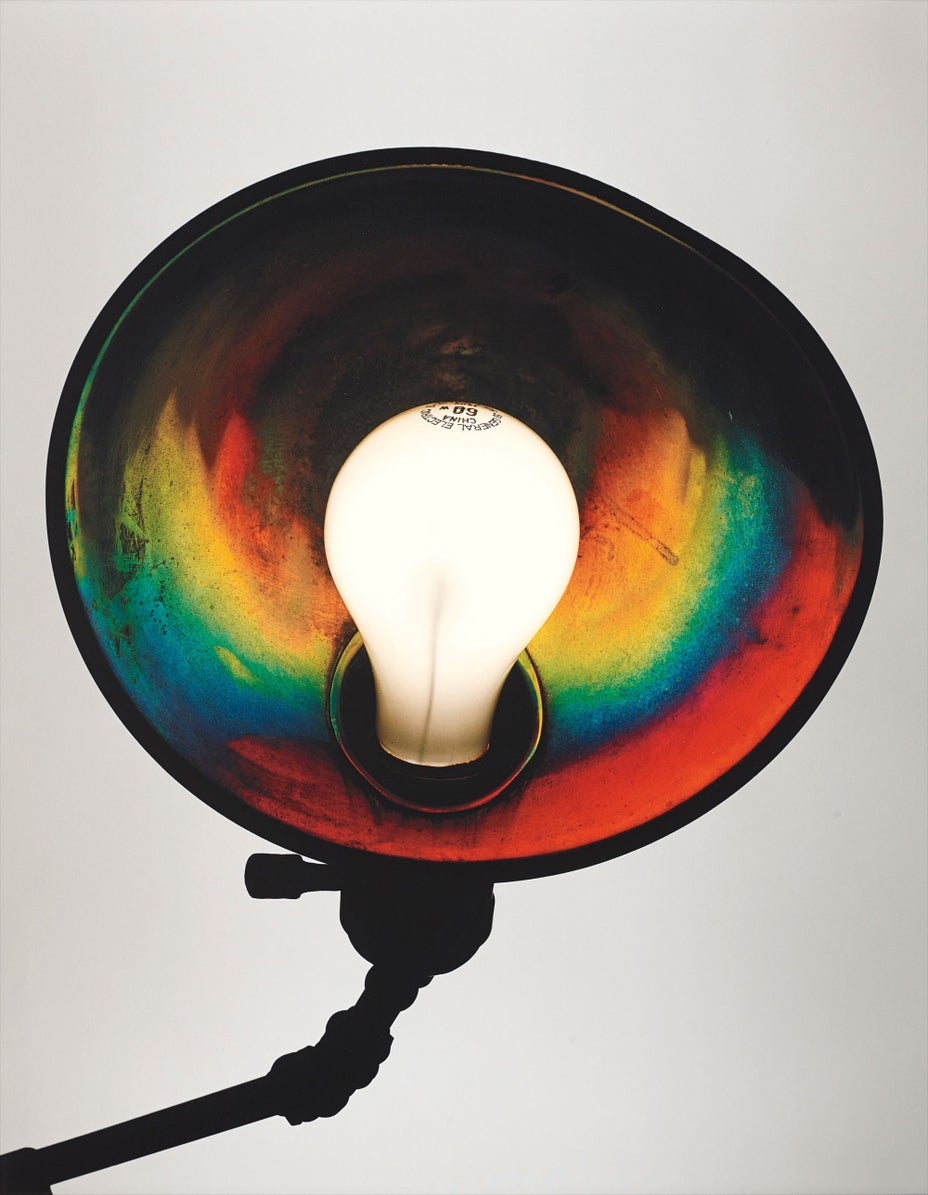
15 years later, in July 2007, Vogue released a special issue in commemoration of Irving Penn’s 90th birthday. For the article, ‘A Mighty Penn’, honouring the photographer’s 60-year association with the magazine, the editors selected the current lot Bedside Lamp— a portrait of the lamp he had bought in his early days at Vogue. As he explains in the article, ‘I decided the lamp was my closest friend. I wanted to celebrate my friendship by making a portrait of it’. Vogue’s celebration of Penn’s genius was accompanied by a stunning portrait of this simple object.
Set against the stark white background typical of many of Penn’s photographs, the lamp’s arm juts into the frame, the shade open like a flower to reveal the mysterious light and the rainbow of colours reflected in the brass from the single bulb. It is a curiously personal image and one of the last made by Penn. As Anna Wintour puts it, ‘The light doesn’t fail. The unrecognisable beauty in our lives is revealed and Irving’s gifts to us will never end’.
The lamp, that staple tool of the photographer’s craft, is rarely featured as the subject of a photographic image. Like a painting of the artist’s own palette, a photograph of a light can feel uncanny and oddly revealing. Bedside Lamp is not simply a deeply private portrait of one of Irving Penn’s most prized possessions, but also a surreal reminder of the manifold inflections of light in the oeuvre of this great artist.
Throughout the course of his life Irving Penn became known for his stunning still lifes and breathtaking portraits. Bedside Lamp combines both these modes. He showcases the lamp as it takes on a life of its own, drawing the viewer’s eye to the subtle reflections in the object that Penn first spotted all those years ago waiting for him on the sidewalk.
Irving Penn
American | B. 1917 D. 2009Irving Penn was one of the 20th century’s most significant photographers, known for his arresting images, technical mastery, and quiet intensity. Though he gained widespread acclaim as a leading Vogue photographer for over sixty years, Penn remained a private figure devoted to his craft. Trained under legendary art director Alexey Brodovitch in Philadelphia, he began his career assisting at Harper’s Bazaar before joining Vogue in 1943, where editor and artist Alexander Liberman recognized Penn’s distinctive eye and encouraged him to pursue photography. Penn’s incomparably elegant fashion studies reset the standard for the magazine world, and his portraits, still lifes, and nude studies broke new ground. His 1960 book Moments Preserved redefined the photographic monograph with its dynamic layout and high-quality reproductions. In 1964, Penn began printing in platinum and palladium, reviving this 19th-century process to serve his own distinct vision. An innovator in every sense, Penn’s approach to photography was endlessly adventurous. Few photographers of his generation experimented as widely with both conventional and historic print processes, and none achieved Penn’s level of excellence in all.