12Σ︎
Isamu Noguchi
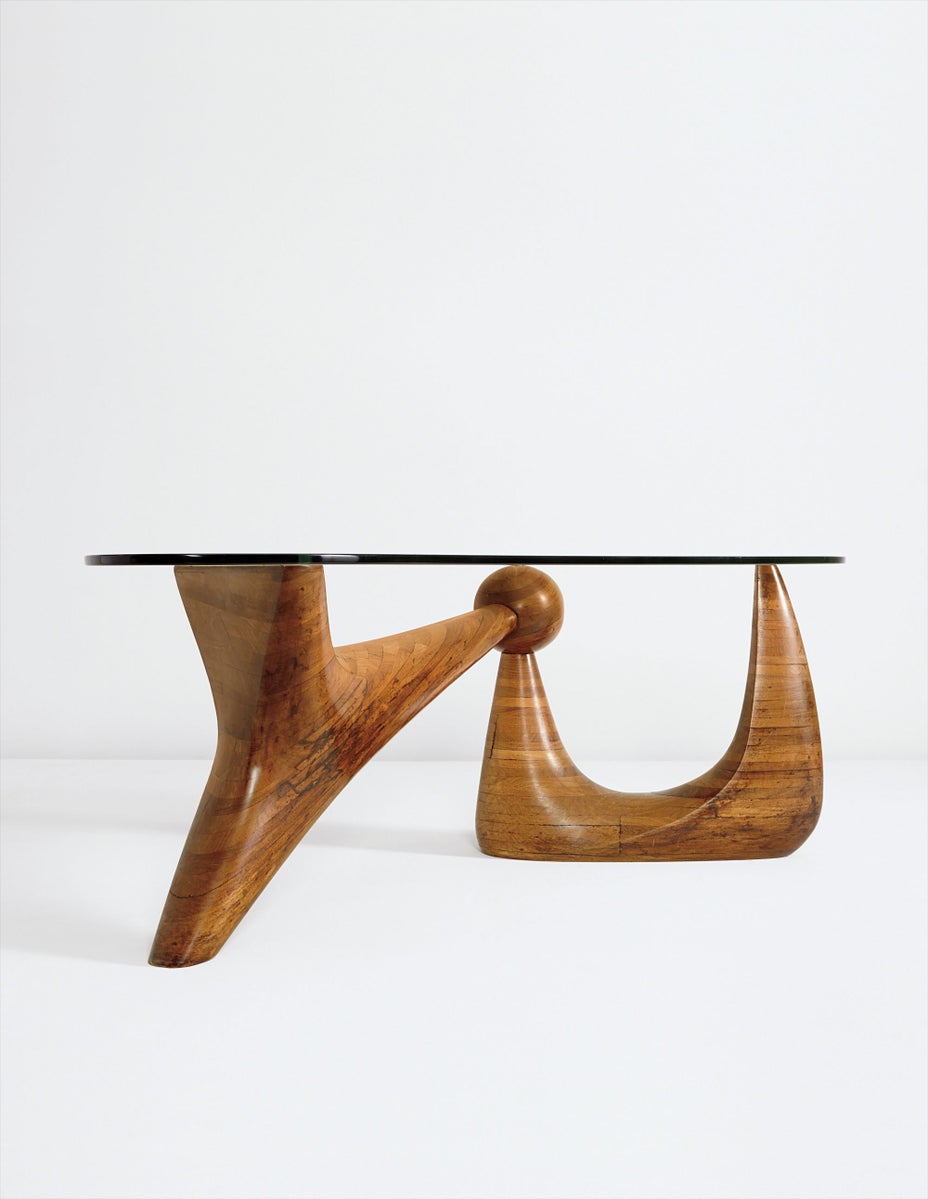
The Goodyear Table, for A. Conger Goodyear, Old Westbury, New York
Estimate
$2,000,000–3,000,000
Sold For
$4,450,500
1939
Stack-laminated rosewood, original Herculite plate glass.
28 3/4 x 83 x 34 3/8 in. (73 x 210.8 x 87.3 cm)
Glass top etched with HERCULITE/PLATE GLASS/AS G.
Full-Cataloguing
The Goodyear Table is listed as artwork number 162 in The Isamu Noguchi Catalogue Raisonné.
Phillips would like to thank The Isamu Noguchi Foundation and Garden Museum and Deborah A. Goldberg, Ph.D, New York, for their assistance cataloguing the present lot.
THE FIRST TABLE: A PIVOT TO ABSTRACTION
After nearly two decades spent producing figurative works in bronze and terracotta, and more specifically a long series of commercially successful portrait sculptures for clients and friends including Buckminster Fuller, Clare Booth Luce, George Gershwin, and Berenice Abbott, among others, Isamu Noguchi hinted at a return to abstraction in the 1930s, at first with costume and set designs for choreographers Ruth Page and Martha Graham, as well as with larger, semi-abstract works including 1000 Horsepower Heart and the Ford Fountain for the New York World’s Fair. During a formative stay in Paris on a Guggenheim Fellowship, during which he was Constantin Brancusi’s studio assistant for six months in 1927, Noguchi had produced an early series of formal, almost rigid abstractions under the influence of his mentor.
Then in 1939, at the request of A. Conger Goodyear, President of the Museum of Modern Art, Noguchi boldly returned to abstraction with the design of the present unique lot—Noguchi’s first table—for the living room of Goodyear’s weekend house in Old Westbury, New York. More than furniture design, the Goodyear Table heralded Noguchi’s fertile developments of the 1940s, including his “interlocking” sculptures, the direct descendants of the present lot. In addition, the Goodyear Table beget three important later commissions (pictured here) of the 1940s, among them a laminated and carved side table now in MoMA’s permanent collection for the museum’s architect Philip L. Goodwin, and a vast, wing-shaped dining table for William A. M. Burden, trustee and later President of MoMA. The last of the three “MoMA” tables, it was destroyed by fire in 1999. A coffee table for Mr. and Mrs. Samuel C. Dretzin was sold at Christie’s, New York, for $2.9 million in June 2012.
Comprising stack-laminated rosewood and Herculite plate glass, the Goodyear Table mimicked the texture and materials—stacked bricks, plate glass windows—of the building for which it was commissioned, the Goodyear House by Edward Durrell Stone, who, together with Philip Goodwin, was at work on the design of MoMA. Paul Goldberger, former architecture critic at the New Yorker, has called the Goodyear House “one of the most important houses built in the United States between the two world wars.” In that sense it is of equal stature with its namesake table, which served as a platform not only for its owner but also for its maker, who embarked from there on a half-century journey deeper into abstraction.
Phillips would like to thank The Isamu Noguchi Foundation and Garden Museum and Deborah A. Goldberg, Ph.D, New York, for their assistance cataloguing the present lot.
THE FIRST TABLE: A PIVOT TO ABSTRACTION
After nearly two decades spent producing figurative works in bronze and terracotta, and more specifically a long series of commercially successful portrait sculptures for clients and friends including Buckminster Fuller, Clare Booth Luce, George Gershwin, and Berenice Abbott, among others, Isamu Noguchi hinted at a return to abstraction in the 1930s, at first with costume and set designs for choreographers Ruth Page and Martha Graham, as well as with larger, semi-abstract works including 1000 Horsepower Heart and the Ford Fountain for the New York World’s Fair. During a formative stay in Paris on a Guggenheim Fellowship, during which he was Constantin Brancusi’s studio assistant for six months in 1927, Noguchi had produced an early series of formal, almost rigid abstractions under the influence of his mentor.
Then in 1939, at the request of A. Conger Goodyear, President of the Museum of Modern Art, Noguchi boldly returned to abstraction with the design of the present unique lot—Noguchi’s first table—for the living room of Goodyear’s weekend house in Old Westbury, New York. More than furniture design, the Goodyear Table heralded Noguchi’s fertile developments of the 1940s, including his “interlocking” sculptures, the direct descendants of the present lot. In addition, the Goodyear Table beget three important later commissions (pictured here) of the 1940s, among them a laminated and carved side table now in MoMA’s permanent collection for the museum’s architect Philip L. Goodwin, and a vast, wing-shaped dining table for William A. M. Burden, trustee and later President of MoMA. The last of the three “MoMA” tables, it was destroyed by fire in 1999. A coffee table for Mr. and Mrs. Samuel C. Dretzin was sold at Christie’s, New York, for $2.9 million in June 2012.
Comprising stack-laminated rosewood and Herculite plate glass, the Goodyear Table mimicked the texture and materials—stacked bricks, plate glass windows—of the building for which it was commissioned, the Goodyear House by Edward Durrell Stone, who, together with Philip Goodwin, was at work on the design of MoMA. Paul Goldberger, former architecture critic at the New Yorker, has called the Goodyear House “one of the most important houses built in the United States between the two world wars.” In that sense it is of equal stature with its namesake table, which served as a platform not only for its owner but also for its maker, who embarked from there on a half-century journey deeper into abstraction.