71
Jacques Ruelland and Dani Ruelland
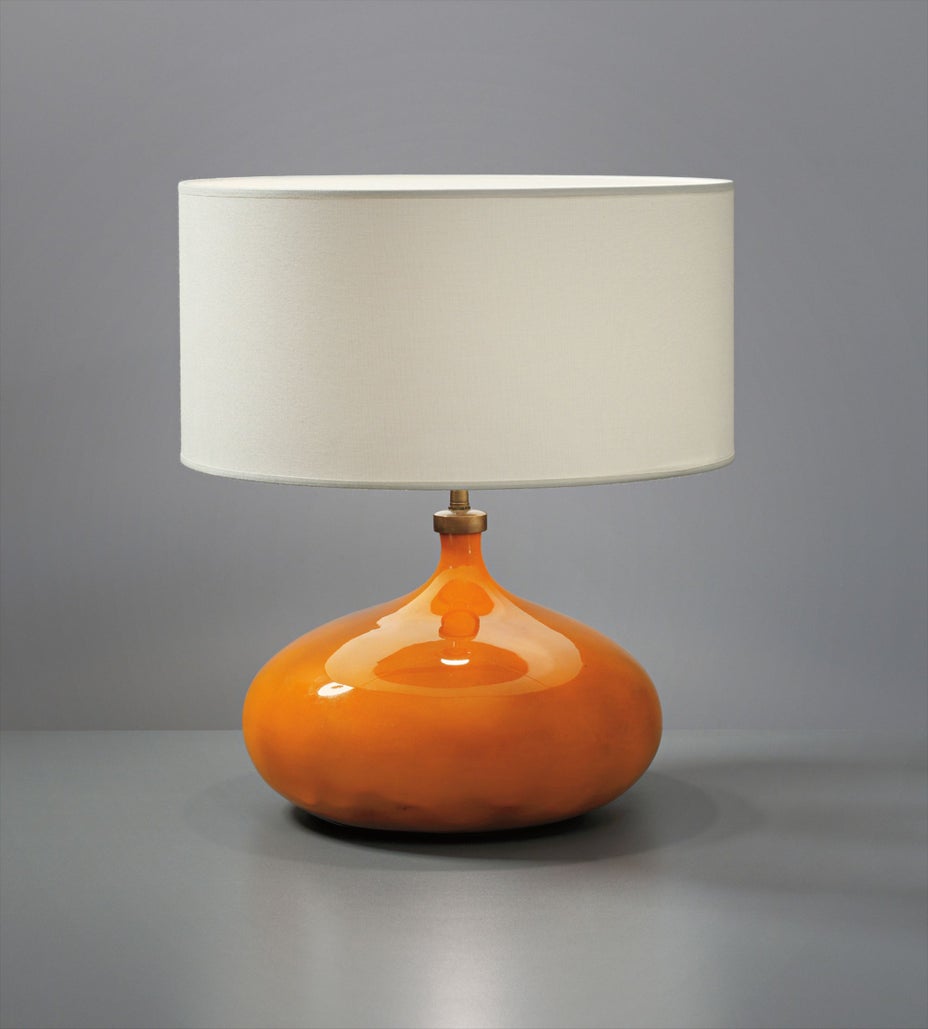
Table lamp
Estimate
£6,000–8,000
circa 1960
Glazed earthenware, brass, tubular brass, paper shade.
45.5 cm (17 7/8 in.) high including shade
Underside incised with D J Ruelland.
Full-Cataloguing
Jean Royère’s work has always appealed for its exuberant modernity. The fashion designer Christian Lacroix once described it as a ‘generous, witty mix of the primitive and the sophisticated’. (Galerie Jacques Lacoste and Galerie Patrick Seguin, Jean Royère, Volume 1, Paris, 2012, p. 19) Wildly successful in Europe and the Middle East in his own lifetime, Royère’s enduring popularity is evidenced by the fact that his ‘comeback’ occurred roughly only a decade after the commission of the present table.
In its graphic interpretation of the Parisian landmark the ‘Tour Eiffel’ motif invokes France’s leading role in the birth of modern design. First conceived in 1939, Royère used the motif on a variety of furnishings, lighting and architectural details. ‘Tour Eiffel’ was the precursor to the later openwork patterns in iron rods that became one of the hallmarks of Royère’s individual style.
In its graphic interpretation of the Parisian landmark the ‘Tour Eiffel’ motif invokes France’s leading role in the birth of modern design. First conceived in 1939, Royère used the motif on a variety of furnishings, lighting and architectural details. ‘Tour Eiffel’ was the precursor to the later openwork patterns in iron rods that became one of the hallmarks of Royère’s individual style.