Property of a Distinguished European Family Collection
9Ο︎◆︎
Jean Dubuffet
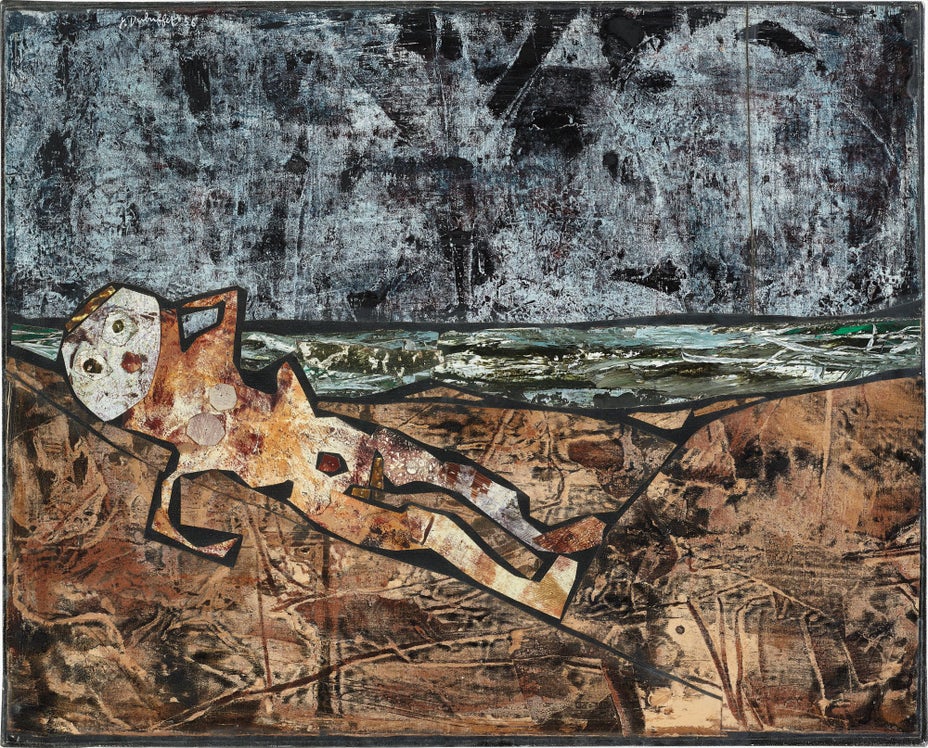
Bain de Soleil
Estimate
£500,000–700,000♠︎
Sold For
£1,202,500
oil and collage on canvas laid on canvas
65 x 81 cm (25 5/8 x 31 7/8 in.)
Signed and dated 'J. Dubuffet 56' on the upper left. Further signed, titled and dated 'J. Dubuffet "Bain de Soleil" Juin 56' on the reverse.
Full-Cataloguing
“In this wondrously fecund decade [the 1950’s], everything did double duty for Dubuffet, and all roads led everywhere and back again.” (Roberta Smith in The New York Times, 8 March 1996)
Of all of the extraordinary artistic achievements of Jean Dubuffet, it is, perhaps, his absolute fearless sense of invention that he will moat be remembered, and celebrated, for. He was an artist who took an almost child-like delight in the most mundane and pedestrian of materials and would transform them in to notable objects of desire that were, at once, classical; contemporary; beautiful and brutish. His oeuvre, one of the most significant of the Twentieth Century, continues to display this: a dazzling articulation of many binary antagonisms, voiced through a creative language hinged on the joie-de-vivre of innocence and the seriousness of experience.
The point-de-depart for much of Dubuffet’s enterprise was Nature. Whether through his Eponge sculptures that physically used real sponges; or his Texturologies paintings that affected the earth and dirt under our feet, Nature has always been a compelling subject and, crucially, medium for the artist. It is in his collaged paintings from the early 1950’s that one sees Nature as both Image and Index. He made a series of works employing butterfly wings; another with tobacco leaves. Always drawing attention to the media he used, whilst simultaneously remaining faithful to the subject he delineated.
In developing this language (and practice) of collage, Dubuffet would turn to his own work, redeveloped and reimagined to allow for another interpretation of collage and of his own painting. The present work – the beautiful Bain de Soleil from 1956 – is such a case. Old canvases have been cut up and used as collaged elements, tessellated on to the canvas by the artist, breathing new life in to the old painting and, by extension, in to the possibilities of new painting at that time.
The (relative) shock of the new is always best articulated in the most Classical of settings. Thus Dubuffet has, here, chosen an age-old subject: a sunbather who is, of course, a reclining nude; in a setting (the beach) which can be seen in any number of twentieth-century masterpieces by French artists in museums all over the world. By engaging with such a familiar subject, Dubuffet draws attention to the power and radicality of his process whilst still allowing the viewer to gently step in to the vibrant energy of Dubuffet’s creative enterprise.
Of all of the extraordinary artistic achievements of Jean Dubuffet, it is, perhaps, his absolute fearless sense of invention that he will moat be remembered, and celebrated, for. He was an artist who took an almost child-like delight in the most mundane and pedestrian of materials and would transform them in to notable objects of desire that were, at once, classical; contemporary; beautiful and brutish. His oeuvre, one of the most significant of the Twentieth Century, continues to display this: a dazzling articulation of many binary antagonisms, voiced through a creative language hinged on the joie-de-vivre of innocence and the seriousness of experience.
The point-de-depart for much of Dubuffet’s enterprise was Nature. Whether through his Eponge sculptures that physically used real sponges; or his Texturologies paintings that affected the earth and dirt under our feet, Nature has always been a compelling subject and, crucially, medium for the artist. It is in his collaged paintings from the early 1950’s that one sees Nature as both Image and Index. He made a series of works employing butterfly wings; another with tobacco leaves. Always drawing attention to the media he used, whilst simultaneously remaining faithful to the subject he delineated.
In developing this language (and practice) of collage, Dubuffet would turn to his own work, redeveloped and reimagined to allow for another interpretation of collage and of his own painting. The present work – the beautiful Bain de Soleil from 1956 – is such a case. Old canvases have been cut up and used as collaged elements, tessellated on to the canvas by the artist, breathing new life in to the old painting and, by extension, in to the possibilities of new painting at that time.
The (relative) shock of the new is always best articulated in the most Classical of settings. Thus Dubuffet has, here, chosen an age-old subject: a sunbather who is, of course, a reclining nude; in a setting (the beach) which can be seen in any number of twentieth-century masterpieces by French artists in museums all over the world. By engaging with such a familiar subject, Dubuffet draws attention to the power and radicality of his process whilst still allowing the viewer to gently step in to the vibrant energy of Dubuffet’s creative enterprise.