Priority Bidding is here! Secure a lower Buyer’s Premium today (excludes Online Auctions and Watches). Learn More
Property from an East Coast Private Collection

11

Jean Prouvé

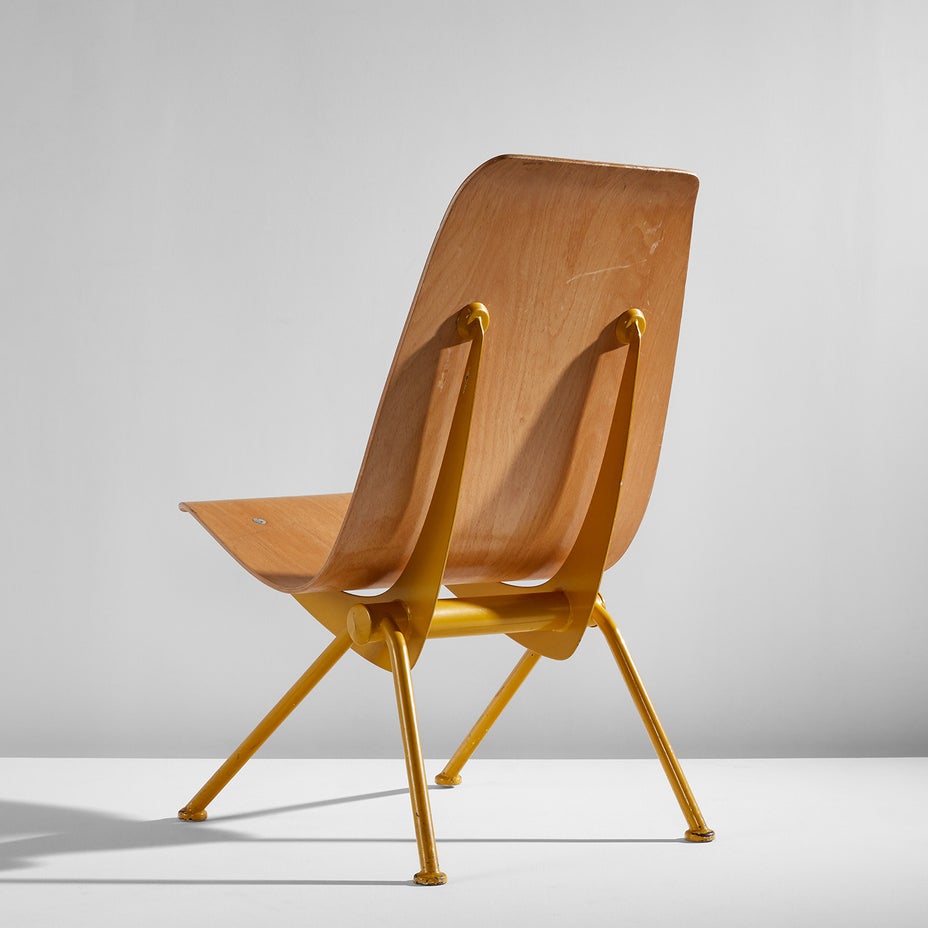
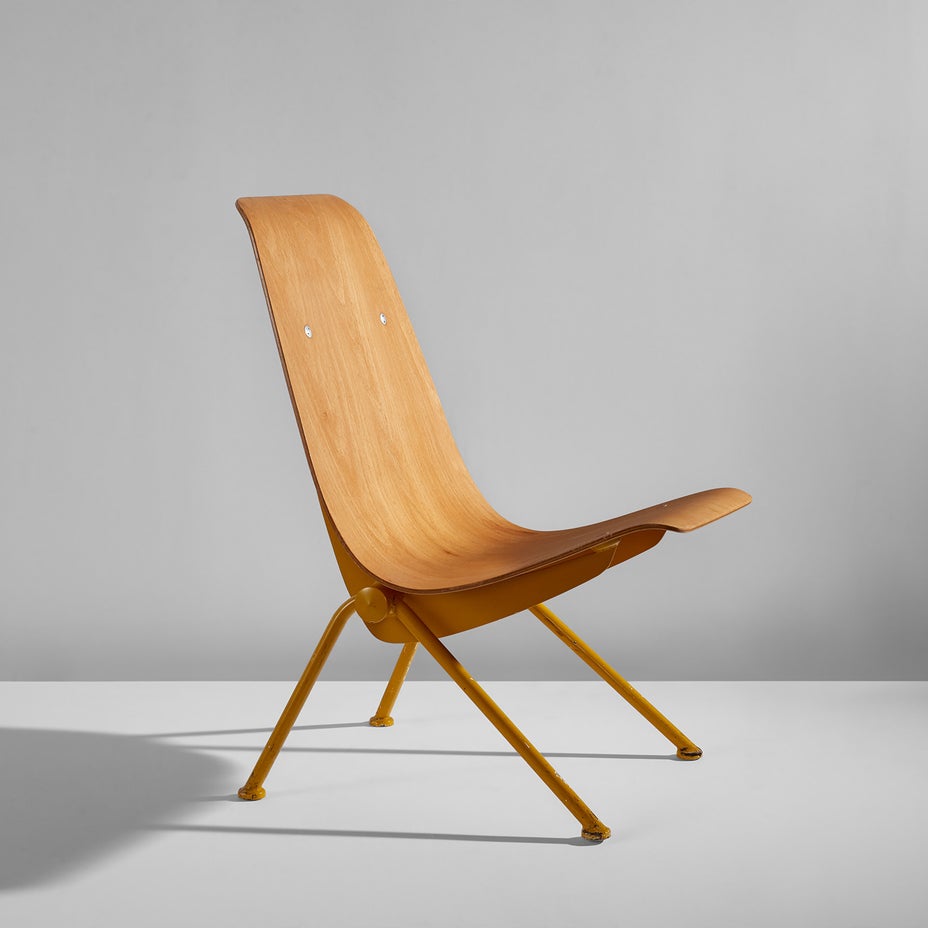
"Antony" chair, model no. 356

Estimate
$15,000 - 20,000
$44,100
Lot Details
Beech-veneered plywood, painted steel, aluminum.
circa 1954
33 3/4 x 19 5/8 x 27 7/8 in. (85.7 x 49.8 x 70.8 cm)
Produced by Les Ateliers Jean Prouvé, France and issued by Galerie Steph Simon, Paris, France.
Catalogue Essay
The Antony chair persists as one of Jean Prouvé’s most celebrated designs. Prouvé devised the model in 1954 for a dormitory hall at the Cité Universitaire d’Antony, having won a design competition put forth by the institution. Here Prouvé testifies to the elasticity of plywood, which in the present model arcs subtly to form the curvilinear silhouette of the chair’s seat, itself cradled by a sheet metal skeleton standing on tubular metal legs. The chair was quickly placed in several other interiors, its light and pleasing form ideal for such varied settings as waiting rooms, offices, and the domicile. Its environmental versatility and agreeable form earned the work alternate nomenclature as the “Light easy” chair. Many institutions retain an Antony model in their permanent collections, including the Museum of Modern Art, New York and The Metropolitan Museum of Art, New York.

Jean Prouvé

French | B. 1901 D. 1984
Jean Prouvé believed in design as a vehicle for improvement. His manufactory Les Ateliers Jean Prouvé, located in Nancy, France, produced furniture for schools, factories and municipal projects, both within France and in locations as far flung as the Congo. Though he designed for the masses, pieces such as his "Potence" lamps and "Standard" chairs are among the most iconic fixtures in sophisticated, high-design interiors today. Collectors connect with his utilitarian, austere designs that strip materials down to the bare minimum without compromising on proportion or style.

Prouvé grew up in Nancy, France, the son of Victor Prouvé, an artist and co-founder of the École de Nancy, and Marie Duhamel, a pianist. He apprenticed to master blacksmiths in Paris and opened a small wrought iron forge in Nancy. However it was sheet steel that ultimately captured Prouvé's imagination, and he ingeniously adapted it to furniture, lighting and even pre-fabricated houses, often collaborating with other design luminaries of the period, such as Robert Mallet-Stevens, Le Corbusier and Charlotte Perriand.
Browse Artist