

Property from a Private Collection, London
14
Jean Royère
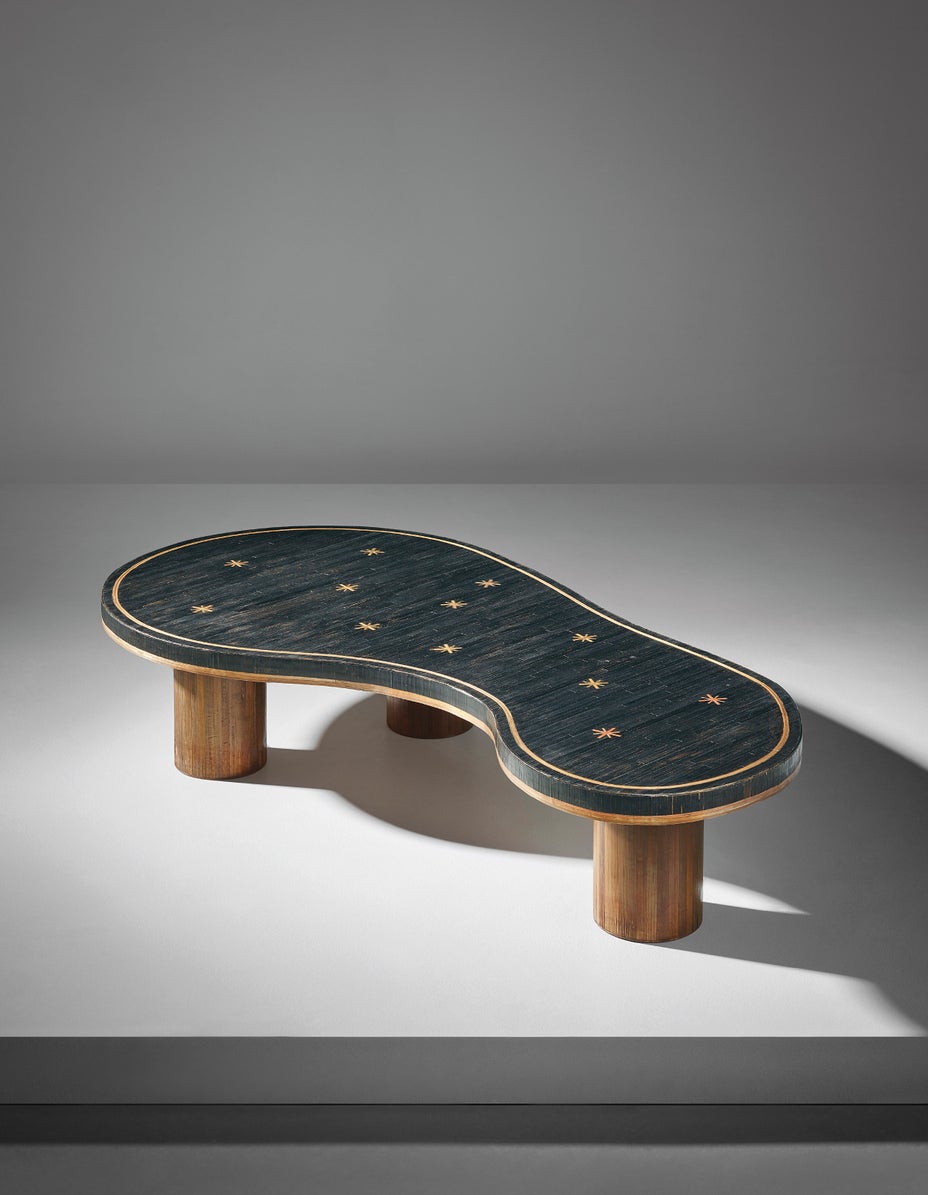
"Flaque" low table
- Estimate
- $180,000 - 250,000
$591,000
Lot Details
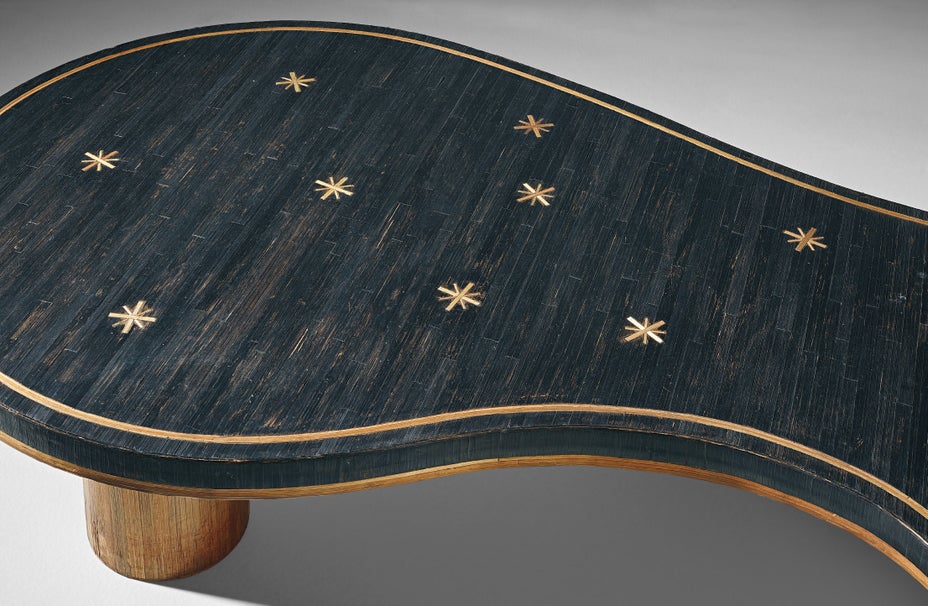
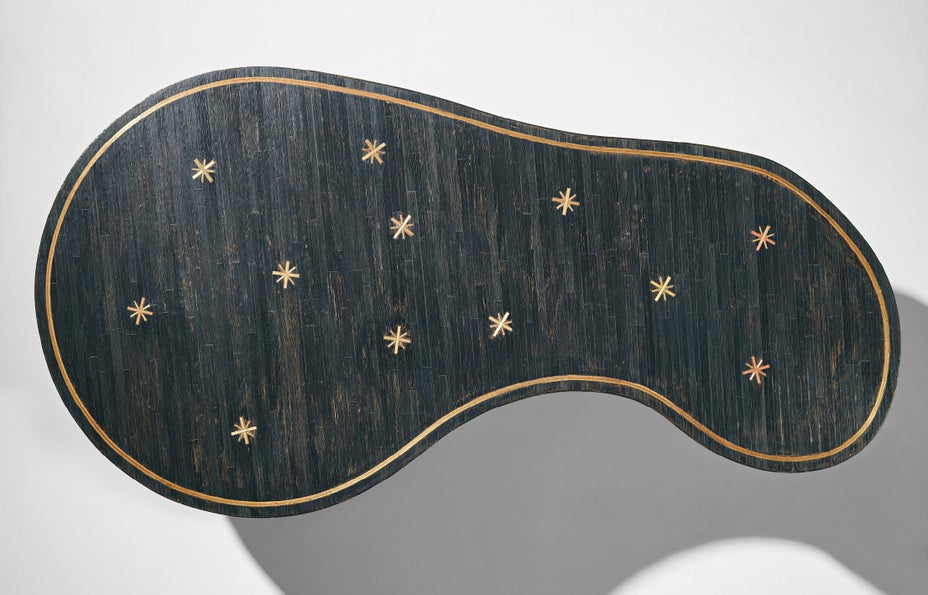
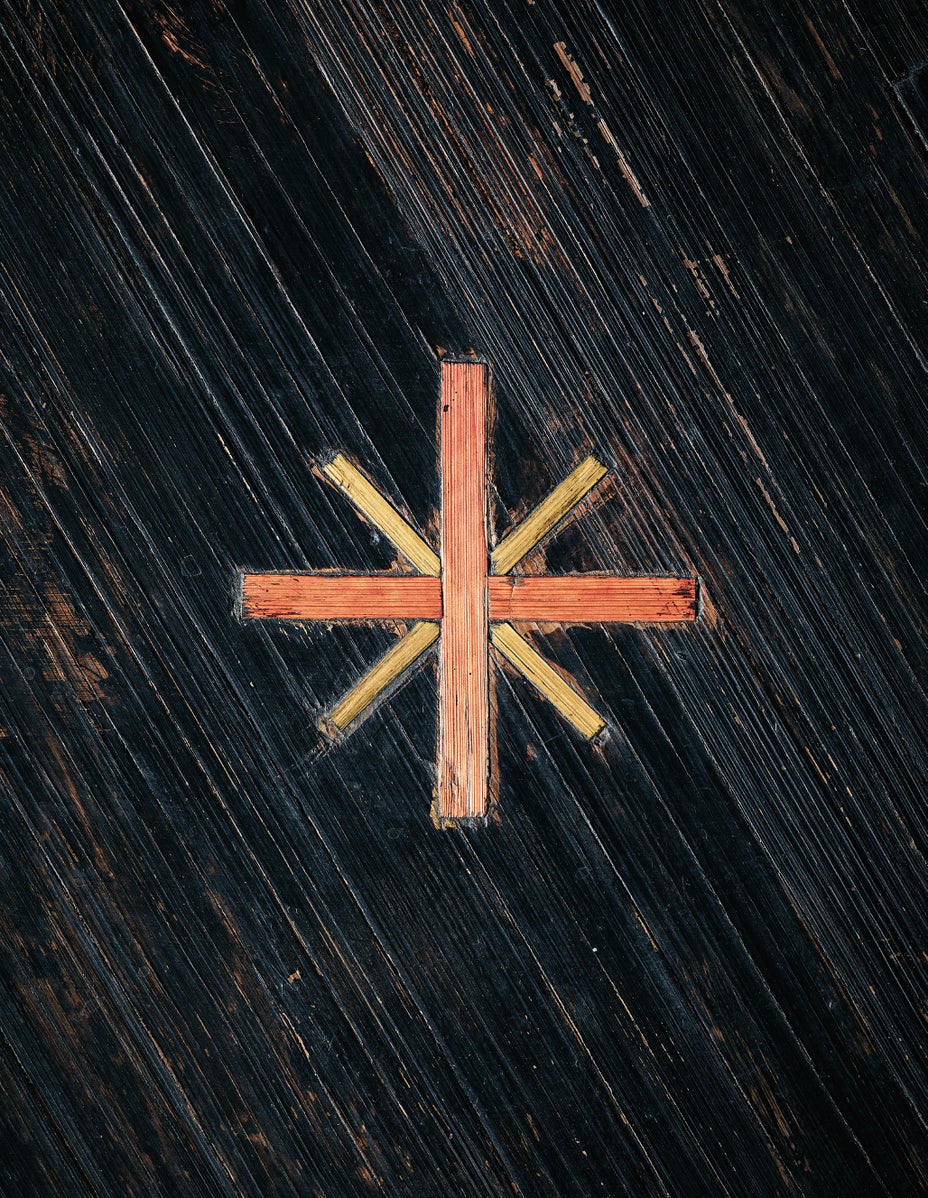
Straw marquetry-covered wood.
circa 1955
10 x 49 3/4 x 25 7/8 in. (25.5 x 126.5 x 65.7 cm)
Specialist
Full-Cataloguing
Catalogue Essay
The freeform shape of the “Flaque” table—French for puddle—illustrates the influence of biomorphism introduced by artists such as Hans Arp and Alexander Calder and situates Royère’s design within a larger international discourse. From the 1930s, designers including Frederick Kiesler, Eileen Gray, Charlotte Perriand, and Isamu Noguchi began exploring biomorphism in their work, departing from more traditional furniture forms. Technical innovations, such as plywood and tubular metal, assisted in the creation of these unconventional, organic forms. However for Royère’s “Flaque” table the designer employed straw marquetry, a traditional technique meant to imitate wood veneer which had been in use in Europe since the seventeenth century. Revitalized by designers such as Jean-Michel Frank and André Groult during the 1930s, the technique of straw marquetry enabled Royère to combine color, pattern, and craftsmanship, transforming a humble material into a sophisticated design. During the following decades Royère would create several variations of the “Flaque” table, incorporating different materials and varied colors and ornamentation.
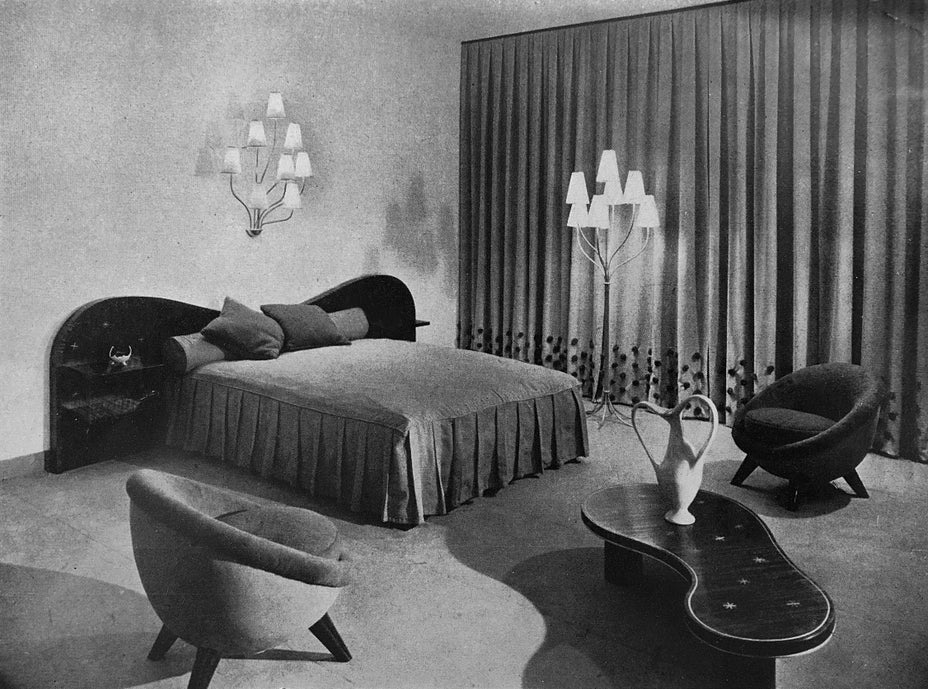
In 1947, for his own residence on the Faubourg-Saint-Honoré in Paris, Royère designed his first pieces of biomorphic furniture, an “Ours Polaire” sofa and a “Flaque” low table. The latter featured an opaline glass top decorated with red stars and supported by three perforated sheet metal legs, positioned in the designer’s living room alongside a carpet whose fluid form echoed that of the low table. A few years later, Royère presented a version of the table with a blue opaline glass top as part of his design for an office lounge at the 1949 Salon des artistes décorateurs. These versions of Royère’s "Flaque" table from the 1940s illustrate the connection to the biomorphic forms developed by designers during the 1930s, such as the series of coffee tables designed by Gray with irregularly shaped wooden or metal tops on tubular steel frames.
During the 1950s Royère developed his repertoire of freeform designs, substituting the use of metal with straw marquetry, thus enabling him to introduce new ornamentation into these works, characterized by supple lines and delicate star motifs. In 1943 at the Salon d’automne Royère presented his first piece of straw marquetry furniture, a cabinet with red and green stars composed of thin strips of straw. For his presentation at the 1954 Salon des arts ménagers, Royère exhibited a Flaque low table featuring black straw marquetry and enlivened with multi-colored stars uniformly positioned across the tabletop. For the furnishings of a villa in Pontault-Combault (1955-1958), Royère paired a cabinet and “Flaque” low table, each decorated with straw marquetry and featuring the multi-colored star motif. Set against matte ivory-colored walls within a sparsely decorated foyer, the pieces illustrate a return to simplicity in Royère’s work of the 1950s. Such works, as demonstrated by the present lot, feature pared-down forms given expression and defined within space through their materials, reflecting Royère’s captivation with ornamentation and his enduring independent expression.
In 1947, for his own residence on the Faubourg-Saint-Honoré in Paris, Royère designed his first pieces of biomorphic furniture, an “Ours Polaire” sofa and a “Flaque” low table. The latter featured an opaline glass top decorated with red stars and supported by three perforated sheet metal legs, positioned in the designer’s living room alongside a carpet whose fluid form echoed that of the low table. A few years later, Royère presented a version of the table with a blue opaline glass top as part of his design for an office lounge at the 1949 Salon des artistes décorateurs. These versions of Royère’s "Flaque" table from the 1940s illustrate the connection to the biomorphic forms developed by designers during the 1930s, such as the series of coffee tables designed by Gray with irregularly shaped wooden or metal tops on tubular steel frames.
During the 1950s Royère developed his repertoire of freeform designs, substituting the use of metal with straw marquetry, thus enabling him to introduce new ornamentation into these works, characterized by supple lines and delicate star motifs. In 1943 at the Salon d’automne Royère presented his first piece of straw marquetry furniture, a cabinet with red and green stars composed of thin strips of straw. For his presentation at the 1954 Salon des arts ménagers, Royère exhibited a Flaque low table featuring black straw marquetry and enlivened with multi-colored stars uniformly positioned across the tabletop. For the furnishings of a villa in Pontault-Combault (1955-1958), Royère paired a cabinet and “Flaque” low table, each decorated with straw marquetry and featuring the multi-colored star motif. Set against matte ivory-colored walls within a sparsely decorated foyer, the pieces illustrate a return to simplicity in Royère’s work of the 1950s. Such works, as demonstrated by the present lot, feature pared-down forms given expression and defined within space through their materials, reflecting Royère’s captivation with ornamentation and his enduring independent expression.
Provenance
Literature
Jean Royère
French | B. 1902 D. 1981Jean Royère took on the mantle of the great artistes décorateurs of 1940s France and ran with it into the second half of the twentieth century. Often perceived as outside of the modernist trajectory ascribed to twentieth-century design, Royère was nonetheless informed by and enormously influential to his peers. Having opened a store in Paris in 1943 before the war had ended, he was one of the first to promote a new way of life through interior decoration, and his lively approach found an international audience early on in his career.
In addition to commissions in Europe and South America, Royère had a strong business in the Middle East where he famously designed homes for the Shah of Iran, King Farouk of Egypt and King Hussein of Jordan. The surrealist humor and artist's thoughtful restraint that he brought to his furniture designs continue to draw admiration to this day.
Browse ArtistIn addition to commissions in Europe and South America, Royère had a strong business in the Middle East where he famously designed homes for the Shah of Iran, King Farouk of Egypt and King Hussein of Jordan. The surrealist humor and artist's thoughtful restraint that he brought to his furniture designs continue to draw admiration to this day.