43
Jean-Michel Basquiat
Untitled
Full-Cataloguing
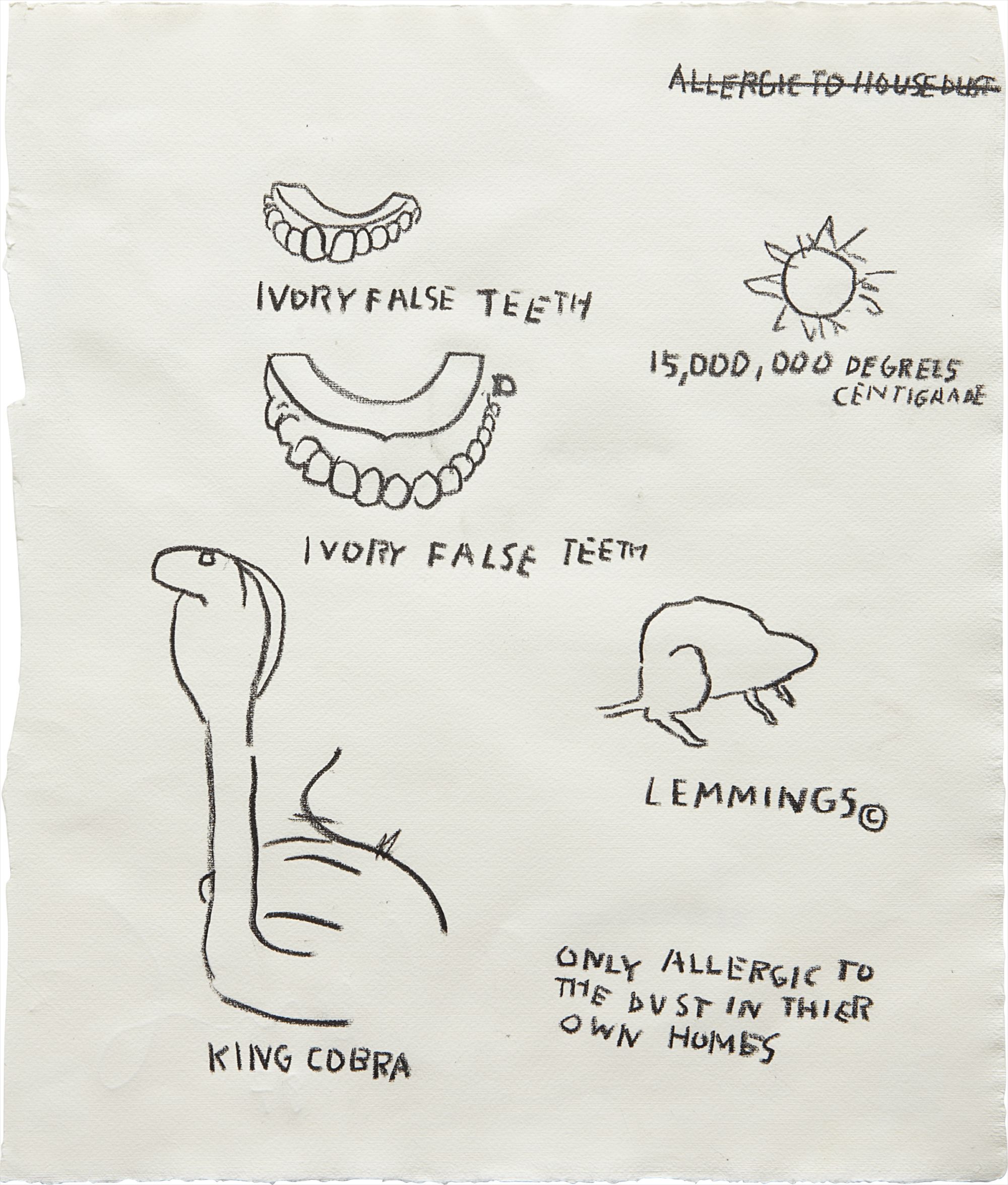
For Basquiat, these symbols represented the world at its most basic level. As an ensemble, they generate an intellectual equation made even more mystical and mysterious by its pointed lack of color. Although they may be equations, they are not meant to be solved or deciphered through any linear formula. In creating and destroying, in scribbling and crossing out, Basquiat deters a definitive decoding of his work, leaving it open to infinite permutations and interpretative possibilities. In this way, he created “a calculated incoherence, calibrating the mystery of what such apparently meaning-laden pictures might ultimately mean.” (Mark Meyer, “Basquiat in History”, Basquiat, exh. cat., Brooklyn Museum of Art, 2005, p.51).
Jean-Michel Basquiat
American | B. 1960 D. 1988One of the most famous American artists of all time, Jean-Michel Basquiat first gained notoriety as a subversive graffiti-artist and street poet in the late 1970s. Operating under the pseudonym SAMO, he emblazoned the abandoned walls of the city with his unique blend of enigmatic symbols, icons and aphorisms. A voracious autodidact, by 1980, at 22-years of age, Basquiat began to direct his extraordinary talent towards painting and drawing. His powerful works brilliantly captured the zeitgeist of the 1980s New York underground scene and catapulted Basquiat on a dizzying meteoric ascent to international stardom that would only be put to a halt by his untimely death in 1988.
Basquiat's iconoclastic oeuvre revolves around the human figure. Exploiting the creative potential of free association and past experience, he created deeply personal, often autobiographical, images by drawing liberally from such disparate fields as urban street culture, music, poetry, Christian iconography, African-American and Aztec cultural histories and a broad range of art historical sources.