41
Jeff Koons
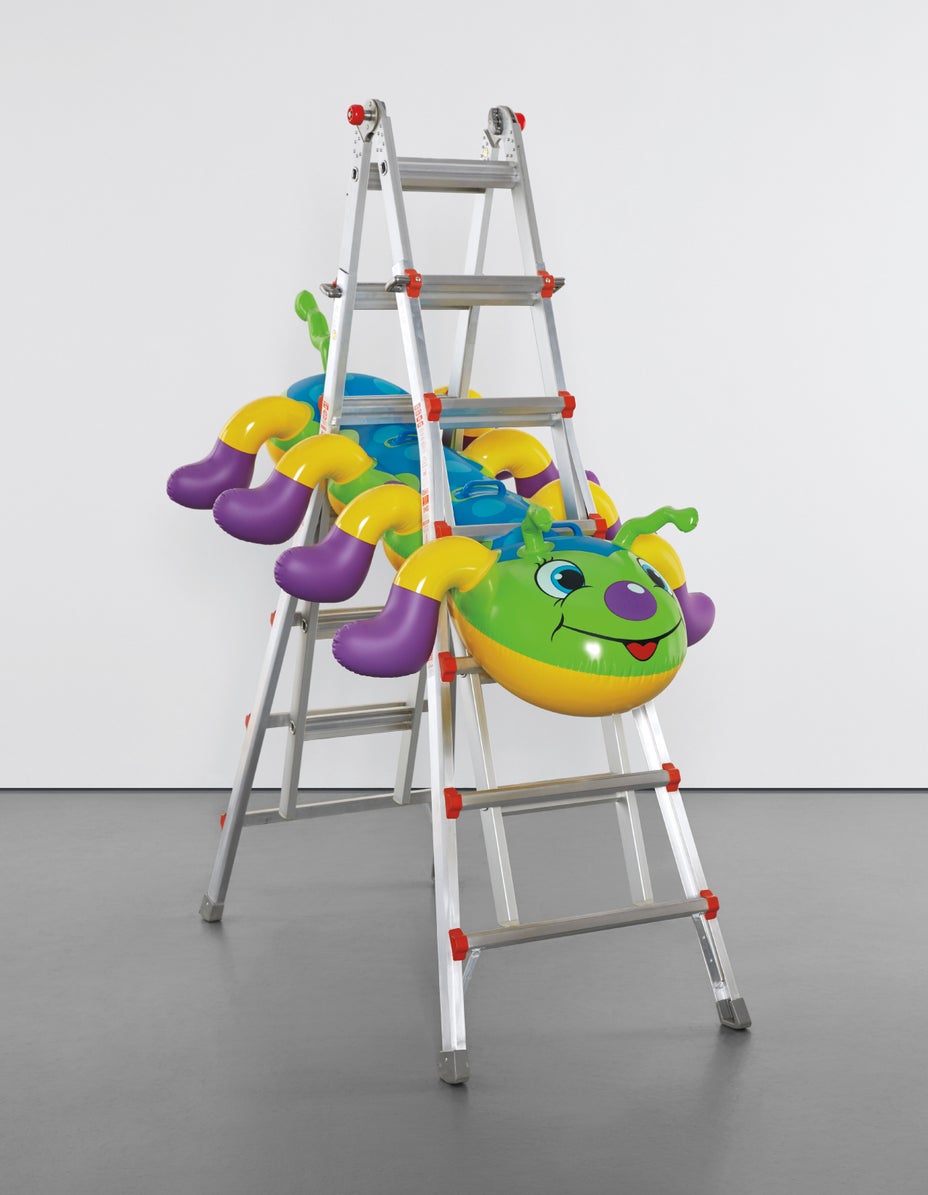
Caterpillar Ladder
Estimate
$1,500,000–2,000,000
Sold For
$2,055,000
polychromed aluminum, aluminum, and plastic
84 x 44 x 76 in. (213.4 x 111.8 x 193 cm.)
Executed in 2003, this work is number 3 from an edition of 3 plus 1 artist's proof.
Full-Cataloguing
"Pool toys are inflatable, just like people. Inflatables really are metaphors for the continuation of life.” — Jeff Koons
Created as part of Jeff Koons’s Popeye series, Caterpillar Ladder is an iconic sculpture that ties some of the artist’s most central themes and motifs together. For some of the sculptures in this series that debuted at the Sonnabend Gallery in 2003, Koons juxtaposed replicas of large inflatable pool toys with unaltered everyday objects to create striking, surrealistic sculptures that are as conceptually complex as they are visually arresting. Caterpillar Ladder, as the title suggests, consists of a large replica of an inflatable caterpillar pool toy that has miraculously wound its voluminous body through the rungs of an aluminum step-ladder. The seeming weightlessness of the inflatable caterpillar is belied by the density of its actual material, having been precisely cast in aluminum and painted to resemble supple plastic. Executed in an edition of three plus an artist’s proof, other examples of Caterpillar Ladder have been exhibited at the artist’s major exhibition at the Museum of Contemporary Art, Chicago, in 2008 and at the Popeye series exhibition at the Serpentine Gallery, London, in 2009, amongst others. Demonstrating Koons’s enduring interests in the ready-made, inflatable objects, and mass culture, Caterpillar Ladder powerfully builds on the central tenets of such acclaimed sculptures as Rabbit, 1986 and Balloon Dog, 1994-2000, while simultaneously prefiguring such recent masterpieces as Lobster, 2007-2012, and Popeye, 2000-2011.
Executed in 2003, the Popeye series signaled Koons’s return to the ready-made that had characterized much of his early work. As Koons exclaimed, “I’ve returned to the readymade. I’ve returned to really enjoying thinking about Duchamp. This whole world seems to have opened itself up again to me, the dialogue of art” (Hans Werner Holzwarth, ed., Jeff Koons, Cologne, 2009, p. 504). Inflatable objects have been among Koons’s favorite motifs since his early Inflatables series of the late 1970s. Whereas works from that series, such as Inflatable Flower and Bunny (Tall White, Pink Bunny), 1979, currently in the collection of the Broad Museum in Los Angeles, saw Koons juxtapose inflatables atop mirrors, the Popeye series distinguishes itself through the combination of both direct and altered ready-mades. Taking the forms of inflatable objects, as in his earlier work, Koons with the Popeye series had precise molds made that were then cast in aluminum. Each cast was then individually chased, sanded, and painted to make it visually indistinguishable from an actual pool inflatable – faithful to every crease and fold of the original vinyl object. While essentially continuing the labor-intensive process of replication pioneered with the Celebration series, the Popeye works are distinguished by the unlikely encounter between the pool inflatable and a simple, unaltered utilitarian object.
This juxtaposition of seemingly unrelated elements within Caterpillar Ladder and its related works links this series, as Hans Ulrich Obrist has pointed out, to the Surrealist notion chance encounter. As David Salle observed, “Koons’s art represents the conflation of the readymade with the dream of surrealism…Koons’s art…begins with the legacy of Duchamp but combines the Frenchman’s contrarian irony with the perverse, sexualized emotionality of Salvador Dalí” (David Salle, “The Art of Childhood: Jeff Koons at the Whitney”, in How to See: Looking, Talking, Thinking about Art, 2016, p. 76). With the Popeye series, Koons, who had painted neo-Surrealist paintings dream imagery during his fine art studies in the mid-1970s, pays homage to Dalí in the Surrealist combination of everyday objects and fantastical creatures. Indeed, Caterpillar Ladder has been interpreted as a reference to the famous hookah smoking caterpillar from Alice in Wonderland, Lewis Carroll’s fantasy novel that Dalí was so fascinated with that he created a set of drawings to accompany the story.
While working within the remit of Pop art in his embrace of consumer driven visual culture, Koons’s inspiration speaks to his strong investment in the mythology of the objects and characters themselves. “If Marcel Duchamp’s intention with the readymade was to expose an object that is bereft of any aesthetic quality, and therefore to remove art from the realm of the subjective,” as Dorothea von Hantelmann has pointed out, “Koons brings this subjective dimensions back in…the viewer attributes the subjective dimensions of these works to the toys, since, in contrast to a ladder or a chair, they have an affective quality. We might attach childhood memories to them —or feel sorry for the cute caterpillar whose many legs are so hopelessly caught” (Dorothea von Hantelmann, “Why Koons”, Jeff Koons Popeye Series, exh. cat., Serpentine Gallery, London, 2009, pp. 51-52). Koons has credited his fascination with inflatable blow-up toys to an early childhood memory of being given a flotation device to swim: “It was like a life-saving tank, it gave me a great sense of independence. Pool toys are inflatable, just like people. Inflatables really are metaphors for the continuation of life. Anything that is deflated is a symbol of death” (Jeff Koons, quoted in Tim Teeman, “From Popeye to puppies: Jeff Koons explains his love of outrageous art,” The Sunday Times, June 13, 2009, online).
Representing the symbol of growth and transformation, Caterpillar Ladder is rendered eternal through Koons’s process of casting. “When making the work,” Koons explained, “the most important thing to me is the preservation of the object – the sense that it has been created to survive and that its longevity is certain” (Jeff Koons, quoted in Julia Peyton-Jones and Hans Ulrich Obrist, “Jeff Koons in conversation”, Jeff Koons Popeye Series, exh. cat., Serpentine Gallery, London, 2009, pp. 71-72). As the caterpillar slithers through the ladder, as though making its way through an obstacle course, the composite sculpture in many ways becomes a metaphor for life. As Arthur C. Danto noted, “It does not hurt the animal, but it does require effort. The animals are nevertheless optimistic. They seem to say to themselves, ‘I’ll get through this!’” (Arthur C. Danto, “A New World for Popeye”, Jeff Koons Popeye Series, exh. cat., Serpentine Gallery, London, 2009, pp. 32-33). As such, Caterpillar Ladder brilliantly encapsulates how Koons’s work, in his own words, is mean to be “a support system for people to feel good about themselves and have confidence in themselves – to enjoy life, to have their life be as enriching as possible, to make them feel secure – a confidence in their own past history, so that they can move on to achieve whatever they want" (Jeff Koons, quoted in Jeff Koons, Cologne, 2009, p. 456).
Created as part of Jeff Koons’s Popeye series, Caterpillar Ladder is an iconic sculpture that ties some of the artist’s most central themes and motifs together. For some of the sculptures in this series that debuted at the Sonnabend Gallery in 2003, Koons juxtaposed replicas of large inflatable pool toys with unaltered everyday objects to create striking, surrealistic sculptures that are as conceptually complex as they are visually arresting. Caterpillar Ladder, as the title suggests, consists of a large replica of an inflatable caterpillar pool toy that has miraculously wound its voluminous body through the rungs of an aluminum step-ladder. The seeming weightlessness of the inflatable caterpillar is belied by the density of its actual material, having been precisely cast in aluminum and painted to resemble supple plastic. Executed in an edition of three plus an artist’s proof, other examples of Caterpillar Ladder have been exhibited at the artist’s major exhibition at the Museum of Contemporary Art, Chicago, in 2008 and at the Popeye series exhibition at the Serpentine Gallery, London, in 2009, amongst others. Demonstrating Koons’s enduring interests in the ready-made, inflatable objects, and mass culture, Caterpillar Ladder powerfully builds on the central tenets of such acclaimed sculptures as Rabbit, 1986 and Balloon Dog, 1994-2000, while simultaneously prefiguring such recent masterpieces as Lobster, 2007-2012, and Popeye, 2000-2011.
Executed in 2003, the Popeye series signaled Koons’s return to the ready-made that had characterized much of his early work. As Koons exclaimed, “I’ve returned to the readymade. I’ve returned to really enjoying thinking about Duchamp. This whole world seems to have opened itself up again to me, the dialogue of art” (Hans Werner Holzwarth, ed., Jeff Koons, Cologne, 2009, p. 504). Inflatable objects have been among Koons’s favorite motifs since his early Inflatables series of the late 1970s. Whereas works from that series, such as Inflatable Flower and Bunny (Tall White, Pink Bunny), 1979, currently in the collection of the Broad Museum in Los Angeles, saw Koons juxtapose inflatables atop mirrors, the Popeye series distinguishes itself through the combination of both direct and altered ready-mades. Taking the forms of inflatable objects, as in his earlier work, Koons with the Popeye series had precise molds made that were then cast in aluminum. Each cast was then individually chased, sanded, and painted to make it visually indistinguishable from an actual pool inflatable – faithful to every crease and fold of the original vinyl object. While essentially continuing the labor-intensive process of replication pioneered with the Celebration series, the Popeye works are distinguished by the unlikely encounter between the pool inflatable and a simple, unaltered utilitarian object.
This juxtaposition of seemingly unrelated elements within Caterpillar Ladder and its related works links this series, as Hans Ulrich Obrist has pointed out, to the Surrealist notion chance encounter. As David Salle observed, “Koons’s art represents the conflation of the readymade with the dream of surrealism…Koons’s art…begins with the legacy of Duchamp but combines the Frenchman’s contrarian irony with the perverse, sexualized emotionality of Salvador Dalí” (David Salle, “The Art of Childhood: Jeff Koons at the Whitney”, in How to See: Looking, Talking, Thinking about Art, 2016, p. 76). With the Popeye series, Koons, who had painted neo-Surrealist paintings dream imagery during his fine art studies in the mid-1970s, pays homage to Dalí in the Surrealist combination of everyday objects and fantastical creatures. Indeed, Caterpillar Ladder has been interpreted as a reference to the famous hookah smoking caterpillar from Alice in Wonderland, Lewis Carroll’s fantasy novel that Dalí was so fascinated with that he created a set of drawings to accompany the story.
While working within the remit of Pop art in his embrace of consumer driven visual culture, Koons’s inspiration speaks to his strong investment in the mythology of the objects and characters themselves. “If Marcel Duchamp’s intention with the readymade was to expose an object that is bereft of any aesthetic quality, and therefore to remove art from the realm of the subjective,” as Dorothea von Hantelmann has pointed out, “Koons brings this subjective dimensions back in…the viewer attributes the subjective dimensions of these works to the toys, since, in contrast to a ladder or a chair, they have an affective quality. We might attach childhood memories to them —or feel sorry for the cute caterpillar whose many legs are so hopelessly caught” (Dorothea von Hantelmann, “Why Koons”, Jeff Koons Popeye Series, exh. cat., Serpentine Gallery, London, 2009, pp. 51-52). Koons has credited his fascination with inflatable blow-up toys to an early childhood memory of being given a flotation device to swim: “It was like a life-saving tank, it gave me a great sense of independence. Pool toys are inflatable, just like people. Inflatables really are metaphors for the continuation of life. Anything that is deflated is a symbol of death” (Jeff Koons, quoted in Tim Teeman, “From Popeye to puppies: Jeff Koons explains his love of outrageous art,” The Sunday Times, June 13, 2009, online).
Representing the symbol of growth and transformation, Caterpillar Ladder is rendered eternal through Koons’s process of casting. “When making the work,” Koons explained, “the most important thing to me is the preservation of the object – the sense that it has been created to survive and that its longevity is certain” (Jeff Koons, quoted in Julia Peyton-Jones and Hans Ulrich Obrist, “Jeff Koons in conversation”, Jeff Koons Popeye Series, exh. cat., Serpentine Gallery, London, 2009, pp. 71-72). As the caterpillar slithers through the ladder, as though making its way through an obstacle course, the composite sculpture in many ways becomes a metaphor for life. As Arthur C. Danto noted, “It does not hurt the animal, but it does require effort. The animals are nevertheless optimistic. They seem to say to themselves, ‘I’ll get through this!’” (Arthur C. Danto, “A New World for Popeye”, Jeff Koons Popeye Series, exh. cat., Serpentine Gallery, London, 2009, pp. 32-33). As such, Caterpillar Ladder brilliantly encapsulates how Koons’s work, in his own words, is mean to be “a support system for people to feel good about themselves and have confidence in themselves – to enjoy life, to have their life be as enriching as possible, to make them feel secure – a confidence in their own past history, so that they can move on to achieve whatever they want" (Jeff Koons, quoted in Jeff Koons, Cologne, 2009, p. 456).