PROPERTY FROM A PRIVATE AMERICAN COLLECTION
28Ο︎◆︎
Jeff Wall
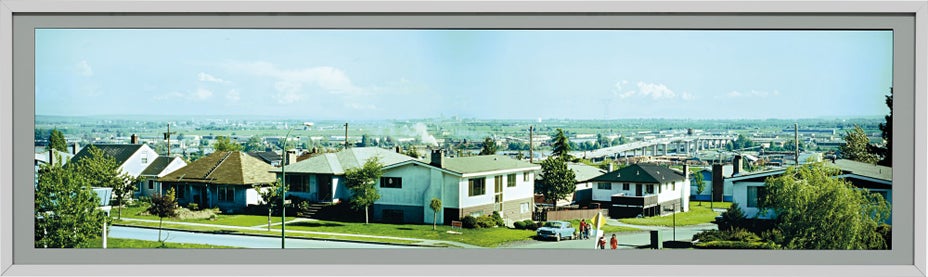
The Bridge
Estimate
$500,000–700,000
Sold For
$485,000
cibachrome transparency in fluorescent lightbox
image 23 7/8 x 90 in. (60.6 x 228.6 cm)
box 29 x 97 x 8 in. (73.7 x 246.4 x 20.3 cm)
box 29 x 97 x 8 in. (73.7 x 246.4 x 20.3 cm)
Signed twice "WALL" on the reverse. Printed in 1985. This work is number 3 from an edition of 3 plus 1 artist's proof.
Full-Cataloguing
“In a luminescent picture the source of the image is hidden …The site from which the image originates is always elsewhere…”
Jeff Wall, 1984
Through his illuminated transparencies, photographer Jeff Wall sets forth an impressive and seductive pictorial landscape. His large format scenes encompass the theatricality and compositional power of a classical history painting set amidst a suburban environment. Wall's carefully crafted photographic tableaux represents a contemporary scene of American life filled with suburban homes and towering smokestacks, a scene which many years from now will be studied as a visual cross section of where industry meets urbanization.
As a leading figure in the early 1970’s in Vancouver, his early photographs captured a diverse series of settings, from un-embellished realisms to flamboyant fantasies. Wall has chartered ambitious territory in his pursuit to capture this imposing world through a maze of resources: Conceptual Art, Neorealist cinema, philosophy, literature, critical theory, modernist photography, and even the tradition of European painting. Creating fewer than five works each year on average, Wall conceives and presents each picture as an isolated and singular statement. The concept for these self-contained illuminations were gleaned from the prosaic, as the artist explains: “I just kept seeing these things at the bus terminals and it just clicked that those backlit pictures might be a way of doing photography that would somehow connect those elements of scale and the body that were important to Donald Judd and Barnett Newman and Jackson Pollock, as well as Velázquez, Goya, Titian or Manet.” (Jeff Wall quoted in: Craig Burnett, Jeff Wall, London 2005, p. 9)
The panoramic The Bridge, 1980 illustrates a sprawling, anonymous suburban housing development. Pitched roof houses, towering smoke chimneys, perfectly manicured lawns, and demure strolling neighbors comprise the picture-perfect world before us. This vivid and illuminated utopia is accessed by a mammoth bridge, connecting one world to another. The carefully cropped and expansive panoramic scene leads the viewer to believe we stand at the edge of this suburban paradise, peering into this tableau from a darker more wild side. The Bridge is a member of what Wall refers to as his near documentary pictures. “The pictures I made between 1978 and about 1982 showed me some paths I could take…showed me how I could work in real places on themes derived from the most part my own experience, remembered and reconstructed. I guess that was the start of what I came to call my ‘near documentary’ pictures.” (Jeff Wall in “James Rondeau in dialogue with Jeff Wall,” Jeff Wall, exh. cat., The Museum of Modern Art, New York, 2007, p. 152)
The Bridge, 1980 acts as a documentary study, surveying the formation of modern residences. The transparency, glowing from an evenly lit light box emits a bluish hue, as though the image we are seeing is a paused scene from a film while the mundane composition keeps the image simultaneously rooted in reality, for Jeff Wall “this experience of two places, two worlds, in one moment is a central form of the experience of modernity. It’s an experience of dissociation, of alienation.” (Jeff Wall, 1984)
Jeff Wall, 1984
Through his illuminated transparencies, photographer Jeff Wall sets forth an impressive and seductive pictorial landscape. His large format scenes encompass the theatricality and compositional power of a classical history painting set amidst a suburban environment. Wall's carefully crafted photographic tableaux represents a contemporary scene of American life filled with suburban homes and towering smokestacks, a scene which many years from now will be studied as a visual cross section of where industry meets urbanization.
As a leading figure in the early 1970’s in Vancouver, his early photographs captured a diverse series of settings, from un-embellished realisms to flamboyant fantasies. Wall has chartered ambitious territory in his pursuit to capture this imposing world through a maze of resources: Conceptual Art, Neorealist cinema, philosophy, literature, critical theory, modernist photography, and even the tradition of European painting. Creating fewer than five works each year on average, Wall conceives and presents each picture as an isolated and singular statement. The concept for these self-contained illuminations were gleaned from the prosaic, as the artist explains: “I just kept seeing these things at the bus terminals and it just clicked that those backlit pictures might be a way of doing photography that would somehow connect those elements of scale and the body that were important to Donald Judd and Barnett Newman and Jackson Pollock, as well as Velázquez, Goya, Titian or Manet.” (Jeff Wall quoted in: Craig Burnett, Jeff Wall, London 2005, p. 9)
The panoramic The Bridge, 1980 illustrates a sprawling, anonymous suburban housing development. Pitched roof houses, towering smoke chimneys, perfectly manicured lawns, and demure strolling neighbors comprise the picture-perfect world before us. This vivid and illuminated utopia is accessed by a mammoth bridge, connecting one world to another. The carefully cropped and expansive panoramic scene leads the viewer to believe we stand at the edge of this suburban paradise, peering into this tableau from a darker more wild side. The Bridge is a member of what Wall refers to as his near documentary pictures. “The pictures I made between 1978 and about 1982 showed me some paths I could take…showed me how I could work in real places on themes derived from the most part my own experience, remembered and reconstructed. I guess that was the start of what I came to call my ‘near documentary’ pictures.” (Jeff Wall in “James Rondeau in dialogue with Jeff Wall,” Jeff Wall, exh. cat., The Museum of Modern Art, New York, 2007, p. 152)
The Bridge, 1980 acts as a documentary study, surveying the formation of modern residences. The transparency, glowing from an evenly lit light box emits a bluish hue, as though the image we are seeing is a paused scene from a film while the mundane composition keeps the image simultaneously rooted in reality, for Jeff Wall “this experience of two places, two worlds, in one moment is a central form of the experience of modernity. It’s an experience of dissociation, of alienation.” (Jeff Wall, 1984)