Property from the Miles and Shirley Fiterman Collection
114Ο︎
Joan Miró
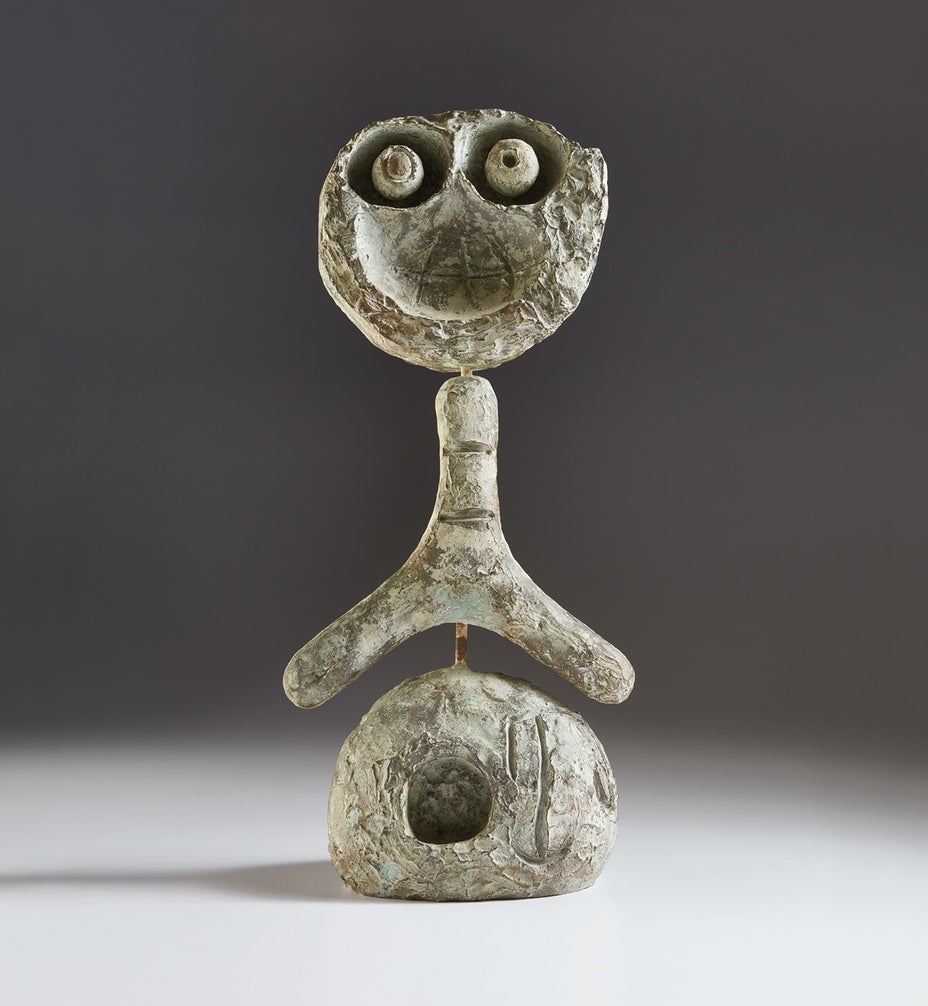
Torse de femme
Estimate
$250,000–350,000
Sold For
$350,000
incised with the artist's signature and number "Miró E.A. 1" and stamped with the Fundició Parellada foundry mark on the reverse
bronze with grey and brown patina
25 5/8 x 11 3/8 x 5 3/4 in. (65 x 29 x 14.5 cm.)
Conceived in 1967 and cast by Fundició Parellada, Barcelona, this work is artist's proof number 1 from an edition of 5 plus 3 artist's proofs and 1 nominative cast.
Full-Cataloguing
A playful subversion of the traditional female bust in sculpture, Joan Miró’s Torse de femme encapsulates how the artist continued to challenge artistic conventions as he shifted his focus from painting to sculpture starting in the late 1950s. "The sculptures from the last two decades of Miró's productive life took on a broad place and force," Jacques Dupin has noted. "For Miró, sculpture became an intrinsic adventure, an important means of expression that competed with the canvas and sheet of paper…without ever simply being a mere derivative or deviation from painting…He dreamt of the street, public squares, gardens and cities. Just as he had always sought to transgress painting, he now sought to transgress his own work” (Jacques Dupin, Miró, Barcelona, 2004, pp. 361- 367). Conceived in 1967, this work is one of three artist’s proofs from an edition of nine casts, of which other examples reside in such prominent collections as the Museo Reina Sofía, Madrid and the Fundació Joan Miró, Barcelona.
Torse de femme presents a powerful continuation of the body of work Miró referred to as Femme. Begun in 1949 with his earliest bronzes, he continued to develop the series further throughout the decades with a remarkably experimental approach. While he created some sculptures by first modeling them in clay, this work was assembled from found objects and then cast in bronze. Torse de femme is a powerful example of how Miró distilled the human form with an aesthetic reminiscent of the Art Brut of Jean Dubuffet, subverting the conventions of traditional sculpture by using what he referred to as “raw materials”. As he explained of his process of using the found materials he collected on strolls through the countryside, “I feel attracted to an object by a magnetic force, without the slightest premediation, and then I feel myself being drawn to another object which is added to the first, and in combination they create a poetic shock, preceded by that visual and physical revelation which makes poetry truly moving…” (Joan Miro, Joan Miro: Selected Writings and Interviews, Boston, 1986, p. 125).
Torse de femme presents a powerful continuation of the body of work Miró referred to as Femme. Begun in 1949 with his earliest bronzes, he continued to develop the series further throughout the decades with a remarkably experimental approach. While he created some sculptures by first modeling them in clay, this work was assembled from found objects and then cast in bronze. Torse de femme is a powerful example of how Miró distilled the human form with an aesthetic reminiscent of the Art Brut of Jean Dubuffet, subverting the conventions of traditional sculpture by using what he referred to as “raw materials”. As he explained of his process of using the found materials he collected on strolls through the countryside, “I feel attracted to an object by a magnetic force, without the slightest premediation, and then I feel myself being drawn to another object which is added to the first, and in combination they create a poetic shock, preceded by that visual and physical revelation which makes poetry truly moving…” (Joan Miro, Joan Miro: Selected Writings and Interviews, Boston, 1986, p. 125).