
25
Joaquín Torres-García
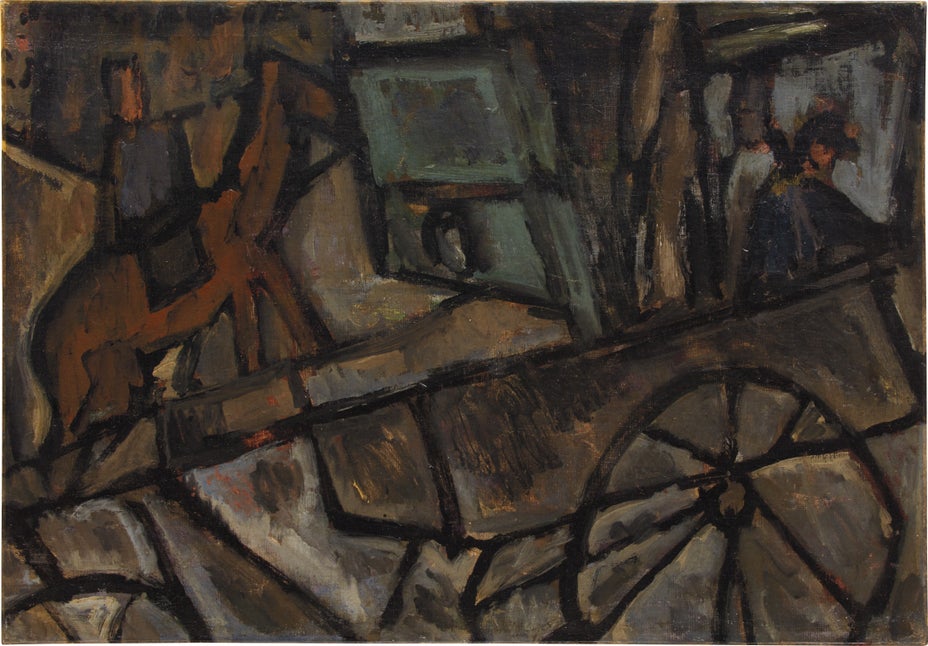
Straatscène met wagen
- Estimate
- $60,000 - 80,000
$62,500
Lot Details
oil on canvas
14 1/4 x 20 5/8 in. (36.2 x 52.4 cm)
Painted in 1928, this work is accompanied by a certificate of authenticity signed by Cecilia de Torres and is no. 1928.226 in the Joaquín Torres-García Online Catalogue Raisonné.
Specialist
Full-Cataloguing
Catalogue Essay
Dr. J.F.S. Esser (1877-1946) was a true Renaissance man. Not only an innovative surgeon who pioneered plastic surgery, he was also a casino owner, a seigneur and even a vaudeville impresario. In addition to his many accomplishments in the field of medicine, Esser was passionate about art. Esser’s patient, the artist Jan Sluijters, opened his eyes to the world of Dutch modernism, including Leo Gestel, Piet van der Hem and Piet Mondrian. Between 1906 and 1912, Esser collected over 1000 artworks, many of which he traded for his medical services. In 1906, the Singer Museum in Laren curated an exhibition titled The Unstoppable Collector J.F.S. Esser, which showed a wide range of his collection, demonstrating how important Esser was to the adaptation of modern art in The Netherlands. It is no surprise that Esser’s taste in art led him to the Uruguayan artist Joaquín Torres-García, who spent over forty years living abroad in Europe. During a period in Paris that began in 1926, Torres-García met Piet Mondrian. Along with Michel Seuphor, Mondrian and Torres-García would go on to found the movement Cercle et Carré (Circle and Square). Painted during this period, the present lot exemplifies Torres-García's early experiments in Constructivism, as portrayed in the gridded pictorial landscape that breaks down the scene into flat, simplified shapes.
Provenance
Exhibited
Literature
Joaquín Torres-García
Uruguayan | B. 1874 D. 1949Joaquín Torres-García was born in Montevideo and moved to Barcelona with his family, studying at the Escuela Oficial de Bellas Artes. The Catalan Noucentismo movement provided the foundation for his artistic development. His work was also influenced by Neo-Plasticism, Cubism and Vibrationism, which fused Cubism and Futurism with urban imagery.
Torres-García returned to Uruguay after a 43-year absence. While at home, he continued to develop his iconic style of Constructive Universalism, a chief contribution to modernism that affected many younger generations of Uruguayan artists. This style aspired to establish a universal structural unity through synthetic abstraction. In order to accomplish this, Torres-García synthesized rather than analyzed the quotidian elements and urban scenes from reality. While remaining in the world of figuration, he integrated abstraction's structural grids within the composition, also incorporating pre-Columbian aesthetics.
Browse ArtistTorres-García returned to Uruguay after a 43-year absence. While at home, he continued to develop his iconic style of Constructive Universalism, a chief contribution to modernism that affected many younger generations of Uruguayan artists. This style aspired to establish a universal structural unity through synthetic abstraction. In order to accomplish this, Torres-García synthesized rather than analyzed the quotidian elements and urban scenes from reality. While remaining in the world of figuration, he integrated abstraction's structural grids within the composition, also incorporating pre-Columbian aesthetics.