348
Joe Bradley
Untitled Freek
Estimate
$400,000–600,000
Sold For
$524,000
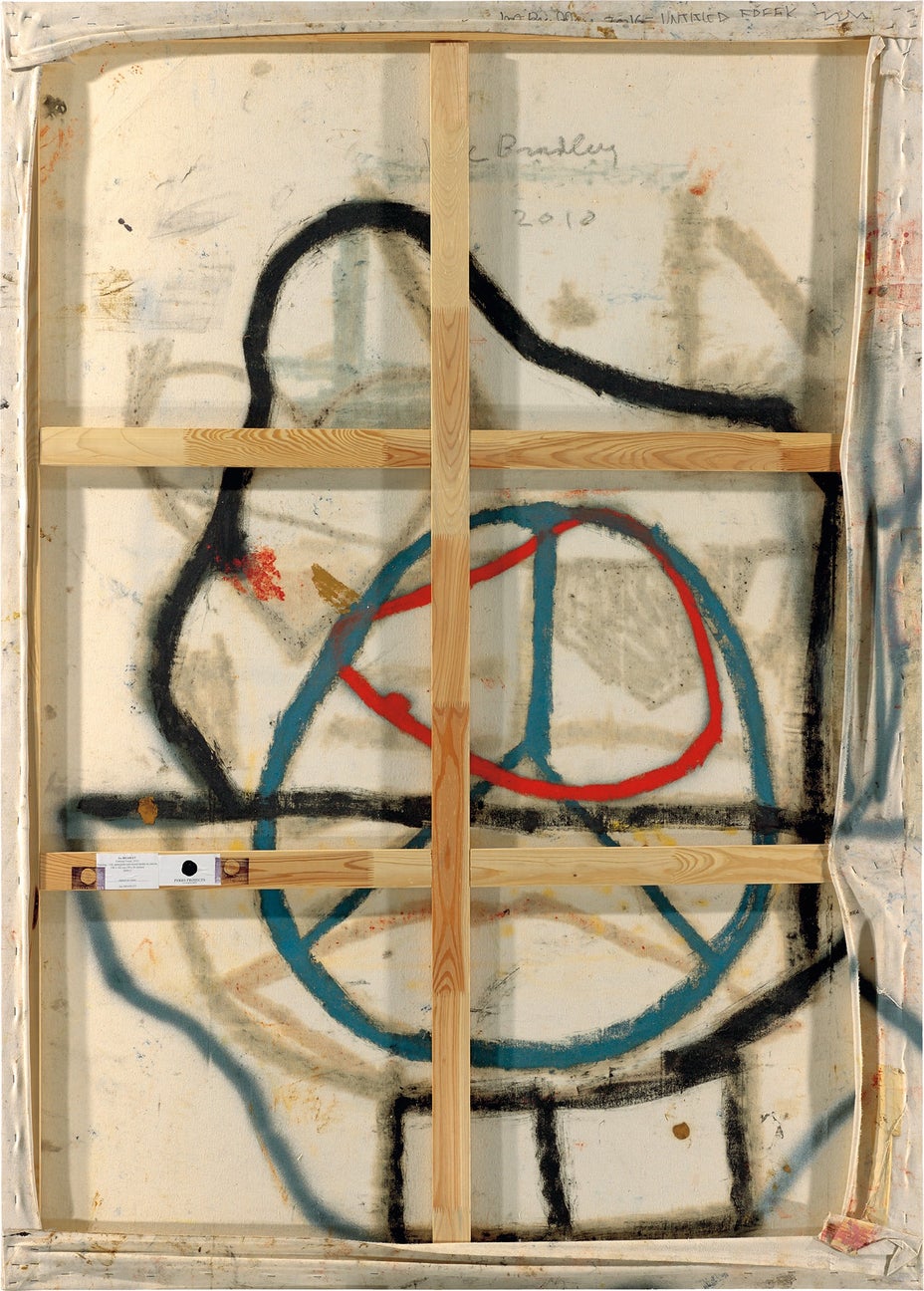
signed, titled, indistinctly inscribed and dated "Joe Bradley 2010 UNTITLED FREEK" on the overlap; further signed and dated "Joe Bradley 2010" on the reverse
oil, spray paint and mixed media on canvas
78 x 56 in. (198.1 x 142.2 cm.)
Executed in 2010.
Full-Cataloguing
“I like to see what someone who doesn’t draw does draw when they draw. It’s always the same stuff...I’ve been paying attention to graffiti too, tags and that sort of thing. It’s funny. It’s just visual background noise until you start to engage with it, and then you just realize that it’s everywhere.” - Joe Bradley
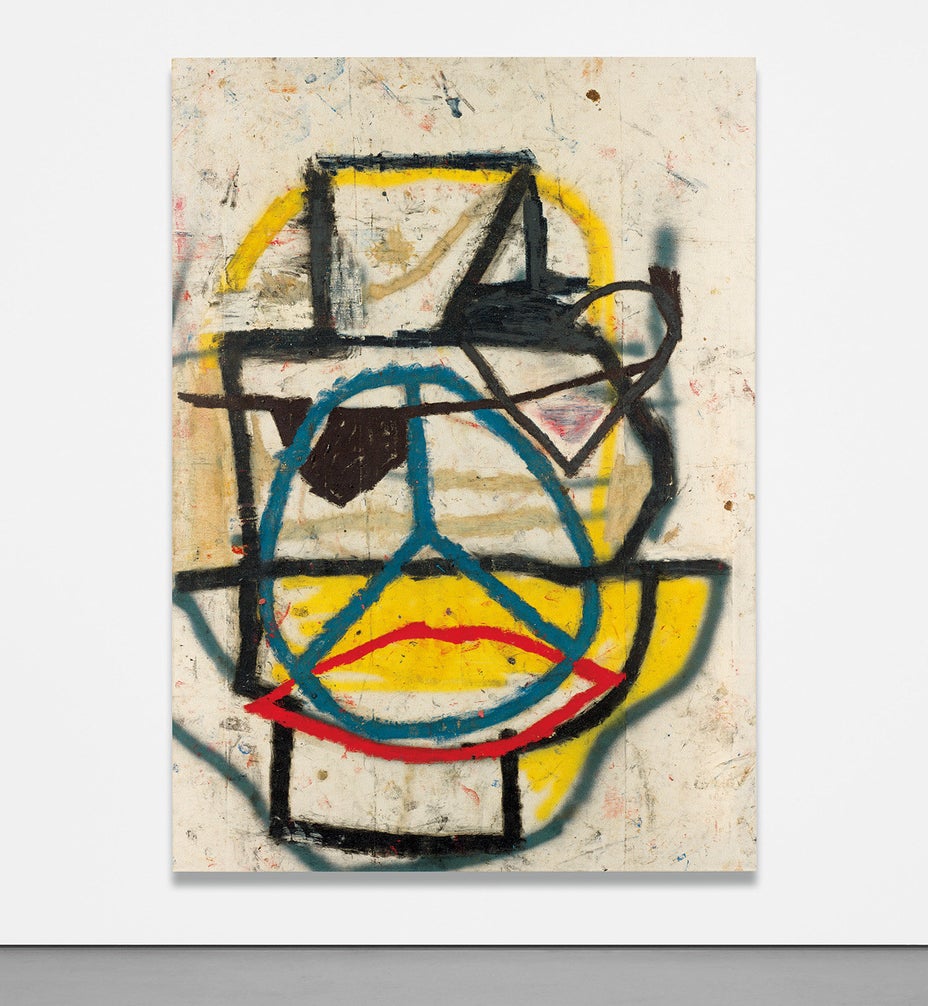
Executed in 2010, just two years after his career-altering inclusion in the Whitney Biennial, Untitled Freek exemplifies the ever-evolving nature of Joe Bradley's artistic practice. The present lot marks the artist’s pivotal transition away from his minimalist-inspired modular monochromes toward a more painterly process. In Untitled Freek seemingly haphazard paint smears, canvas creases and scattered footprints narrate its creation through Bradley's unconventional methods of working with an unprimed canvas on the studio floor. Successfully breaking the mold of stale art historical conventions of composition, Bradley relishes in the radical themes emphasized in his work.
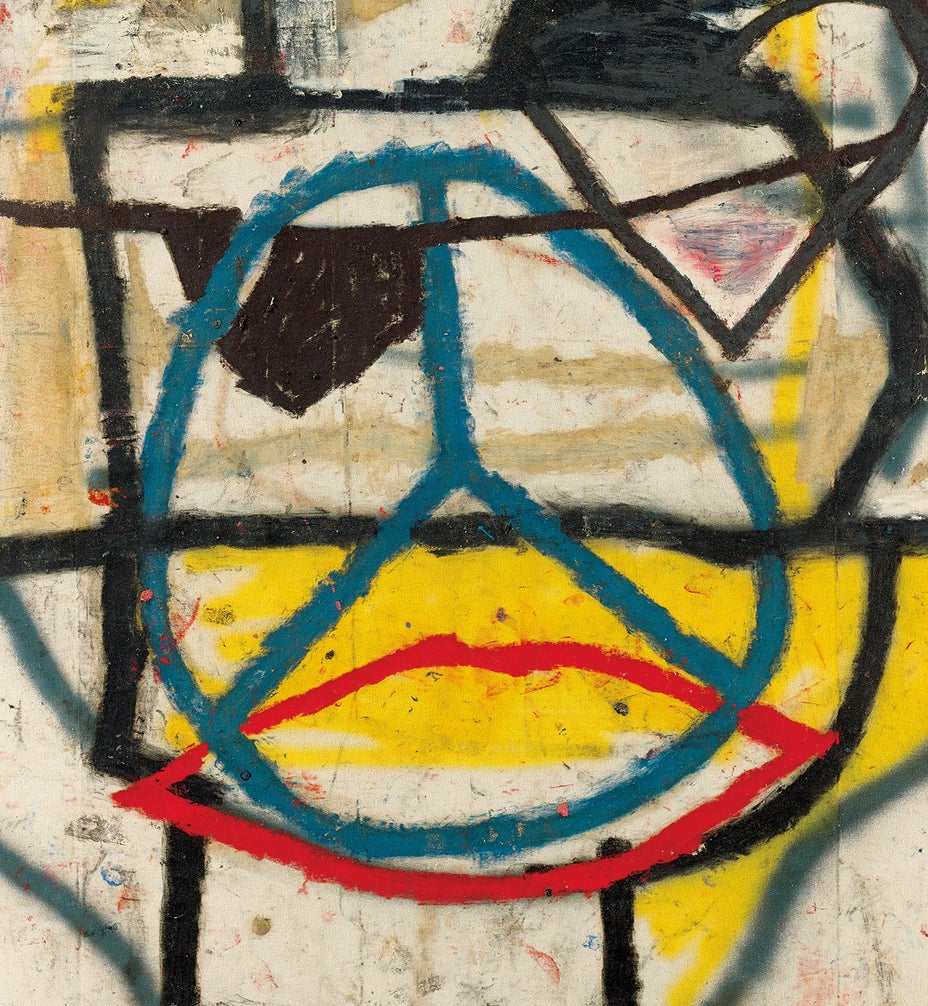
Introducing dimension and vibrant primary colors into his work proceeding the very sparse Schmagoo series, Bradley features raw yellow scribbles and bold graphic lines throughout Untitled Freek. His quasi-figurative style further encourages viewers to intently peruse the painting and make sense of the large-scale doodles. Resisting confinement as an abstractionist, Bradley affirms that there are figurative elements present in every work that enable one to extract a narrative within his imagery. “I had been thinking of them as having personality or hoping they would have personality. I liked the idea of a painting having a sort of ambiance, giving off a vibe. Like you could look at one out of the corner of your eye like you would a stranger in the room” (Joe Bradley, quoted in Ross Simonini, “An Interview with Joe Bradley", The Believer, November 1, 2012, online). These figurative themes take form in Untitled Freek, most noticeably in the blue peace sign, which stands out prominently against the clutter of seemingly abstract sketches behind it. When digesting the work in totality, it appears that the red, almond-shaped outline resembles the outer edge of a plump pair of lips and the triangular shapes in the center, an expressive set of eyes. Bearing a visual resemblance to Jean-Michel Basquiat’s evocative marks, Bradley scrawls simplified pictorial symbols inspired by primitive cave paintings, hieroglyphs, and graffiti. Untitled Freek expertly channels the same energetic quality and functions as a liberated example of self-expression that rejects traditional modes of representation.
Executed in 2010, just two years after his career-altering inclusion in the Whitney Biennial, Untitled Freek exemplifies the ever-evolving nature of Joe Bradley's artistic practice. The present lot marks the artist’s pivotal transition away from his minimalist-inspired modular monochromes toward a more painterly process. In Untitled Freek seemingly haphazard paint smears, canvas creases and scattered footprints narrate its creation through Bradley's unconventional methods of working with an unprimed canvas on the studio floor. Successfully breaking the mold of stale art historical conventions of composition, Bradley relishes in the radical themes emphasized in his work.
Introducing dimension and vibrant primary colors into his work proceeding the very sparse Schmagoo series, Bradley features raw yellow scribbles and bold graphic lines throughout Untitled Freek. His quasi-figurative style further encourages viewers to intently peruse the painting and make sense of the large-scale doodles. Resisting confinement as an abstractionist, Bradley affirms that there are figurative elements present in every work that enable one to extract a narrative within his imagery. “I had been thinking of them as having personality or hoping they would have personality. I liked the idea of a painting having a sort of ambiance, giving off a vibe. Like you could look at one out of the corner of your eye like you would a stranger in the room” (Joe Bradley, quoted in Ross Simonini, “An Interview with Joe Bradley", The Believer, November 1, 2012, online). These figurative themes take form in Untitled Freek, most noticeably in the blue peace sign, which stands out prominently against the clutter of seemingly abstract sketches behind it. When digesting the work in totality, it appears that the red, almond-shaped outline resembles the outer edge of a plump pair of lips and the triangular shapes in the center, an expressive set of eyes. Bearing a visual resemblance to Jean-Michel Basquiat’s evocative marks, Bradley scrawls simplified pictorial symbols inspired by primitive cave paintings, hieroglyphs, and graffiti. Untitled Freek expertly channels the same energetic quality and functions as a liberated example of self-expression that rejects traditional modes of representation.