14Ο︎◆︎
John Chamberlain
Endzoneboogie
Estimate
$800,000–1,200,000
Sold For
$900,000
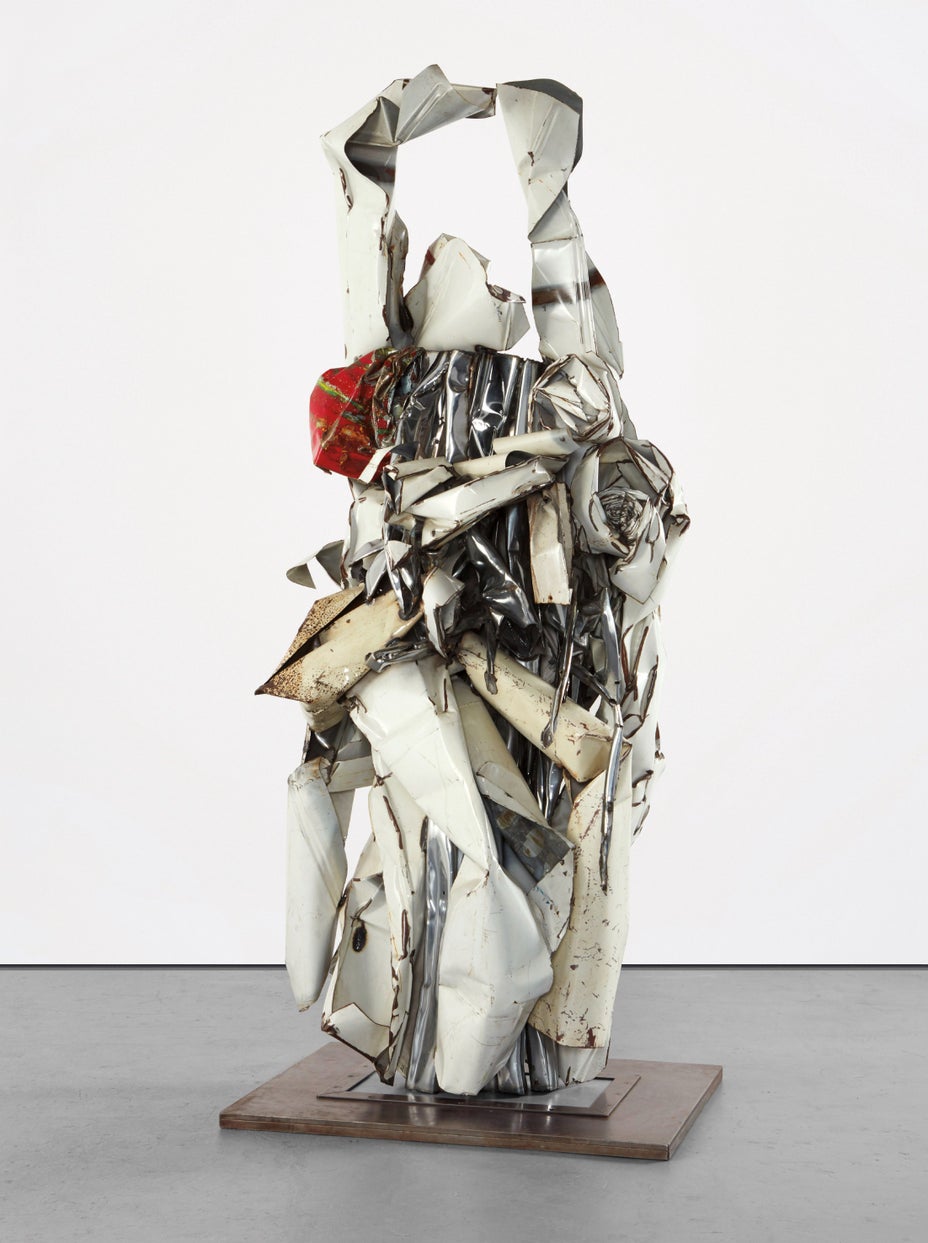
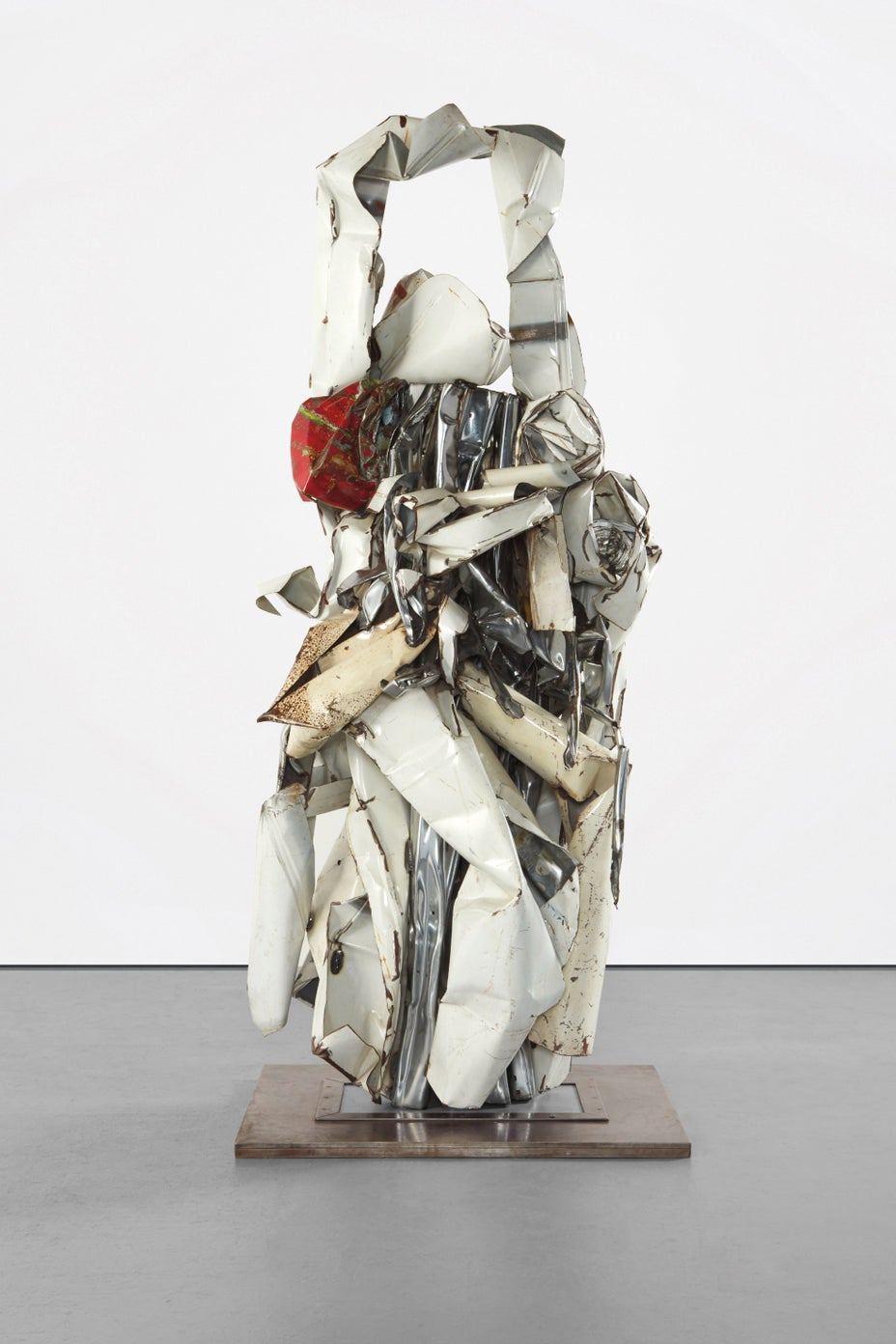
painted and chrome plated steel
116 x 48 1/2 x 48 1/2 in. (294.6 x 123.2 x 123.2 cm.)
Executed in 1988.
Full-Cataloguing
“Its daily life. That’s where I get the idea that everybody makes sculpture every day, whether in the way they throw the towel over the rack or the way they wad up the toilet paper…those little things, like blowing up a paper bag and hitting it so it pops – take it one little step further and do it in slow motion and explore what the resistance of the air in the bag is, and you make something.” – John Chamberlain
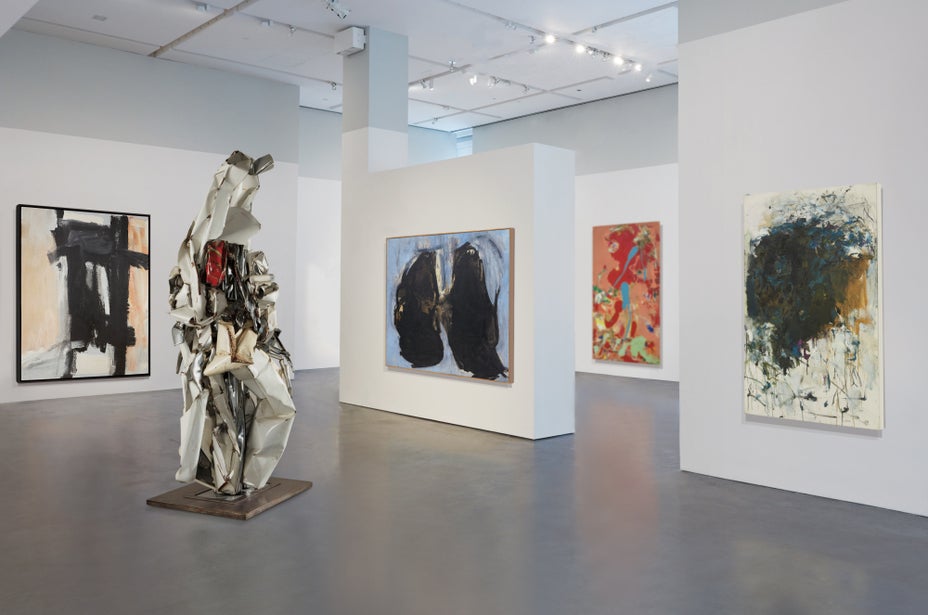
Elegantly winding itself into a soaring totem-like sculpture, Endzoneboogie is a striking example of John Chamberlain’s late oeuvre. Evocative of Velvet White, 1962, Whitney Museum of American Art, New York, the sculpture’s voluminous form is beautifully manipulated as one might fold a piece of fabric – belying the material weight of the discarded automobile parts from which it is elaborately constructed. The winding folds, interlaced with streaks of vibrant color and slashes of reflective chrome, give a sense of rotational force – encouraging the viewer to walk around the jagged form to experience Endzoneboogie in full. Executed in 1988, the work belongs to a group of fifteen freestanding vertical sculptures that debuted at the artist’s first solo show at The Pace Gallery in New York in 1989, including The Bride, 1988, Centre Georges Pompidou, Paris. Within this body of work, Endzoneboogie stood out as one of the tallest and most ambitious. While continuing Chamberlain’s signature process of using salvaged automobile metal, these works in particular demonstrate the artist’s use of discarded van tops from the mid-1980s onwards. Endzoneboogie exemplifies how he typically cut these van tops into strips, painted them and then torqued, crimped and rolled them into shape with metal-working machinery. Endzoneboogie was directly acquired from this landmark exhibition by the eminent German collectors Anna and Josef Froehlich and has since been prominently exhibited in some of the most renowned museums internationally, including amongst others the Kunsthalle Baden-Baden; the Stedelijk Museum, Amsterdam; and Tate Gallery, London.
Endzoneboogie speaks to the increasing manipulation of form and color that entered Chamberlain’s oeuvre after his move to Sarasota, Florida in 1980. Like fellow New York transplants such as Robert Rauschenberg and James Rosenquist, Chamberlain’s move to Florida and purchase of a large warehouse provided him with the freedom for greater aesthetic experimentation. The unprecedented degree of space and viable resources allowed him to push the complexity and scale of his sculptures. As art curator Lynee Cooke noted of Endzoneboogie and the other new sculptures exhibited at The Pace Gallery in 1989, “The compositions have grown internally complex, as a plethora of small components twist and blend snakily into almost sinuous ribbons which, with mannerist serpentine elusiveness, prevent the whole from being comprehended from any single viewpoint” (Lynne Cooke, “John Chamberlain: New Sculpture”, The Pace Gallery, New York, 1989, online). In contrast to the ready identification with wrecked cars in his earlier works, Endzoneboogie articulates Chamberlain’s shift to creating more ambiguous sculptures that, with their deep folds, “resemble Renaissance drapery studies that imply the underlying presence of a figure, or conversely, a void” (Susan Davidson, “A Sea of Foam, an Ocean of Metal”, John Chamberlain: Choices, exh. cat., Solomon R. Guggenheim Museum, New York, 2012, p. 26).
Elegantly winding itself into a soaring totem-like sculpture, Endzoneboogie is a striking example of John Chamberlain’s late oeuvre. Evocative of Velvet White, 1962, Whitney Museum of American Art, New York, the sculpture’s voluminous form is beautifully manipulated as one might fold a piece of fabric – belying the material weight of the discarded automobile parts from which it is elaborately constructed. The winding folds, interlaced with streaks of vibrant color and slashes of reflective chrome, give a sense of rotational force – encouraging the viewer to walk around the jagged form to experience Endzoneboogie in full. Executed in 1988, the work belongs to a group of fifteen freestanding vertical sculptures that debuted at the artist’s first solo show at The Pace Gallery in New York in 1989, including The Bride, 1988, Centre Georges Pompidou, Paris. Within this body of work, Endzoneboogie stood out as one of the tallest and most ambitious. While continuing Chamberlain’s signature process of using salvaged automobile metal, these works in particular demonstrate the artist’s use of discarded van tops from the mid-1980s onwards. Endzoneboogie exemplifies how he typically cut these van tops into strips, painted them and then torqued, crimped and rolled them into shape with metal-working machinery. Endzoneboogie was directly acquired from this landmark exhibition by the eminent German collectors Anna and Josef Froehlich and has since been prominently exhibited in some of the most renowned museums internationally, including amongst others the Kunsthalle Baden-Baden; the Stedelijk Museum, Amsterdam; and Tate Gallery, London.
Endzoneboogie speaks to the increasing manipulation of form and color that entered Chamberlain’s oeuvre after his move to Sarasota, Florida in 1980. Like fellow New York transplants such as Robert Rauschenberg and James Rosenquist, Chamberlain’s move to Florida and purchase of a large warehouse provided him with the freedom for greater aesthetic experimentation. The unprecedented degree of space and viable resources allowed him to push the complexity and scale of his sculptures. As art curator Lynee Cooke noted of Endzoneboogie and the other new sculptures exhibited at The Pace Gallery in 1989, “The compositions have grown internally complex, as a plethora of small components twist and blend snakily into almost sinuous ribbons which, with mannerist serpentine elusiveness, prevent the whole from being comprehended from any single viewpoint” (Lynne Cooke, “John Chamberlain: New Sculpture”, The Pace Gallery, New York, 1989, online). In contrast to the ready identification with wrecked cars in his earlier works, Endzoneboogie articulates Chamberlain’s shift to creating more ambiguous sculptures that, with their deep folds, “resemble Renaissance drapery studies that imply the underlying presence of a figure, or conversely, a void” (Susan Davidson, “A Sea of Foam, an Ocean of Metal”, John Chamberlain: Choices, exh. cat., Solomon R. Guggenheim Museum, New York, 2012, p. 26).