112
John Gerrard
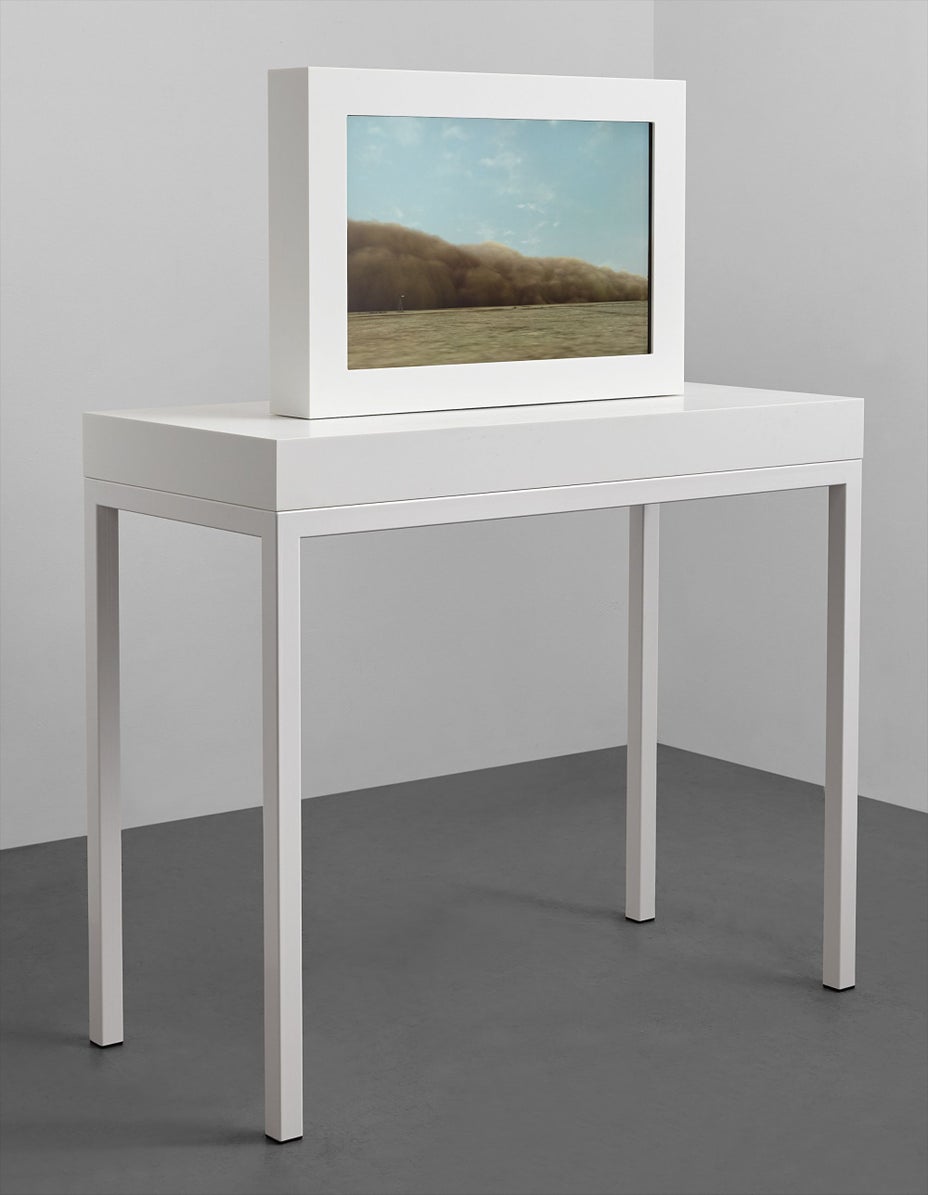
Dust Storm (Dalhart, Texas)
Estimate
$40,000–60,000
Sold For
$62,500
simulation, with artist's Corian frame and artist's Corian console table
screen 28 in. (71.1 cm)
overall 60 1/2 x 46 1/8 x 21 1/4 in. (153.7 x 117.2 x 54 cm)
overall 60 1/2 x 46 1/8 x 21 1/4 in. (153.7 x 117.2 x 54 cm)
Signed, titled, numbered and dated twice "Dust Storm (Dalhart, Texas) 2007 5/6 2007 John Gerrard" on a card inside artist's box. Further signed, numbered and dated "John Gerrard 2007 5/6" on a label affixed to the inside of the monitor casing.
This work is number 5 from an edition of 6.
This work is number 5 from an edition of 6.
Full-Cataloguing
"The medium of simulation speaks to these scenes as they are in effect minimal, and have a curious synthetic quality." - John Gerrard
Over the last decade, Irish-born artist John Gerrard’s video projections have elevated contemporary interpretations of the American landscape in both scope and medium. As an outsider representing a homeland that is not his own, Gerrard approaches his subject matter from an objective rather than a sentimental standpoint, resulting in imagery that is not patriotic, but instead overtly realistic and at times tragic.
The present lot occupies a unique position in the artist’s oeuvre of animated scenes, executed between 2007 and 2010, which featured reconstructions of historical events utilizing existing landscapes. Dust Storm (Dalhart, Texas) from 2007, named after its specific location in the American south, is actually the result of a hybrid of images. His source materials range from personal photographs and footage of an abandoned farm in the Texas panhandle, to archival photos from the Dust Bowl, the series of severe dust storms that engulfed areas across the country throughout the 1930s. Specifically, Gerrard derived his composition from one of the few surviving photos documenting Black Sunday, a large storm that hit the region on April 14, 1935. He further fabricates the scene with the inclusion of another photograph taken by an American soldier witnessing a dust storm in Iraq. The result is a multi-faceted visual amalgamation, brought to life with the utilization of realtime 3D in a seamless projection. Despite the variation in reference imagery, Gerrard’s resulting animation is a remarkably conceivable depiction of an imaginary force of nature.
Gerrard’s projections, or self-described “simulations,” are displayed on movable flat screen monitors that meet the viewer at eye level. One approaches the piece as if walking into the desolate scene, captivated by the 8-minute sequence which seems to move at once both slowly and rapidly. A threatening dust storm enters at the corner and moves steadily across the picture, containing only deserted farmhouses, telephone poles, windmills and rickety fences. The lack of human presence, a feature characteristic of many of Gerrard’s projections, leaves the desolate farmland ahead, the only victim to the storm. The viewer is left with an overwhelming feeling of helplessness and anxiety in response to the destructive nature of the storm. As Alan Artner describes the effect of the artist’s technical process in his review of his work in 2008, “The pity in the subject comes to viewers subliminally through a visual poem of complexity and power.” Gerrard’s Dust Storm thus brings to mind the irrevocable forces of nature in an aesthetically compelling way, those which continue to transform the landscape that we occupy.
Over the last decade, Irish-born artist John Gerrard’s video projections have elevated contemporary interpretations of the American landscape in both scope and medium. As an outsider representing a homeland that is not his own, Gerrard approaches his subject matter from an objective rather than a sentimental standpoint, resulting in imagery that is not patriotic, but instead overtly realistic and at times tragic.
The present lot occupies a unique position in the artist’s oeuvre of animated scenes, executed between 2007 and 2010, which featured reconstructions of historical events utilizing existing landscapes. Dust Storm (Dalhart, Texas) from 2007, named after its specific location in the American south, is actually the result of a hybrid of images. His source materials range from personal photographs and footage of an abandoned farm in the Texas panhandle, to archival photos from the Dust Bowl, the series of severe dust storms that engulfed areas across the country throughout the 1930s. Specifically, Gerrard derived his composition from one of the few surviving photos documenting Black Sunday, a large storm that hit the region on April 14, 1935. He further fabricates the scene with the inclusion of another photograph taken by an American soldier witnessing a dust storm in Iraq. The result is a multi-faceted visual amalgamation, brought to life with the utilization of realtime 3D in a seamless projection. Despite the variation in reference imagery, Gerrard’s resulting animation is a remarkably conceivable depiction of an imaginary force of nature.
Gerrard’s projections, or self-described “simulations,” are displayed on movable flat screen monitors that meet the viewer at eye level. One approaches the piece as if walking into the desolate scene, captivated by the 8-minute sequence which seems to move at once both slowly and rapidly. A threatening dust storm enters at the corner and moves steadily across the picture, containing only deserted farmhouses, telephone poles, windmills and rickety fences. The lack of human presence, a feature characteristic of many of Gerrard’s projections, leaves the desolate farmland ahead, the only victim to the storm. The viewer is left with an overwhelming feeling of helplessness and anxiety in response to the destructive nature of the storm. As Alan Artner describes the effect of the artist’s technical process in his review of his work in 2008, “The pity in the subject comes to viewers subliminally through a visual poem of complexity and power.” Gerrard’s Dust Storm thus brings to mind the irrevocable forces of nature in an aesthetically compelling way, those which continue to transform the landscape that we occupy.