Property of an Important European Collector
1
Jonas Wood
Mini French Open
Estimate
HK$400,000–600,000
€48,200–72,200
$51,300–76,900
Sold For
HK$1,625,000
signed with the artist's initials, titled, and dated 'Mini French Open JBRW 2012' on the reverse
oil and acrylic on canvas
59 x 51 cm (23 1/4 x 20 1/8 in.)
Painted in 2012.
Full-Cataloguing
“Wood has one foot in Modernist cool and the other in vibrant Pop Art.”
(Linda Yablonsky, “The Insider | Jonas Wood”, New York Times Style Magazine, 20 March 2012)
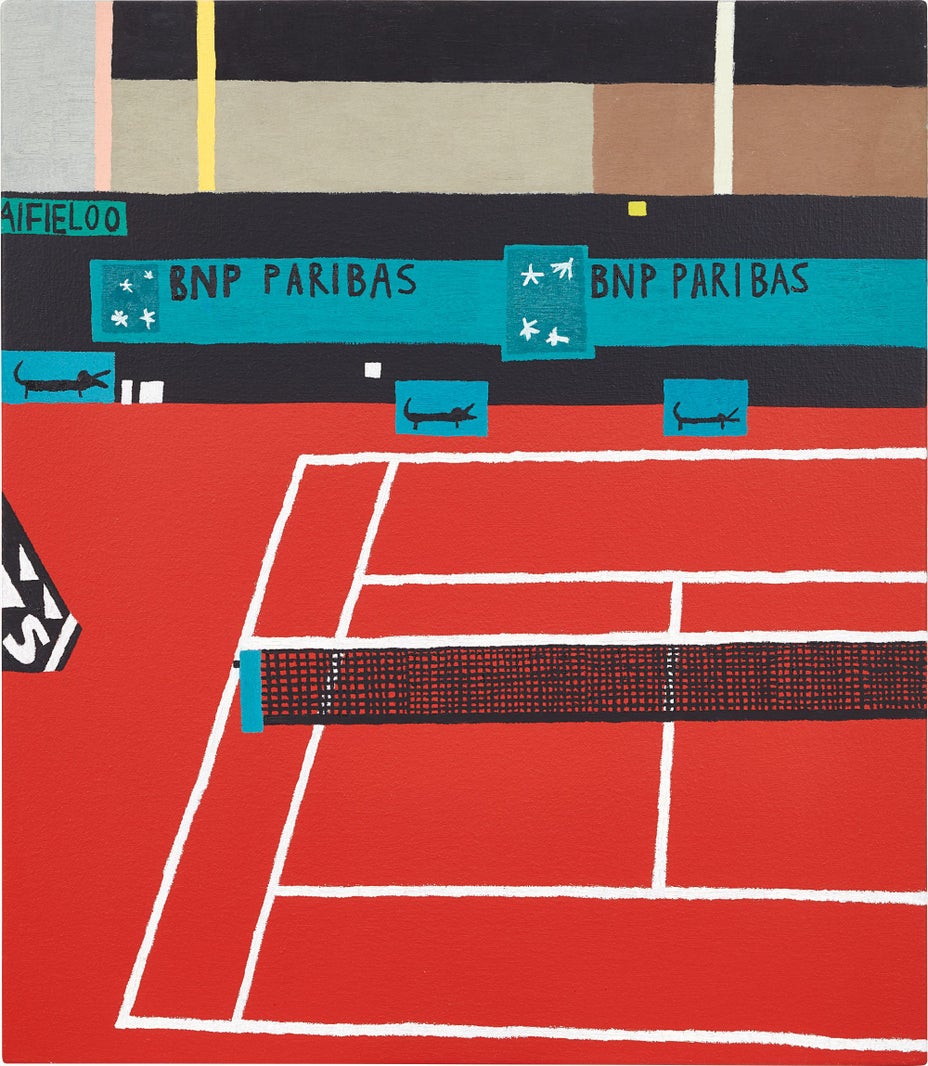
“My forms are not rendered spatially. My paintings of tennis courts were about an interest in abstraction, and how the court becomes a geometric puzzle. There also is text, because of the advertising. My work is under-painted with big flat shapes of colour; that is how they start. They are generated from an abundance of flat planes built up on top of each other.” (Jonas Wood, quoted in Jennifer Samet, “Beer with a Painter, LA Edition: Jonas Wood”, Hyperallergic, 12 September 2015)
Jonas Wood’s oeuvre is most notable for his reconsideration of the golden era of 20th Century American painting, drawing fine comparisons to artists such as Edward Hopper. Drawing inspiration from quotidian life, Wood creates bold works that distill and deconstruct the very meaning of the world around him, his subjects ranging from basketball players to living rooms. Condensing what he sees, Wood’s compact images are rendered in coloured blocks, “in a flat, Pop way” (Jonas Wood, quoted in Jennifer Samet, “Beer with a Painter, LA Edition: Jonas Wood”, Hyperallergic, 12 September 2015), not unlike those on sports cards, visual prompts which the artist has noted as important. In spite of this however, the artist’s works are far from two-dimensional. The seemingly simple final images that we see in Wood’s works are constructed atop many layers and flat planes, and in the case of pieces such as Mini French Open, the final result is a heightened version of reality, where images almost exist in a complete vacuum, stripped of original context. With its striking primary colours, the present work engages with a tennis court’s inherent geometry to create a trompe-l’oeil of sorts, where depth has been erased entirely, leaving the audience with an esoteric tennis court, uncanny yet unquestionably familiar.
(Linda Yablonsky, “The Insider | Jonas Wood”, New York Times Style Magazine, 20 March 2012)
“My forms are not rendered spatially. My paintings of tennis courts were about an interest in abstraction, and how the court becomes a geometric puzzle. There also is text, because of the advertising. My work is under-painted with big flat shapes of colour; that is how they start. They are generated from an abundance of flat planes built up on top of each other.” (Jonas Wood, quoted in Jennifer Samet, “Beer with a Painter, LA Edition: Jonas Wood”, Hyperallergic, 12 September 2015)
Jonas Wood’s oeuvre is most notable for his reconsideration of the golden era of 20th Century American painting, drawing fine comparisons to artists such as Edward Hopper. Drawing inspiration from quotidian life, Wood creates bold works that distill and deconstruct the very meaning of the world around him, his subjects ranging from basketball players to living rooms. Condensing what he sees, Wood’s compact images are rendered in coloured blocks, “in a flat, Pop way” (Jonas Wood, quoted in Jennifer Samet, “Beer with a Painter, LA Edition: Jonas Wood”, Hyperallergic, 12 September 2015), not unlike those on sports cards, visual prompts which the artist has noted as important. In spite of this however, the artist’s works are far from two-dimensional. The seemingly simple final images that we see in Wood’s works are constructed atop many layers and flat planes, and in the case of pieces such as Mini French Open, the final result is a heightened version of reality, where images almost exist in a complete vacuum, stripped of original context. With its striking primary colours, the present work engages with a tennis court’s inherent geometry to create a trompe-l’oeil of sorts, where depth has been erased entirely, leaving the audience with an esoteric tennis court, uncanny yet unquestionably familiar.