151
KAWS
Untitled
Full-Cataloguing
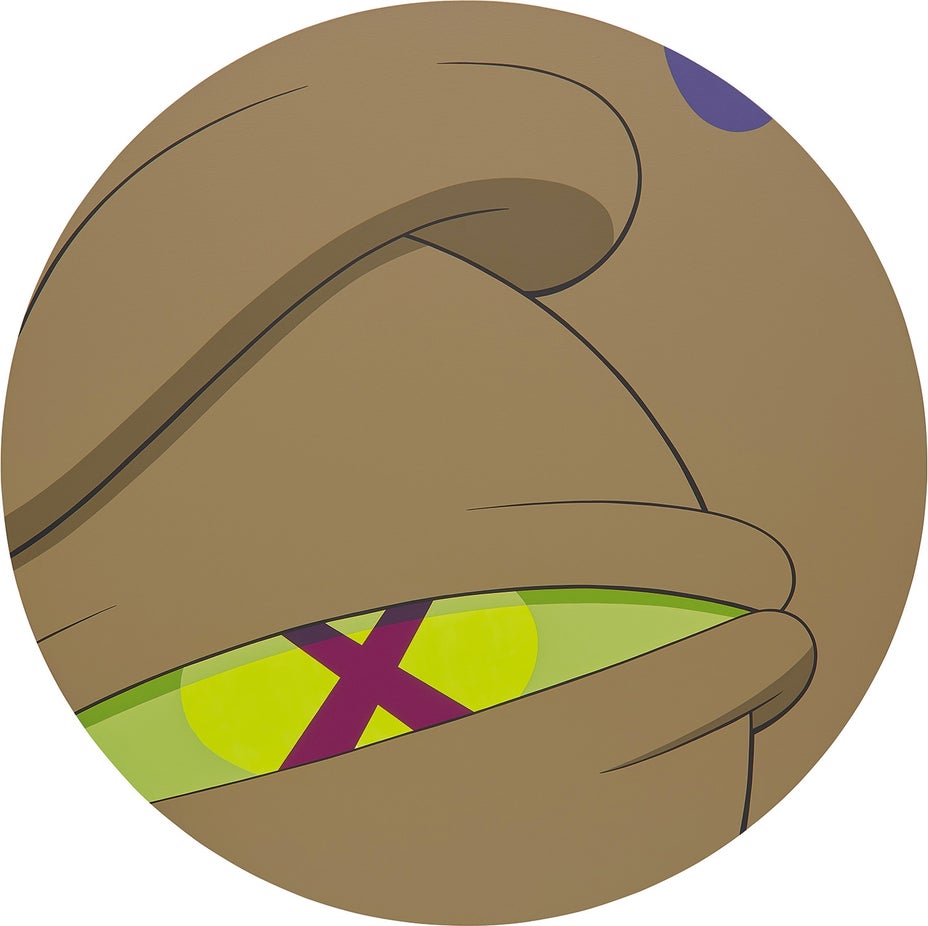
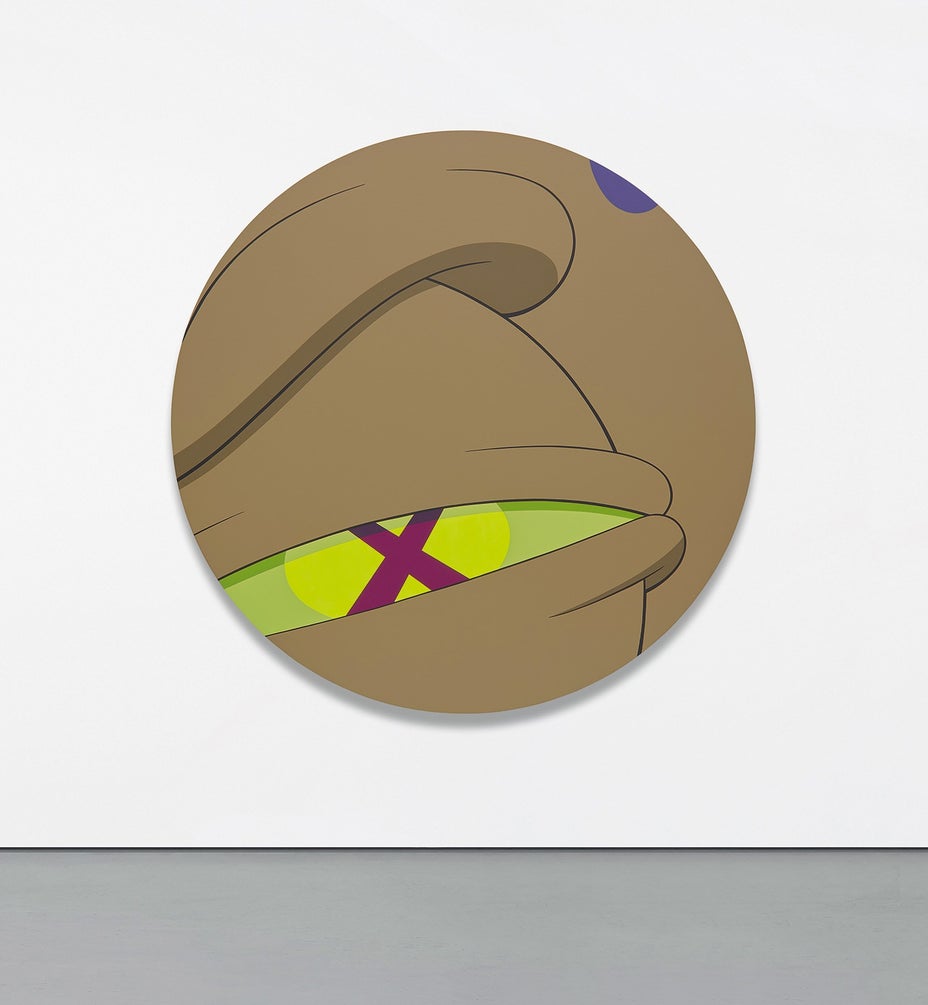
In Untitled, KAWS’ character is rendered in muted, amphibian-like hues that contrast sharply with the near-radioactive yellow of its eyes, suggestive of an otherworldly creature. Replacing its pupil, the character’s eye is marked by KAWS’ characteristic cross, his globally recognised cartoonish symbol which alludes to drunkenness, death or a piratical skull and crossbones. The result is an image stripped of comforting familiarity. As KAWS explains, ‘even though I use a comic language, my figures are not always reflecting the idealistic cartoon view that I grew up on, where everything has a happy ending...I want to understand the world I’m in and, for me, making and seeing art is a way to do that.’ (KAWS, quoted in KAWS. WHERE THE END STARTS, exh. cat., Modern Art Museum of Fort Worth, Fort Worth, 2016, p.5).
Visual quotation was also a common theme in the work of American pop artist Roy Lichtenstein, who, like KAWS, was heavily influenced by cartoon and comic book imagery; Lichtenstein commented that ‘artists have often converted the work of other artists to their own style.’ (Roy Lichtenstein, ‘A Review of My Work Since 1961’, in Graham Bader, Roy Lichtenstein, Cambridge, MA, 2009, p.61). Whereas Lichtenstein’s Mirror series exposed the artifice of the canvas by mimicking the surface of a mirror which cannot reflect, here KAWS uses the tondo formation to reflect the viewer’s reflection as a cartoon character, subsuming us into his protagonist's world. Continuing a dialogue with Pop and Street artists, KAWS captures an astute cultural consciousness in his work whilst simultaneously carving out a unique style. With a background in the New Jersey skateboarding community, KAWS’ oeuvre seeks to blur and level distinctions between perceived ‘high’ and ‘mass’ culture, his work playfully oscillating between traditional painting practice and recognisable cultural signifiers from the cartoon world of television, books and film.
KAWS
American | 1974To understand the work of KAWS is to understand his roots in the skateboard and graffiti crews of New York City. Brian Donnelly chose KAWS as his moniker to tag city streets beginning in the 1990s, and quickly became a celebrated standout in the scene. Having swapped spray paint for explorations in fine art spanning sculpture, painting and collage, KAWS has maintained a fascination with classic cartoons, including Garfield, SpongeBob SquarePants and The Simpsons, and reconfigured familiar subjects into a world of fantasy.
Perhaps he is most known for his larger-than-life fiberglass sculptures that supplant the body of Mickey Mouse onto KAWS' own imagined creatures, often with 'x'-ed out eyes or ultra-animated features. However, KAWS also works frequently in neon and vivid paint, adding animation and depth to contemporary paintings filled with approachable imagination. There is mass appeal to KAWS, who exhibits globally and most frequently in Asia, Europe and the United States.