401
Keith Haring
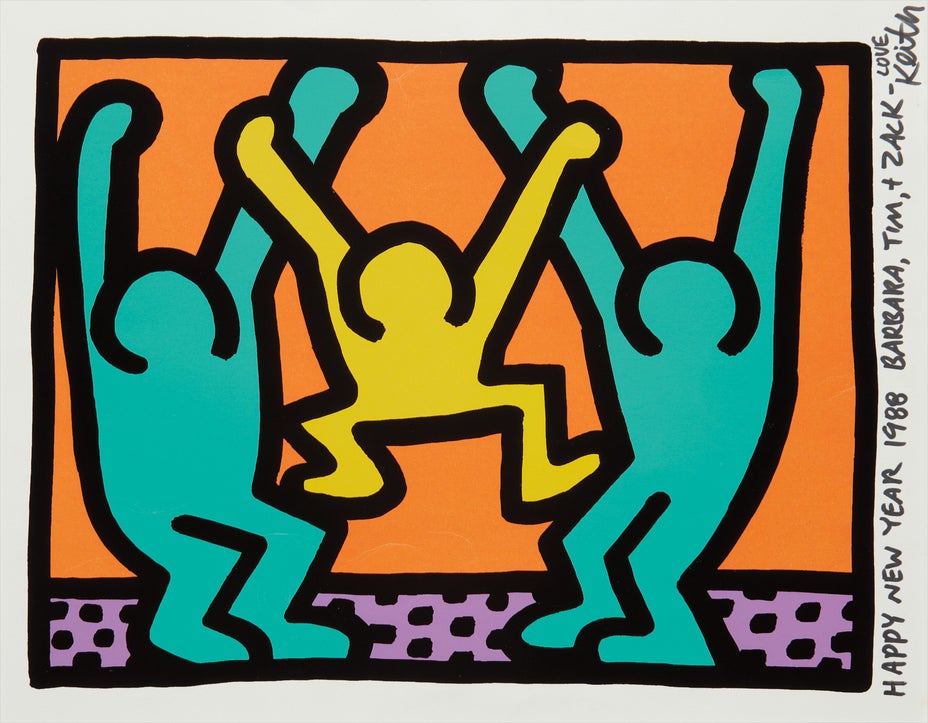
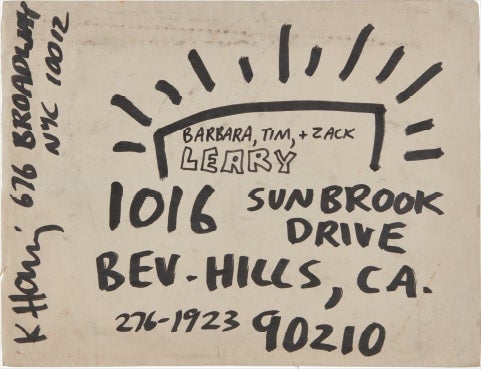
Pop Shop I: one plate, with accompanying unique envelope
Estimate
$7,000–10,000
Sold For
$15,000
1987
Screenprint in colors, on wove paper, with full margins and the accompanying addressed envelope to Timothy Leary.
I. 10 3/8 x 13 3/8 in. (26.4 x 34 cm)
S. 12 x 15 in. (30.5 x 38.1 cm)
envelope 14 x 18 in. (35.6 x 45.7 cm)
S. 12 x 15 in. (30.5 x 38.1 cm)
envelope 14 x 18 in. (35.6 x 45.7 cm)
Both signed, Pop Shop I dedicated 'Happy New Year 1988 Barbara, Tim, and Zack - Love Keith' in black ink (from the edition of 200), published by Martin Lawrence Limited Editions, New York, both framed.
Full-Cataloguing
Keith Haring addressed this work directly to his dear friend Timothy Leary, whom President Nixon once described as “the most dangerous man in America.” A leading researcher in the field of psychedelics, Leary coined the infamous phrase “turn on, tune in, drop out” before some questionable experiments with LSD forced him to drop out of Harvard’s research faculty. Throughout the 1980s Leary frequented the legendary New York City dance club Paradise Garage where he cavorted with local luminaries like the singer Grace Jones. In 1984 Grace Jones herself sparked a thrilling and illustrious friendship when she introduced Leary to Keith Haring. A friendship between the drug-positive advocate and this young street artist who turned the streets of New York into his canvas was instantaneous. Only some weeks later, Haring had sent Timothy Leary a set of drawings that he made while pouring over that researcher’s boisterous autobiography. Their years-long friendship became a prolific one, resulting in innovative collaborations in art, film, and technology.
Keith Haring
American | B. 1958 D. 1990Haring's art and life typified youthful exuberance and fearlessness. While seemingly playful and transparent, Haring dealt with weighty subjects such as death, sex and war, enabling subtle and multiple interpretations.
Throughout his tragically brief career, Haring refined a visual language of symbols, which he called icons, the origins of which began with his trademark linear style scrawled in white chalk on the black unused advertising spaces in subway stations. Haring developed and disseminated these icons far and wide, in his vibrant and dynamic style, from public murals and paintings to t-shirts and Swatch watches. His art bridged high and low, erasing the distinctions between rarefied art, political activism and popular culture.