Property of an Important American Collector
39
Kim Tschang-Yeul
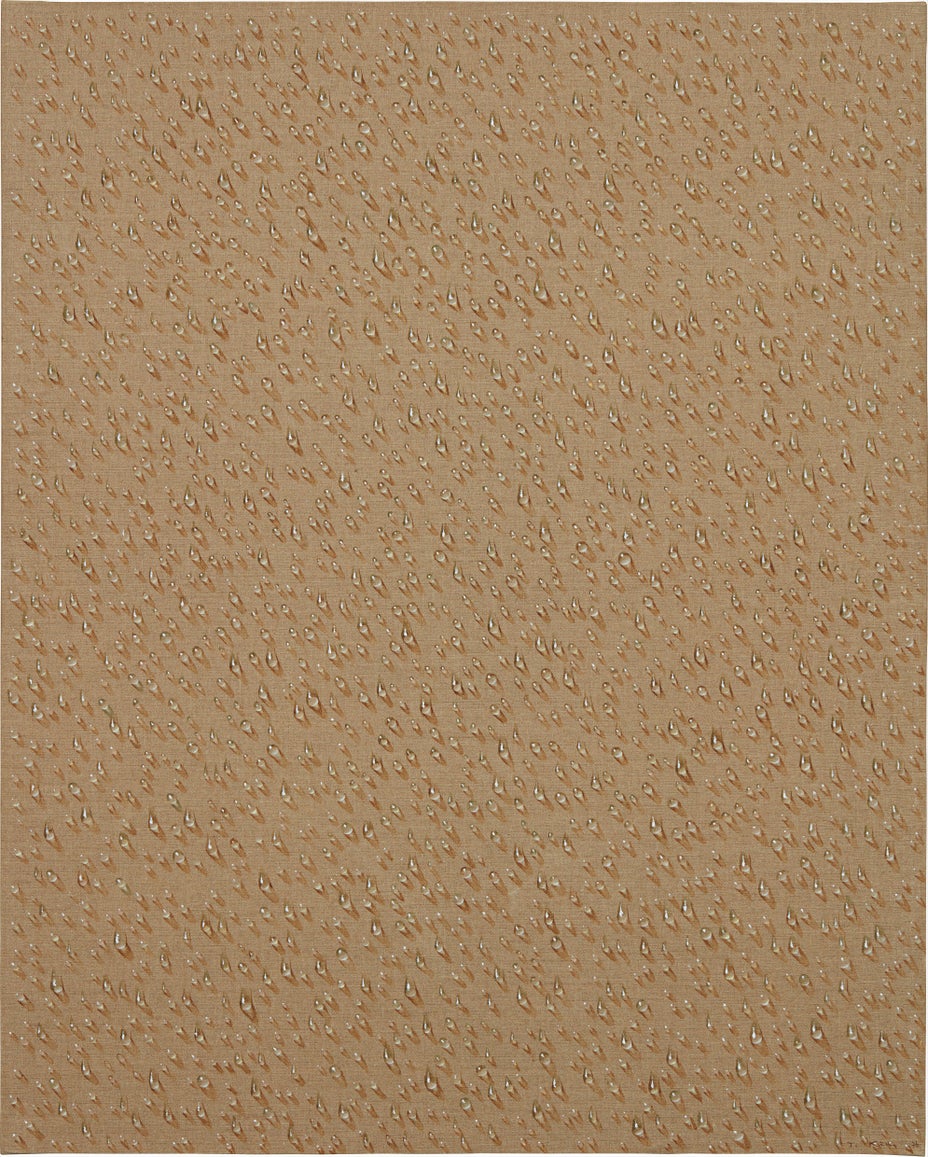
Gouttes d'eau
Estimate
HK$2,000,000–3,000,000
€221,000–331,000
$256,000–385,000
Sold For
HK$3,220,000
signed and dated 'T. Kim 76' lower right; further signed, titled and dated 'TSCHANG-YEUL KIM "Gouttes d'eau" 1976' on the reverse
oil on linen
162 x 130 cm. (63 3/4 x 51 1/8 in.)
Painted in 1976, this work is accompanied by a letter of authenticity signed by the artist.
Full-Cataloguing
“The reason for drawing drops of water is to dissolve everything into drops of water and return it transparently into nothingness. When we have turned anger, unease, and fear into emptiness, we can experience peace and harmony.” Kim Tschang-Yeul
Kim Tschang-Yeul is one of most significant South Korean artists and over the past forty years his acclaimed 'water drop' paintings have earned worldwide critical praise for their illusionistic appearance and skillful artistry. Studying calligraphy during his childhood sparked Kim’s fascination with the repetitive and delicate practice of mark making, leading him to study art in college in Seoul as a founder of the Hyeondae Misulga Hyeophoe (Contemporary Artists Association) in the 1950s. He continued his training in New York in the 1960s and later in Paris during the 1970s. While in Paris, Kim stumbled upon what would become his iconic water drop pattern. He recalled one morning he woke up in a barn in a Paris suburb that served as his studio and home; the previous evening he had sprayed water on a canvas to eradicate the dried oil paint in the hope of reusing the canvas. Through the barn window the morning sunlight fell upon the canvas and the water droplets appeared to glow, miraculously gleaming on the picture surface. Kim observed, "It was spectacular. It was like a symphony…..I took pictures of them and started thinking about how to express them on a canvas. Then began my lifelong task."
The starkness of the canvas of Gouttes d'eau, 1976 stands in direct opposition to the fluidity of the tactile and pristine water droplets. The illusionistic surface of the present lot reveals a seductive and highly skillful composition. The drops of moisture fall across the painting and provoke the viewer to lean in closer to inspect the hyperrealism and even to spark the desire to touch the surprisingly waterless drops. Each unique drop covers the canvas with spiraling repetition, touching on a link between water and Buddhist concepts of ritualistic purification; merging Western techniques of oil painting with the Eastern philosophy of natural, spiritual elements. As Kim explains, "I see repetition in terms of Buddhist prayer. You repeat and repeat until it blocks out all other thoughts, and you pass into an empty state...in the same way that one sprinkles water to protect the dead from evil spirits during a Buddhist purification ritual." The healing practice of painting for Kim is the dissolution of uneasy memories, and the healing of deep scars, drawing our attention to the fragile yet complex patterns that can be found within nature. While seemingly delicate and transient, these motifs have been rendered by Kim within an arrested temporality, suspended for eternity within an artistic composition that bridges impermanence with resilience.
Kim Tschang-Yeul is one of most significant South Korean artists and over the past forty years his acclaimed 'water drop' paintings have earned worldwide critical praise for their illusionistic appearance and skillful artistry. Studying calligraphy during his childhood sparked Kim’s fascination with the repetitive and delicate practice of mark making, leading him to study art in college in Seoul as a founder of the Hyeondae Misulga Hyeophoe (Contemporary Artists Association) in the 1950s. He continued his training in New York in the 1960s and later in Paris during the 1970s. While in Paris, Kim stumbled upon what would become his iconic water drop pattern. He recalled one morning he woke up in a barn in a Paris suburb that served as his studio and home; the previous evening he had sprayed water on a canvas to eradicate the dried oil paint in the hope of reusing the canvas. Through the barn window the morning sunlight fell upon the canvas and the water droplets appeared to glow, miraculously gleaming on the picture surface. Kim observed, "It was spectacular. It was like a symphony…..I took pictures of them and started thinking about how to express them on a canvas. Then began my lifelong task."
The starkness of the canvas of Gouttes d'eau, 1976 stands in direct opposition to the fluidity of the tactile and pristine water droplets. The illusionistic surface of the present lot reveals a seductive and highly skillful composition. The drops of moisture fall across the painting and provoke the viewer to lean in closer to inspect the hyperrealism and even to spark the desire to touch the surprisingly waterless drops. Each unique drop covers the canvas with spiraling repetition, touching on a link between water and Buddhist concepts of ritualistic purification; merging Western techniques of oil painting with the Eastern philosophy of natural, spiritual elements. As Kim explains, "I see repetition in terms of Buddhist prayer. You repeat and repeat until it blocks out all other thoughts, and you pass into an empty state...in the same way that one sprinkles water to protect the dead from evil spirits during a Buddhist purification ritual." The healing practice of painting for Kim is the dissolution of uneasy memories, and the healing of deep scars, drawing our attention to the fragile yet complex patterns that can be found within nature. While seemingly delicate and transient, these motifs have been rendered by Kim within an arrested temporality, suspended for eternity within an artistic composition that bridges impermanence with resilience.