Property of an Important Canadian Collector
60
Kim Tschang-Yeul
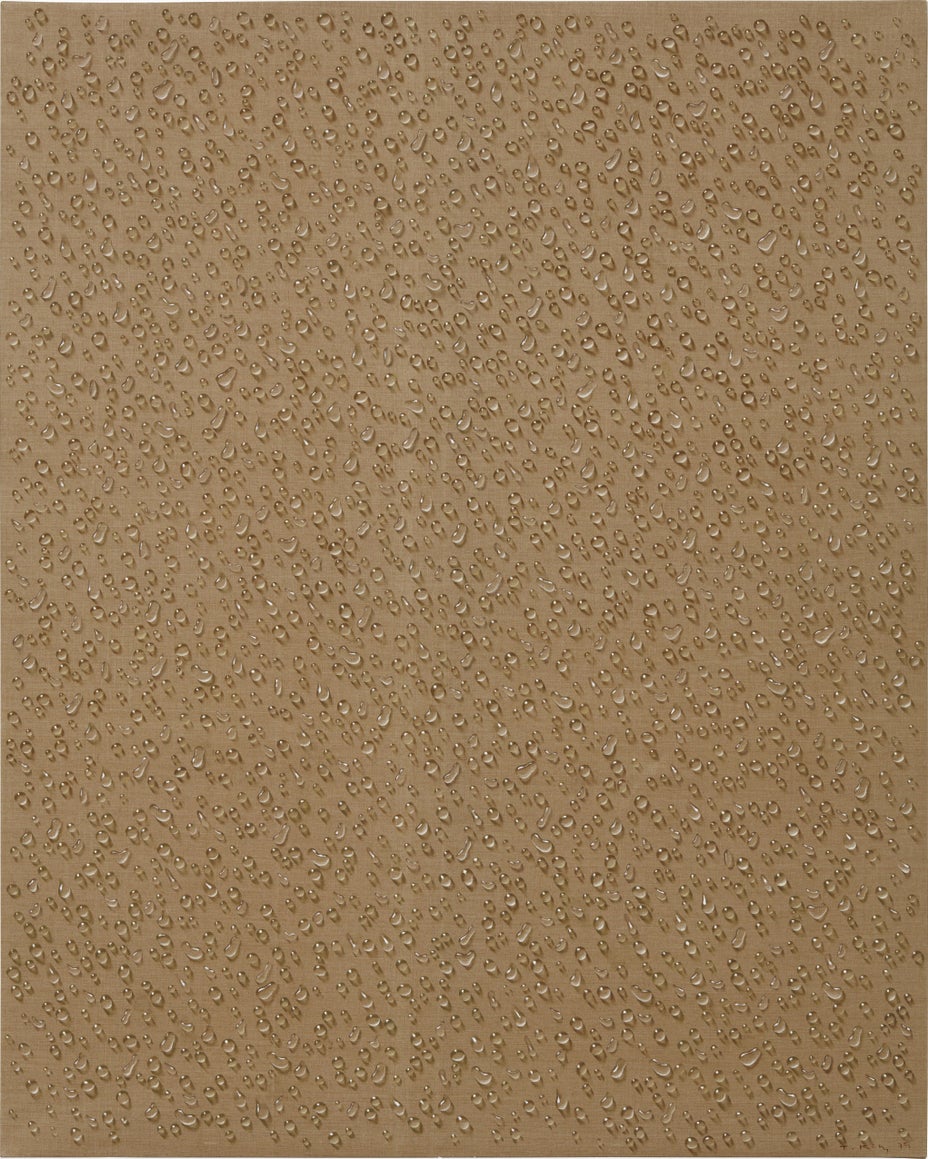
Gouttes d'eau
Estimate
HK$2,000,000–3,000,000
€215,000–323,000
$256,000–385,000
Sold For
HK$3,940,000
signed and dated 'T. Kim 75' lower right; further signed, titled and dated 'TSCHNG YEUL KIM "Gouttes d'eau" 1975' on the reverse
oil and mineral pigment on canvas
162.1 x 129.6 cm. (63 7/8 x 51 in.)
Executed in 1975.
Full-Cataloguing
Post-war Korean artist Kim Tschang-Yeul is renowned worldwide for his Waterdrops series. Trained in New York and Paris between the 1960s and 1970s, he studied calligraphy in Seoul and founded the Hyeondae Misulga Hyeophoe (Contemporary Artists Association) in the 1950s. According to Kim, water is at the origin of the universe; it exists everywhere around us, including space and time. Through the detailed rendering of water drops, the artist demonstrates a silent, contemplative and reflective approach in his art.
In Gouttes d’eau, the flatness of the canvas is animated by scattered water drops. They are shown all together but each one has its own identity; individual drops are perfectly rendered in their own size, shape and orientation. Some seem to be evaporating; many are pictured so round that they seem to have just been placed on the canvas, while others are slipping down towards the earth. The compositional balance of the painting evokes a sense of serenity in the viewer. Upon closer observation, the size and quantity of the drops also bring forth a surreal impression to the viewer. The language of water drops here combines photorealism with abstraction, placing the work between illusion and reality. Kim freezes the ephemerality of water drops, offering viewers a paradox of time. The present lot shows an exploration of textures, where oil paint is used on a wet canvas to achieve the realism of the drops. Through merging Western techniques of oil painting with the Eastern philosophy of natural elements, Kim shows the repeated depiction of water drops as a meditative and healing practice.
“I see repetition in terms of Buddhist prayer. You repeat and repeat until it blocks out all other thoughts, and you pass into an empty state. I have thought a great deal about my experiences during the war, and the water drops have become a requiem for the dead. For me, painting can be compared to an act of consolation towards the spirits of the dead, in the same way that one sprinkles water to protect the dead from evil spirits during a Buddhist purification ritual.” In reference to his tragic past in the Korean War, the practice of painting water drops becomes a healing process with an attempt to erase his traumatic memories. Water drops can thus be seen as tears of joy, sadness, frustration, or pain, reflecting Kim’s inner emotions.
In Gouttes d’eau, the flatness of the canvas is animated by scattered water drops. They are shown all together but each one has its own identity; individual drops are perfectly rendered in their own size, shape and orientation. Some seem to be evaporating; many are pictured so round that they seem to have just been placed on the canvas, while others are slipping down towards the earth. The compositional balance of the painting evokes a sense of serenity in the viewer. Upon closer observation, the size and quantity of the drops also bring forth a surreal impression to the viewer. The language of water drops here combines photorealism with abstraction, placing the work between illusion and reality. Kim freezes the ephemerality of water drops, offering viewers a paradox of time. The present lot shows an exploration of textures, where oil paint is used on a wet canvas to achieve the realism of the drops. Through merging Western techniques of oil painting with the Eastern philosophy of natural elements, Kim shows the repeated depiction of water drops as a meditative and healing practice.
“I see repetition in terms of Buddhist prayer. You repeat and repeat until it blocks out all other thoughts, and you pass into an empty state. I have thought a great deal about my experiences during the war, and the water drops have become a requiem for the dead. For me, painting can be compared to an act of consolation towards the spirits of the dead, in the same way that one sprinkles water to protect the dead from evil spirits during a Buddhist purification ritual.” In reference to his tragic past in the Korean War, the practice of painting water drops becomes a healing process with an attempt to erase his traumatic memories. Water drops can thus be seen as tears of joy, sadness, frustration, or pain, reflecting Kim’s inner emotions.