
No Reserve
16
Konstantin Chaykin
Thinking Of the Time’s Birth
Thinking Of the Time’s Birth
Estimate
CHF2,000–4,000•︎
€2,200–4,300
$2,500–4,900
Sold For
CHF53,340
Manufacturer
Konstantin Chaykin
Year
2025
Model Name
Thinking Of the Time’s Birth
Material
Acrylic on canvas
Dimensions
100cm X 100cm
Signed
Canvas signed
Full-Cataloguing
Konstantin Chaykin is a true artist in its full sense, a brilliant watchmaker, inventor and painter.
The painting reveals a certain mystery – the process of creating something infinitely complex yet fragile. Every gear, screw, and bridge is akin to cells united into a single living system. In the master's hands, the record-thin watch comes to life, and its 'heart' begins to beat steadily and solemnly.
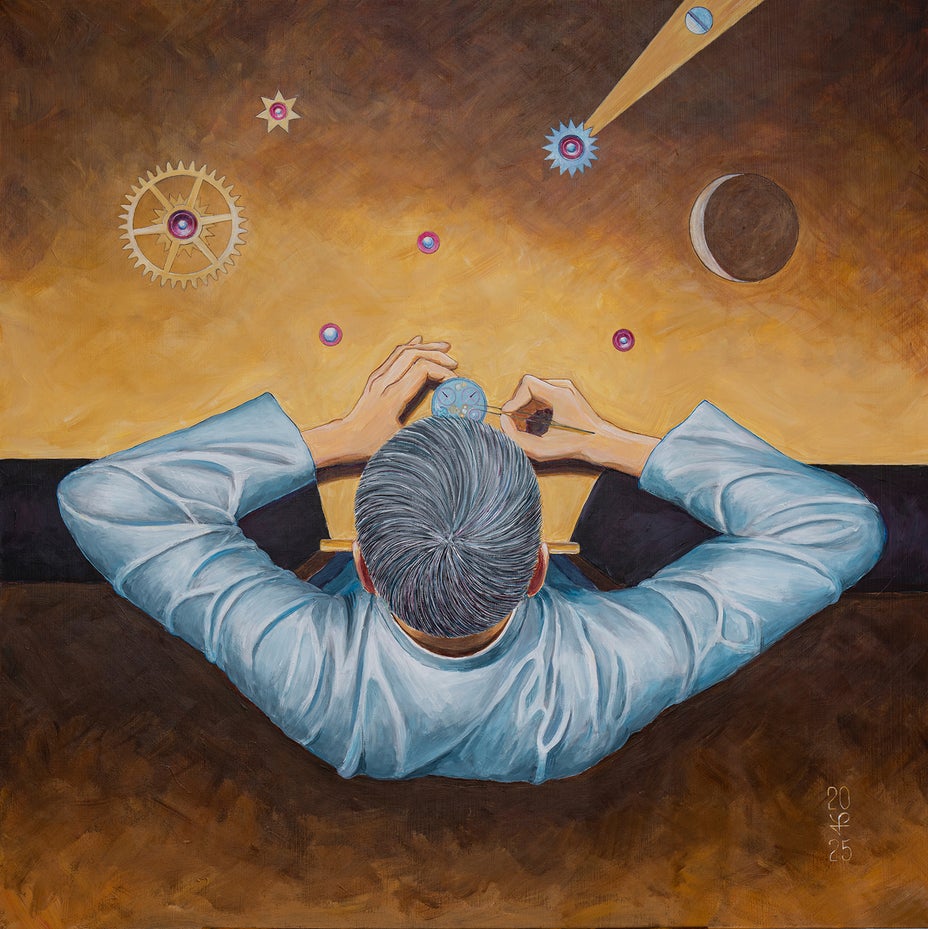
In this self-portrait, Konstantin Chaykin depicts himself leaning over the ultra-thin movement, deeply concentrated, capturing the moment when inspiration and engineering precision merge in a grand act of creation. The delicate case of the new watch symbolizes not only the genius of technical thought but also the fragile beauty of life itself.
The creation of this 'living' movement echoes the famous allegory of the English philosopher William Paley, who asserted that a meticulously designed movement inevitably implies the presence of a brilliant creator. Within the context of the painting, this idea takes on a new meaning: Chaykin, being both a watchmaker and an artist, creates not merely an instrument for measuring time but a 'new organism'.
Just as Paley contemplated the metaphysical structure of the world, the creation of record-thin watches here reflects the very concept of creation – the more perfect and refined the mechanism, the deeper we penetrate the mystery of the universe.
Despite the innovative nature of the subject, the painting clearly resonates with the legacy of the old masters. For example, it echoes Albrecht Dürer’s engraving 'Melancholia I', where a bright comet crosses the sky. The reference to 'Melancholia' is evident in one element: in the upper right corner of the painting, a comet appears, depicted in the form of a watch bridge with a tiny gear. This celestial body is a direct nod to Dürer’s artwork, elegantly woven into the composition. The image of the comet-mechanism simultaneously pays homage to classical art and enhances the dynamics and the 'horological' theme of the painting, reminding us that even moments of melancholy, often accompanying the creative process, can be measured by the invisible workings of time.
The master's workbench precisely divides the canvas in half. The surface of the table seems to rotate vertically, transforming into the sky. On it, gears take the form of the Moon, the Sun, and the stars. This is a metaphor for the fourth day of creation, when celestial bodies began to separate day from night.
"Thinking of the Time’s Birth” is more than just a self-portrait of the master. The painting invites the viewer to experience awe in the face of mystery, where human inspiration and the 'breath' of the universe merge in a single creative act. Here, the biblical theme of creation, theology, the experimental spirit of modern watchmaking, and the subtle, almost mystical contrast between the micro-world of watch mechanisms and the vast expanses of space intertwine. In this realm, a new watch becomes a new form of life, and its creator transforms into a conduit of the hidden forces of the cosmos.
The painting reveals a certain mystery – the process of creating something infinitely complex yet fragile. Every gear, screw, and bridge is akin to cells united into a single living system. In the master's hands, the record-thin watch comes to life, and its 'heart' begins to beat steadily and solemnly.
In this self-portrait, Konstantin Chaykin depicts himself leaning over the ultra-thin movement, deeply concentrated, capturing the moment when inspiration and engineering precision merge in a grand act of creation. The delicate case of the new watch symbolizes not only the genius of technical thought but also the fragile beauty of life itself.
The creation of this 'living' movement echoes the famous allegory of the English philosopher William Paley, who asserted that a meticulously designed movement inevitably implies the presence of a brilliant creator. Within the context of the painting, this idea takes on a new meaning: Chaykin, being both a watchmaker and an artist, creates not merely an instrument for measuring time but a 'new organism'.
Just as Paley contemplated the metaphysical structure of the world, the creation of record-thin watches here reflects the very concept of creation – the more perfect and refined the mechanism, the deeper we penetrate the mystery of the universe.
Despite the innovative nature of the subject, the painting clearly resonates with the legacy of the old masters. For example, it echoes Albrecht Dürer’s engraving 'Melancholia I', where a bright comet crosses the sky. The reference to 'Melancholia' is evident in one element: in the upper right corner of the painting, a comet appears, depicted in the form of a watch bridge with a tiny gear. This celestial body is a direct nod to Dürer’s artwork, elegantly woven into the composition. The image of the comet-mechanism simultaneously pays homage to classical art and enhances the dynamics and the 'horological' theme of the painting, reminding us that even moments of melancholy, often accompanying the creative process, can be measured by the invisible workings of time.
The master's workbench precisely divides the canvas in half. The surface of the table seems to rotate vertically, transforming into the sky. On it, gears take the form of the Moon, the Sun, and the stars. This is a metaphor for the fourth day of creation, when celestial bodies began to separate day from night.
"Thinking of the Time’s Birth” is more than just a self-portrait of the master. The painting invites the viewer to experience awe in the face of mystery, where human inspiration and the 'breath' of the universe merge in a single creative act. Here, the biblical theme of creation, theology, the experimental spirit of modern watchmaking, and the subtle, almost mystical contrast between the micro-world of watch mechanisms and the vast expanses of space intertwine. In this realm, a new watch becomes a new form of life, and its creator transforms into a conduit of the hidden forces of the cosmos.