Property from a Private Collection, Tokyo
185
Kumi Sugaï
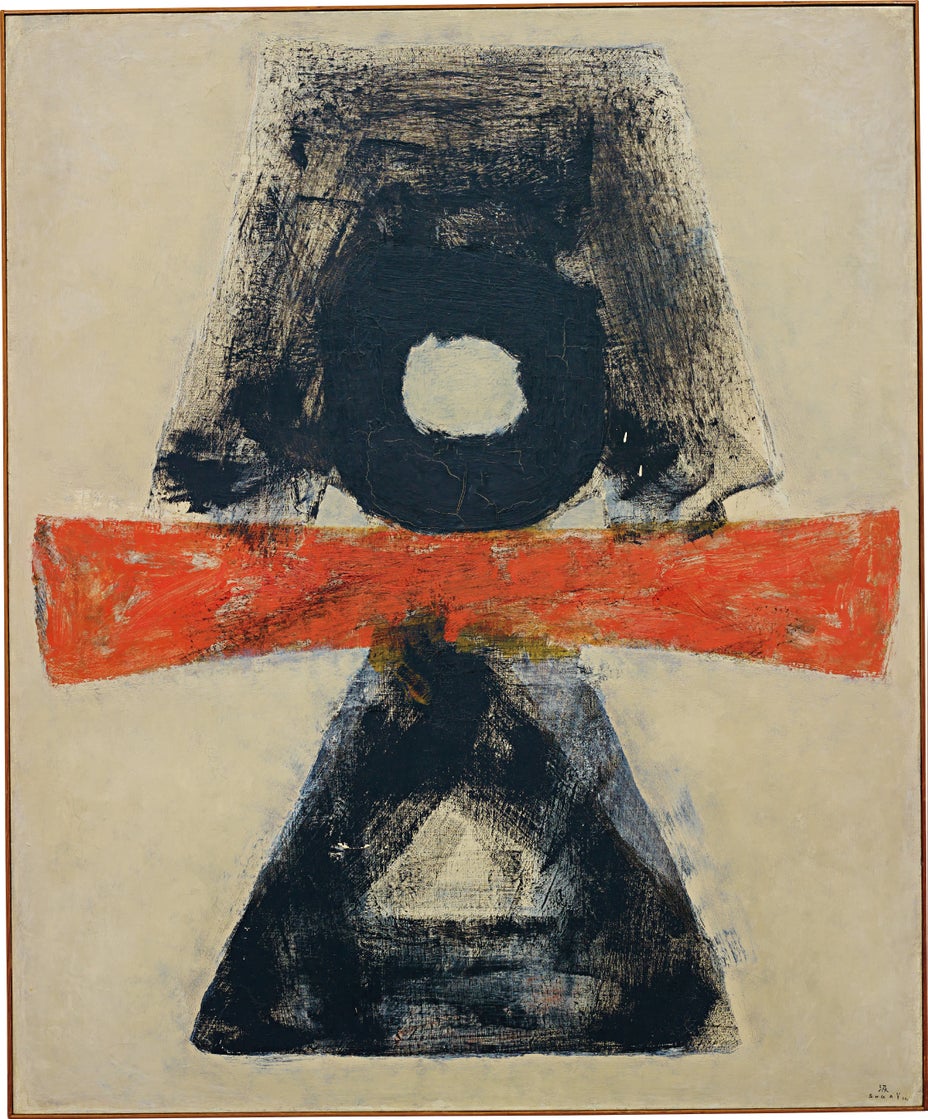
KAGURA (Sacred Music and Dance)
Estimate
$250,000–350,000
Sold For
$293,000
oil on canvas
54 3/8 x 44 7/8 in. (138 x 114 cm)
Signed and dated "汲 [Kumi] SUGAÏ" lower right; further signed, titled and dated "SUGAÏ 58 'KAGURA'" on the reverse.
Full-Cataloguing
Kumi Sugai’s work KAGURA presents the artist’s attempt to create his own creative typography. Here, one sees various forms creating the likeness of a human figure or architectural structure. Sugai’s use of a thick horizontal line in red against white background echoes the colors of a costume originating from the Heian period (794–1185) associated with dancers who are female shamans. Meanwhile, the trapezoidal form embracing a circle standing on the triangular bottom simulates a balance of an early Shinto shrine structure. Literally meaning “music dedicated to gods,” KAGURA is an early form of Shinto religious music and dance. Referencing the pictographic origin of Kanji characters (letters adopted from Chinese characters), he transposes the dancer-like motif into a sign that brings abstraction and writing infinitely closer. In many of his late 1950s works, Sugai made use of this linguistic strategy, playing with the relationship between signifiant (signifier) and signifié (signified). As the artist’s own formal invention, KAGURA becomes an empty signifiant that is infinitely open-ended and malleable to allow for any number of meanings. While many European and American artists working in Paris contemporaneously with Sugai concerned themselves with the visual affinity between gestural abstraction and Asian calligraphy, Sugai cultivated a completely new field of encounter between East and West in the structuralist linguist mode of thinking.