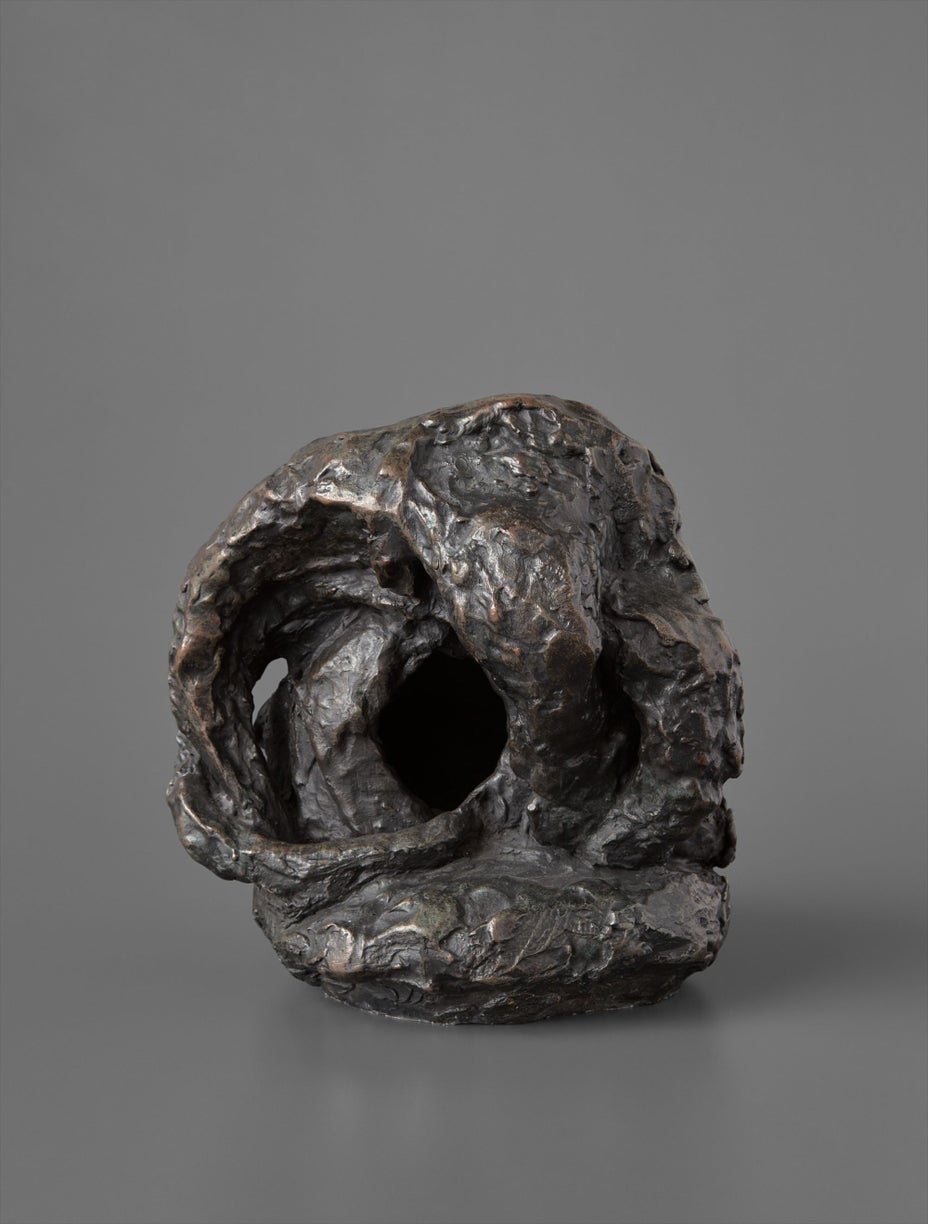
211
Louise Bourgeois
Rondeau for L
Estimate
$200,000–300,000
incised with the artist's initials and number "L.B. 4/6" on the back right turning edge
bronze
11 x 11 x 10 1/2 in. (27.9 x 27.9 x 26.7 cm.)
Conceived in 1963 and cast in 1990, this work is number 4 from an edition of 6.
Full-Cataloguing
A few years before Louise Bourgeois’ death in 2010, a portfolio of her autobiographical, psychoanalytical writings surfaced, providing a deeper look into both her life and art. These analytical notebooks revealed even more profound themes than those illuminated through her daily journal entries that are ever-present in the artist’s prolific oeuvre. As evident through his repeated mention, these writings were inspired by the artist’s psychoanalyst Dr. Henry Lowenfeld, or “L” as she refers to him on paper, whom she began seeing for the first time in 1952. The writings describe an increasingly complex relationship between the Doctor and his patient, making it clear that Bourgeois felt a paradoxical sense of admiration for and frustration with him. Confirmed by the artist just before her death, this is the very same “L” referenced in the present lot, Rondeau for L. While many close to Bourgeois assumed the “L” in this title stood for the artist herself, the homage to Dr. Lowenfeld provides the sculpture with even more psychological undertones than if it were an actual self-portrait. Like Bourgeois’s earlier Personnages, Rondeau for L exists as a surrogate for its subjects—both Dr. Lowenfeld himself and the artist’s own psyche.
In addition to its poignant dedication to Dr. Lowenfeld, Rondeau for L represents an important aesthetic shift in the artist’s approach to sculpture. In the early 1960s, Bourgeois moved from her upright Personages to poured plaster works, a phase in her art which corresponds to the increasingly introspective phase in her life. The present example is a bronze variant of the original plaster sculpture from 1963, cast in 1990, examples of which have been exhibited in two of the artist’s most important retrospectives within recent years, including her 2007 traveling show beginning at the Tate Modern and culminating at the Hirshhorn, and another in 2011 entitled Louise Bourgeois: The Return of the Repressed, which traveled through Brazil. With its greenish patina and varied surface, the density of the bronze object is emphasized, simultaneously representing both the profound effect of Dr. Lowenfeld on the artist, and the physical weight of the object itself. Like other sculptures cast in the early 1960s, Rondeau for L’s abstract form is thought to be loosely inspired by the artist’s study of folding clothes in her home and studio. The inwardly spiraling object suggests the varied structure of coiled fabric, as evident by the recessions and progression along the surface. The resulting, imperfectly round object thus assumes a uniquely complex structure, as its infinite spiral draws the viewer deeper and deeper into its inner cavity. As Mignon Nixon aptly describes of the shape, “It sits there and takes it. The analytic metaphors could be extended. It holds. It contains. It is something to grasp, to seize, to hold onto, to fill up, to attack. It is a new kind of surrogate in Bourgeois’s art” (Mignon Nixon, The Return of the Repressed, exh. cat., Fundación Proa, London, 2012, p. 92). Indeed, Rondeau for L occupies a unique place in the artist’s oeuvre, a dedication to one of the most influential people in her life and evidently, her work.
In addition to its poignant dedication to Dr. Lowenfeld, Rondeau for L represents an important aesthetic shift in the artist’s approach to sculpture. In the early 1960s, Bourgeois moved from her upright Personages to poured plaster works, a phase in her art which corresponds to the increasingly introspective phase in her life. The present example is a bronze variant of the original plaster sculpture from 1963, cast in 1990, examples of which have been exhibited in two of the artist’s most important retrospectives within recent years, including her 2007 traveling show beginning at the Tate Modern and culminating at the Hirshhorn, and another in 2011 entitled Louise Bourgeois: The Return of the Repressed, which traveled through Brazil. With its greenish patina and varied surface, the density of the bronze object is emphasized, simultaneously representing both the profound effect of Dr. Lowenfeld on the artist, and the physical weight of the object itself. Like other sculptures cast in the early 1960s, Rondeau for L’s abstract form is thought to be loosely inspired by the artist’s study of folding clothes in her home and studio. The inwardly spiraling object suggests the varied structure of coiled fabric, as evident by the recessions and progression along the surface. The resulting, imperfectly round object thus assumes a uniquely complex structure, as its infinite spiral draws the viewer deeper and deeper into its inner cavity. As Mignon Nixon aptly describes of the shape, “It sits there and takes it. The analytic metaphors could be extended. It holds. It contains. It is something to grasp, to seize, to hold onto, to fill up, to attack. It is a new kind of surrogate in Bourgeois’s art” (Mignon Nixon, The Return of the Repressed, exh. cat., Fundación Proa, London, 2012, p. 92). Indeed, Rondeau for L occupies a unique place in the artist’s oeuvre, a dedication to one of the most influential people in her life and evidently, her work.
Louise Bourgeois
French-American | B. 1911 D. 2010Known for her idiosyncratic style, Louise Bourgeois was a pioneering and iconic figure of twentieth and early twenty-first century art. Untied to an art historical movement, Bourgeois was a singular voice, both commanding and quiet.
Bourgeois was a prolific printmaker, draftsman, sculptor and painter. She employed diverse materials including metal, fabric, wood, plaster, paper and paint in a range of scale — both monumental and intimate. She used recurring themes and subjects (animals, insects, architecture, the figure, text and abstraction) as form and metaphor to explore the fragility of relationships and the human body. Her artworks are meditations of emotional states: loneliness, jealousy, pride, anger, fear, love and longing.