Property from a Distinguished Private Collection
176
Manolo Valdés
Rostro sobre fondo turquesa
Estimate
$180,000–250,000
Sold For
$225,000
signed and inscribed "M VALDES NY" on the reverse
oil and burlap collage on canvas
52 1/4 x 60 in. (132.8 x 152.5 cm.)
Executed in 2002.
Full-Cataloguing
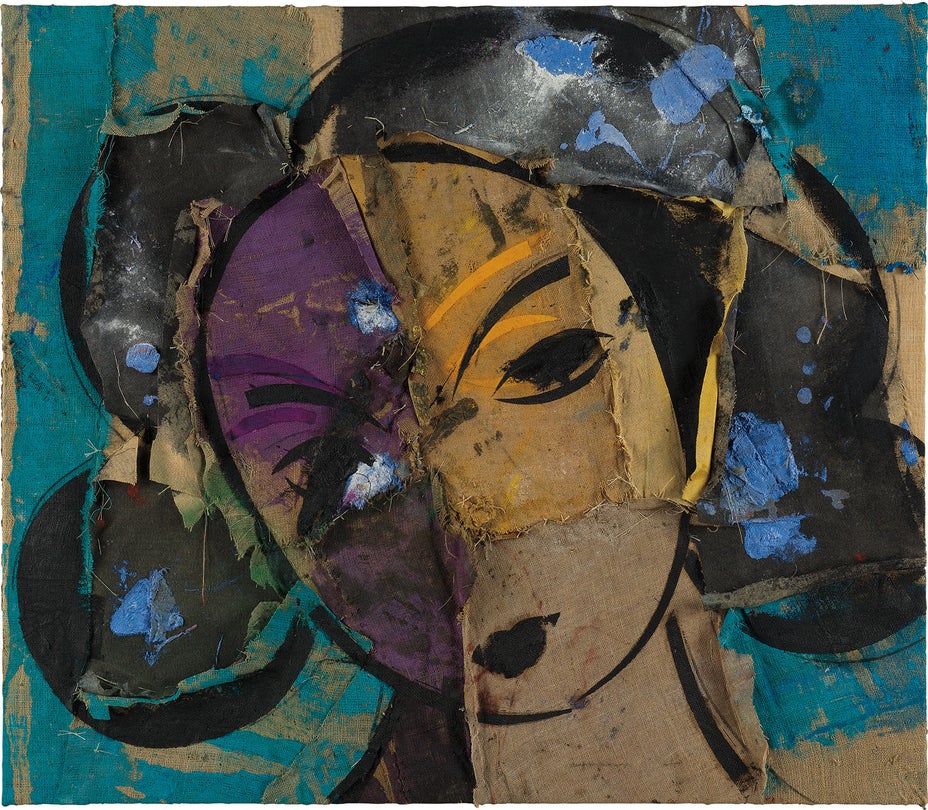
Rostro sobre fondo turquesa is an iconic example of Manolo Valdés’ vibrant paintings on burlap. Executed in 2002, the present work displays the full maturity of a vigorous group of works which the artist developed in the early 1980s that are centered around the appropriation and reinterpretation of art history. Channeling the portraits of Henri Matisse, Valdés’ figure is constructed from layers of stitched burlap rendered in rich color, lending the composition a vibrant energy.
Indeed, Valdés’ daring choices of materials is pivotal to his practice, as they breathe new life into the appropriated imagery by liberating them from their original support. Inspired by Rauschenberg’s Canyon from 1959, Valdes began questioning the hierarchy in artistic materials – experimenting with unconventional materials to disrupt the century-old tradition of figurative painting. In Rostro sobre fondo turquesa, the coarse fabric plays an essential role in creating a rich texture on an otherwise flat composition. The disjointed remnants are stitched together, with the edges of roughly cut fabric erupting at the seams and adding depth to the figure’s cheeks and nose. This stitching also brings the creative process to the forefront, with the collage method serving as a metaphor for his practice, wherein the new is created by piecing together and transforming the old.
Indeed, Valdés’ daring choices of materials is pivotal to his practice, as they breathe new life into the appropriated imagery by liberating them from their original support. Inspired by Rauschenberg’s Canyon from 1959, Valdes began questioning the hierarchy in artistic materials – experimenting with unconventional materials to disrupt the century-old tradition of figurative painting. In Rostro sobre fondo turquesa, the coarse fabric plays an essential role in creating a rich texture on an otherwise flat composition. The disjointed remnants are stitched together, with the edges of roughly cut fabric erupting at the seams and adding depth to the figure’s cheeks and nose. This stitching also brings the creative process to the forefront, with the collage method serving as a metaphor for his practice, wherein the new is created by piecing together and transforming the old.